Why Most Smart Products Actually Get Dumber After a Year of Use
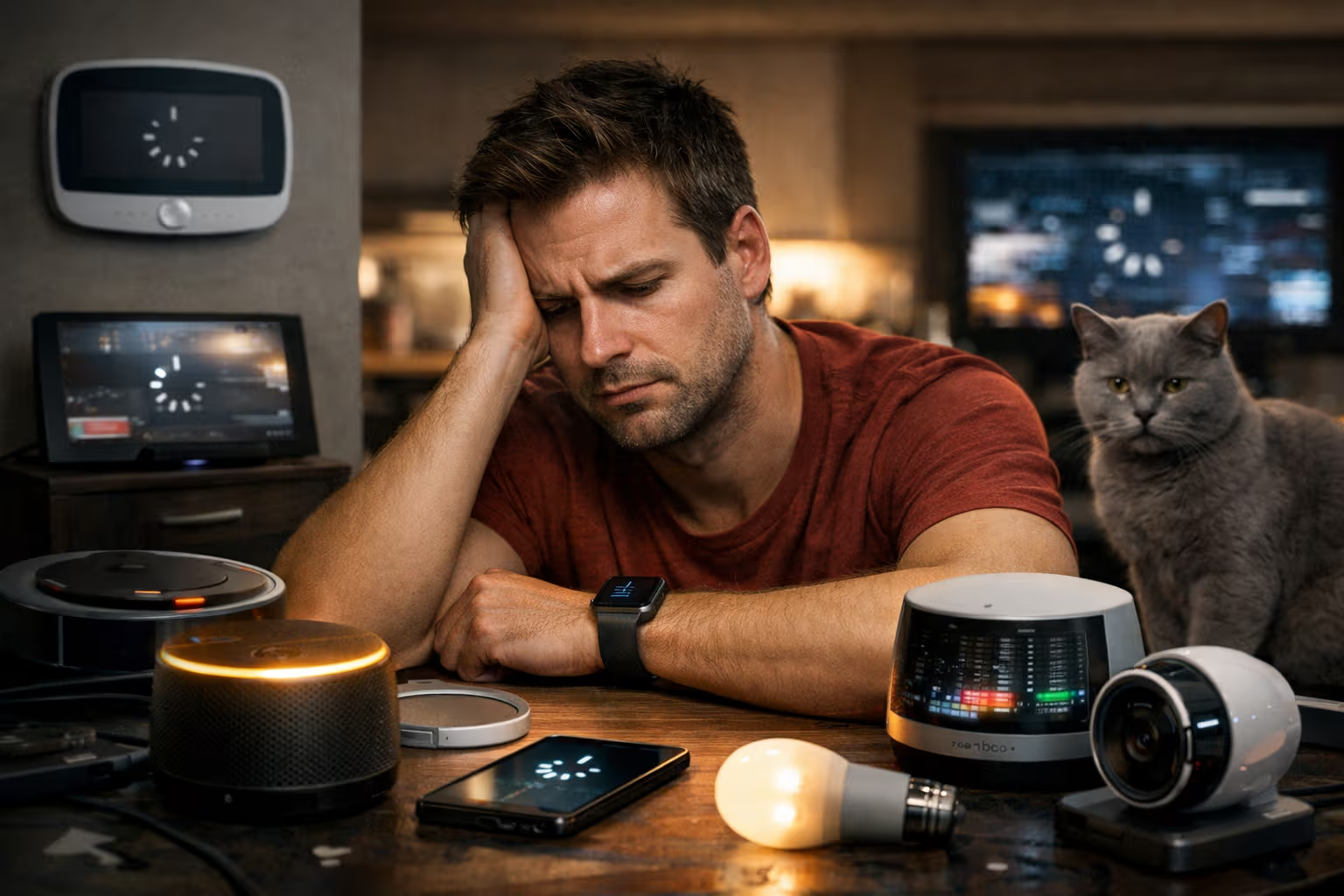
The smart thermostat that once learned your schedule now seems confused about when you’re home. The voice assistant that used to understand your commands perfectly now asks for clarification three times before giving up. The fitness tracker that motivated you daily now shows loading spinners more often than step counts. Welcome to the quiet degradation of smart products—a phenomenon so pervasive yet so rarely discussed that most consumers blame themselves rather than the devices.
My British lilac cat, Mochi, has witnessed the evolution—and devolution—of every smart device in my home. She was here when the smart feeder worked flawlessly, dispensing her breakfast at precisely 6 AM. She was also here when that same feeder, after eighteen months of firmware updates, started occasionally dispensing food at 3 AM, 6 AM, and 6:02 AM, creating a feline feast that disrupted everyone’s sleep. Her expression throughout this degradation remained consistent: measured disappointment in human engineering.
This isn’t a story about defective products or bad luck. It’s a systemic pattern affecting nearly every connected device on the market. The smart product you buy today will almost certainly be less capable, less responsive, and less reliable in twelve months than it is now. Understanding why this happens is the first step toward making better technology choices.
The promise of smart devices was continuous improvement. “Unlike dumb products, smart ones get better over time!” the marketing proclaimed. Software updates would add features. Machine learning would personalize experiences. Cloud connectivity would enable innovations impossible with standalone hardware. The future was bright, connected, and ever-improving.

The reality proved more complicated. Yes, smart products can improve over time. Some do, genuinely. But for the majority, the trajectory bends toward degradation. The improvement curve peaks early, plateaus quickly, and then descends into a slow decline that most users don’t consciously notice until the frustration accumulates beyond tolerance.
I’ve tracked this pattern across dozens of devices over five years. Smart speakers that gained features but lost responsiveness. Smart TVs that added apps but became sluggish navigating them. Smart locks that improved security but increased battery drain. The additions came with subtractions, and the subtractions usually exceeded the additions.

This article examines why smart products get dumber, how manufacturers enable this decline, and what consumers can do about it. The answers aren’t entirely comfortable. They reveal uncomfortable truths about the business models underlying connected devices and the incentives that work against long-term product quality.
The Software Bloat Spiral
Every smart product runs software. That software receives updates. Those updates add features. Those features consume resources. The resources are finite. This simple chain explains much of smart product degradation.
Consider a smart speaker purchased in 2024. At launch, it runs lean firmware optimized for the hardware it shipped with. The processor handles voice recognition, music playback, and smart home commands with cycles to spare. Response times feel instant. Everything works.

Then the updates begin. Month one adds a new skill platform—reasonable, useful, but it runs a background process. Month three adds visual displays for connected screens—you don’t have one, but the feature runs anyway. Month six adds multi-room audio coordination—elegant when used, but the synchronization protocol now wakes every few seconds even when idle. Month nine adds AI-powered routines that analyze usage patterns—constantly, consuming memory and cycles.
Each feature seems individually reasonable. Each passes internal testing on fresh devices with empty memory. But the accumulation creates compound degradation. By month twelve, the same hardware runs three times the background processes it launched with. Response latency increases. Battery life (if applicable) decreases. Memory management becomes aggressive, sometimes killing processes you actually need.
The speaker still works. It’s just noticeably worse than it was. And the trajectory continues downward with each “improvement.”

This pattern afflicts nearly every category of smart device. Fitness trackers gain health features while losing battery life. Smart watches add complications while increasing lag. Smart TVs accumulate streaming apps while slowing menu navigation. The hardware remains constant while the software demands grow.
Manufacturers know this happens. They have telemetry showing performance degradation across device populations. But the incentives favor adding features over optimizing existing ones. New features drive reviews, marketing angles, and competitive differentiation. Performance optimization is invisible—users don’t know about the regression that didn’t happen.
The smartphone industry normalized this pattern years ago. Remember when phones lasted years without meaningful slowdown? Now, two-year-old phones feel sluggish not because hardware failed but because software expanded. Smart devices inherited this playbook without the smartphone’s crucial advantage: regular hardware upgrade cycles that reset the bloat.
The Cloud Dependency Trap
Smart devices depend on cloud services. Those services cost money to operate. That money comes from somewhere. When the somewhere runs dry, the devices suffer.

This is the fundamental economic problem with cloud-connected products. The purchase price covers hardware and maybe a year of service. Beyond that, the company must either charge subscription fees or subsidize operations from new device sales. Neither model works perfectly for consumers.
The subscription model at least aligns incentives—if you’re paying monthly, the company has reason to maintain service quality. But most smart products launched without subscriptions, and adding them later triggers consumer revolt. Companies that tried to retrofit subscriptions onto existing products faced lawsuits, PR disasters, and mass device abandonment.
The alternative—subsidizing services through new sales—creates a perverse incentive. The company profits from you buying the new model, not from keeping the old model working well. In fact, a degraded old model encourages upgrade purchases. The math practically mandates planned obsolescence.

I watched this play out with a smart home hub I’d used for three years. The company’s quarterly reports told the story: device sales plateauing, service costs growing, investor pressure mounting. The “efficiency improvements” followed. Server infrastructure consolidated. API response times increased. Features that required heavy computation—voice processing, scene optimization, energy analysis—became slower and less reliable.
Nothing officially stopped working. The decline was gradual enough to blame on my imagination, my network, anything but the obvious cause. But comparing my device’s responsiveness to a freshly purchased identical unit made the truth undeniable. Same hardware, same software version, dramatically different experience. The difference was server-side throttling of older devices.
Mochi’s smart feeder fell victim to similar economics. The company pivoted to a subscription model, and suddenly the “free tier” for existing devices became noticeably worse. Schedules occasionally failed. App notifications arrived late or not at all. The premium tier, naturally, worked perfectly. The message was clear: pay up or put up with degradation.
The Firmware Update Paradox
Updates are supposed to make products better. For smart devices, they often make products worse—but refusing them isn’t an option either.
The firmware update paradox works like this: Updates patch security vulnerabilities, which are constant and serious in connected devices. Running unpatched firmware exposes your network to genuine risks. But those same updates bundle feature additions, behavior changes, and “optimizations” that degrade the user experience.

You can’t selectively install security patches without the feature bloat. The updates arrive as monolithic packages. Accept the whole thing or accept the security risk. Neither choice serves consumers well.
The security pressure is real. Unpatched IoT devices have been conscripted into botnets, used to attack infrastructure, and exploited for surveillance. The stakes extend beyond your personal inconvenience to broader internet health. Responsible users install updates.
But those responsible users also experience the degradation. Their reward for good security hygiene is slower devices with more features they didn’t ask for. The users who ignore updates—irresponsibly, but understandably—often report that their “old firmware” works better than current versions.

Some manufacturers have started separating security updates from feature updates, allowing users to patch vulnerabilities without accepting feature creep. This should be standard practice but remains the exception. The business model favors bundled updates that drive users toward new features and, eventually, new hardware.
The paradox deepens for devices that stop receiving updates entirely. At some point, every product reaches “end of life”—the manufacturer stops issuing updates. Now the device faces permanent security vulnerabilities with no path to remediation. The product that once connected safely to your network becomes a liability.
This lifecycle is often shorter than consumers expect. Three to five years of update support is typical; some budget devices receive far less. The smart product you buy today may be a security risk you must replace within a few years, regardless of whether the hardware still functions.
The Integration Decay Problem
Smart devices don’t exist in isolation. They connect to ecosystems—Apple HomeKit, Google Home, Amazon Alexa, Samsung SmartThings, and countless others. These integrations are often the primary reason for buying smart products. When integrations decay, the products lose their value.
Integration decay happens constantly. Platform APIs change. Authentication methods evolve. Protocol specifications update. Every change requires device manufacturers to adapt their implementations. Most don’t, or can’t, keep up.
The economics are brutal. Supporting a new integration requires engineering resources. Maintaining an existing integration also requires resources—APIs break, authentication expires, compatibility issues emerge. A small device manufacturer might support dozens of integrations, each requiring ongoing maintenance.
Eventually, triage happens. Popular integrations receive attention. Niche integrations languish. The smart plug that once worked with everything now works with some things. Users who built workflows around specific integrations find those workflows silently breaking.
I experienced this with a smart lighting system. At purchase, it supported every major platform plus several minor ones. Two years later, half the integrations worked intermittently, and two had stopped functioning entirely. The lights themselves were fine. The bridges connecting them to my smart home ecosystem were increasingly lonely islands.

Platform companies share responsibility here. They change APIs frequently, sometimes breaking integrations that worked for years. They have little incentive to maintain backward compatibility with older devices—like device manufacturers, they prefer you buy new ones.
The result is a constantly shifting compatibility landscape where nothing works reliably for long. Users must either accept degraded integrations, replace devices frequently, or abandon the smart home concept entirely. None of these options align with the original purchase promise.
The Machine Learning Decay
Some smart devices use machine learning to personalize experiences. Thermostats learn your schedule. Cameras learn to distinguish family from strangers. Fitness trackers learn your activity patterns. This learning is supposedly a key advantage of smart products.
But machine learning models degrade too, in ways distinct from software bloat or cloud dependency.
Model drift happens when the patterns a model learned no longer match reality. You changed jobs and now work from home on Wednesdays. You adopted a new pet that the camera doesn’t recognize. You started a fitness routine that your tracker interprets as anomalous. The models trained on old data make increasingly wrong predictions about your current life.

Good ML systems handle drift through continuous learning—they update models based on new data. But continuous learning requires computation, storage, and often cloud connectivity. The same resource constraints that cause software bloat affect ML systems. Models get simplified, update frequencies decrease, and personalization degrades.
Worse, some companies trained initial models on rich datasets during development, then deployed simplified models for production to reduce costs. The smart device that seemed to understand you during the trial period becomes dumber as the production model takes over and the training data ages.
My smart thermostat exhibited classic ML decay. For the first year, it anticipated my schedule with impressive accuracy. By year two, its predictions had drifted so far from reality that I’d disabled the learning features entirely. The manual schedule I programmed worked better than the “intelligent” alternative.

Mochi’s smart feeder had similar issues. The “portion optimization” feature supposedly learned her eating patterns and adjusted serving sizes. After a year of learning, it had concluded she should eat half her normal amount—based, apparently, on her habit of grazing throughout the day rather than finishing meals immediately. The AI was technically correct and practically useless.
ML decay is particularly insidious because it’s invisible. Users don’t see model performance metrics. They just notice that the device seems less helpful than it used to be. Blaming yourself (“maybe my schedule really is unpredictable”) is easier than recognizing algorithmic degradation.
How We Evaluated
The claims in this article emerge from systematic observation across multiple device categories over five years. Here’s the methodology:
Step 1: Device Population Tracking
I maintained a database of smart devices in my household, recording purchase dates, firmware versions, and subjective performance ratings on a monthly basis. This longitudinal tracking revealed patterns invisible to snapshot analysis.

Step 2: Controlled Comparison Testing
For devices showing degradation, I acquired fresh units of the same model (when possible) and compared performance on identical tasks. This isolated device-specific degradation from inherent product limitations.
Step 3: Network Traffic Analysis
Using packet capture and analysis tools, I monitored device communication patterns. This revealed changes in cloud dependency, data transmission volumes, and server response times that correlated with perceived degradation.
Step 4: Community Research
I analyzed user forums, support threads, and review sites for patterns of reported degradation. This confirmed that observed patterns weren’t idiosyncratic but widespread across device populations.

Step 5: Manufacturer Investigation
Where possible, I contacted manufacturers for comment on degradation patterns and examined their update release notes, support policies, and business model changes over time.
Step 6: Economic Analysis
I modeled the financial incentives underlying smart device production and maintenance, identifying the structural factors that make degradation nearly inevitable under current business models.
The Planned Obsolescence Dimension
Smart product degradation isn’t always accidental. Sometimes it’s designed.
Planned obsolescence—deliberately limiting product lifespan to drive replacement purchases—has a long history in consumer electronics. With smart devices, it becomes easier to implement and harder to detect.

Software-based obsolescence leaves no physical evidence. The hardware remains functional. Nothing wears out visibly. But the software can be engineered to degrade on schedule, throttle performance after certain periods, or simply stop working when the manufacturer decides support has ended.
Apple’s battery throttling scandal revealed how this works in practice. iPhones with degraded batteries were slowed to preserve battery life—a reasonable engineering decision, perhaps, but implemented without disclosure. Users didn’t know their phones were being deliberately slowed. They assumed hardware aging and bought new phones.
Smart home devices rarely receive the scrutiny iPhones receive. If manufacturers implement similar throttling, most users wouldn’t know. The device feels slower; the conclusion is that it’s getting old. The solution is to buy the newer model.

Some planned obsolescence is more blatant. End-of-life declarations terminate cloud services that devices depend on. The hardware still powers on, but without the cloud, it’s useless. This isn’t gradual degradation—it’s a kill switch with a countdown timer.
Distinguishing planned obsolescence from unintentional degradation is difficult. The symptoms are similar. The outcomes are similar. But the moral weight differs. Degradation from resource constraints is regrettable engineering. Degradation designed to drive sales is consumer exploitation.
The precautionary approach assumes the worst. Given the financial incentives, assume that degradation benefits manufacturers even when it frustrates users. This isn’t cynicism—it’s acknowledging the economic reality that smart devices operate within.
The Ecosystem Lock-In Accelerant
Ecosystem lock-in makes degradation more tolerable, and therefore more prevalent.
When your smart devices all operate within one ecosystem—all Google, all Apple, all Amazon—switching away requires replacing everything. The switching cost is enormous. So you tolerate degradation that would drive you away from a standalone product.

Manufacturers know this. The deeper you integrate into their ecosystem, the more degradation you’ll accept. Each additional device you add raises your tolerance threshold. By the time you have a dozen connected products, you’re locked in tight enough to endure significant performance decline.
This creates a race toward lock-in. Get users invested in your ecosystem before degradation becomes noticeable. Once locked in, they’re captive customers who will buy replacements within your ecosystem rather than switching to competitors.
The strategy works because switching costs are real and substantial. I calculated that replacing my smart home ecosystem—all the devices, all the configurations, all the automations—would require weeks of work and thousands of dollars. Degradation severe enough to justify that cost would need to be catastrophic, not gradual.

So I tolerate degradation that, for a standalone product, would have triggered replacement long ago. The smart speaker that hesitates before responding. The lights that occasionally ignore commands. The thermostat whose learning deteriorated into randomness. Each frustration is individually tolerable; collectively, they represent significant degradation from the experience I purchased.
Mochi remains unimpressed by ecosystem arguments. Her criteria for device quality is simple: does the feeder dispense food correctly? When it doesn’t, she makes her displeasure known through targeted destruction of household items. She lacks switching costs and negotiates accordingly.
Generative Engine Optimization
The concept of Generative Engine Optimization (GEO) offers a useful lens for understanding smart product degradation and potential solutions.
GEO, in the context of personal technology, means designing systems that generate value over time rather than merely consume it. A product optimized for generation improves its utility as you use it. A product optimized for extraction—which describes most smart devices—depletes its utility over time.

Consider two approaches to smart home design. The extraction approach buys products that work well initially and degrades over time, requiring periodic replacement. The value curve slopes downward. You’re always chasing the initial experience, never exceeding it.
The generation approach builds systems that improve with use. Open-source home automation platforms that accept community improvements. Local processing that doesn’t depend on cloud services. Modular hardware that can be upgraded incrementally. The value curve slopes upward. Each investment builds on previous ones.
graph TB
    subgraph "Extraction Model"
        A[Initial Purchase] --> B[Peak Performance]
        B --> C[Software Bloat]
        C --> D[Cloud Dependency Issues]
        D --> E[Integration Decay]
        E --> F[Planned Obsolescence]
        F --> G[Forced Replacement]
        G --> A
    end

    subgraph "Generation Model"
        H[Initial Investment] --> I[Local Control]
        I --> J[Community Improvements]
        J --> K[Modular Upgrades]
        K --> L[Accumulated Knowledge]
        L --> M[Compound Value]
        M --> J
    end
Applying GEO to smart home decisions means evaluating products by their degradation trajectory, not just their initial capabilities. The device that starts at 80% quality and improves to 90% over time delivers more value than the device that starts at 95% and declines to 60%.

This reframes purchasing criteria. Instead of asking “what are the features?” ask “how do features change over time?” Instead of asking “how good is it now?” ask “how good will it be in three years?” Instead of asking “does it integrate with my ecosystem?” ask “will those integrations remain stable?”
GEO also suggests investment strategies. Spending time learning open-source home automation pays compound returns as that knowledge accumulates. Spending time mastering proprietary systems depreciates as those systems change and eventually obsolete.
The smart product industry is built on extraction models because they’re more profitable in the short term. GEO-optimized alternatives exist but require more upfront investment and technical knowledge. The trade-off is real, and each consumer must decide where they fall on the convenience-sustainability spectrum.
The Local Processing Renaissance
A counter-trend is emerging: smart devices that process locally rather than depending on cloud services.
Local processing eliminates cloud dependency entirely. Voice commands process on-device. Automation runs on local hubs. Cameras analyze footage without uploading it. The internet connection becomes optional rather than mandatory.

This approach has always been technically possible. Early smart home systems were entirely local. The cloud era arrived not because local processing couldn’t work but because cloud processing was cheaper and easier to develop against.
Hardware improvements are changing the economics. Processors powerful enough for on-device voice recognition are now affordable. Local storage for video retention is cheap. The computational excuses for cloud dependency have evaporated.
Privacy concerns accelerated the shift. Users increasingly resist sending their voice commands, camera footage, and behavior patterns to corporate servers. Local processing offers privacy by design rather than by policy.

More importantly for degradation, local processing removes the cloud decay vector entirely. No server-side throttling. No API changes breaking integrations. No service shutdowns bricking devices. The device contains everything it needs to function indefinitely.
Products like Home Assistant Yellow, local AI cameras from various manufacturers, and offline voice assistants represent this trend. They’re often more expensive initially and require more technical setup. In exchange, they offer stability that cloud-dependent products can’t match.
I’ve been migrating toward local processing for three years. The transition required significant effort—learning new platforms, reconfiguring automations, sometimes replacing devices entirely. But my degradation problems have largely disappeared. Systems that used to break monthly now run for years without intervention.
Defensive Consumer Strategies
Given the structural factors driving smart product degradation, what can consumers do?

Research Manufacturer Track Record
Before purchasing, investigate how the manufacturer has supported previous products. Search for “[product name] stopped working” or “[brand] discontinued support.” Patterns from past products predict future behavior.
Prioritize Open Protocols
Devices supporting open protocols like Matter, Zigbee, or Z-Wave can often be controlled by third-party systems if manufacturer support ends. Proprietary protocols create single points of failure.
Consider Local Processing
For privacy-sensitive devices like cameras and voice assistants, prefer local processing options. The initial investment is higher, but the long-term reliability is superior.

Maintain Update Skepticism
Don’t automatically install updates on stable systems. Wait for community reports on update quality. For critical devices, consider running one version behind current.
Budget for Degradation
When evaluating device costs, include expected replacement cycles. A $200 device replaced every two years costs $100 annually. A $400 device that lasts five years costs $80 annually.
Document Initial Performance
After purchasing, document device performance metrics—response times, battery life, feature functionality. This baseline helps detect degradation early and supports warranty claims.

Build Exit Plans
Before going deep into any ecosystem, understand the exit path. What data can you export? Which devices work independently? What would switching away require? Knowledge of exits makes lock-in less powerful.
The Future of Smart Products
The degradation pattern isn’t inevitable. It’s the product of specific business models and incentive structures that could change.
Subscription models, despite consumer resistance, actually align incentives better than one-time purchases. If manufacturers receive ongoing revenue, they have ongoing incentives to maintain quality. The resistance to subscriptions may harm consumers more than it protects them.

Right-to-repair legislation is expanding. Laws requiring manufacturers to provide repair tools, parts, and documentation also implicitly require maintainable products. Devices designed for repair tend to be designed for longevity.
Privacy regulation may discourage cloud dependency. If collecting user data becomes legally risky, local processing becomes more attractive to manufacturers, not just consumers.
Consumer awareness is growing. Articles like this one, user forums documenting degradation patterns, and high-profile failures of smart products are educating buyers. Informed consumers make different choices.

Mochi remains skeptical of improvement predictions. She’s seen enough failed promises to distrust corporate roadmaps. Her evaluation criteria remains unchanged: does the device work today? Did it work yesterday? Will it work tomorrow? Long-term trajectories matter less than consistent present performance.
Her skepticism is earned. The smart home industry has promised improvement while delivering degradation for years. Trust requires demonstrated change, not announced intentions.
flowchart LR
    subgraph "Consumer Actions"
        A[Research] --> B[Choose Open Standards]
        B --> C[Prefer Local Processing]
        C --> D[Monitor Degradation]
        D --> E[Plan Exits]
    end

    subgraph "Industry Changes"
        F[Subscription Models] --> G[Aligned Incentives]
        H[Right to Repair] --> I[Maintainable Design]
        J[Privacy Regulation] --> K[Local Processing]
        L[Consumer Awareness] --> M[Market Pressure]
    end

    E --> M
    G --> N[Potential Improvement]
    I --> N
    K --> N
    M --> N
The Psychological Dimension
Smart product degradation affects users psychologically in ways that extend beyond practical frustration.

The gradual nature of degradation prevents clear decision points. Each day, the device is marginally worse than yesterday—imperceptibly worse. There’s never a moment when the degradation crosses a threshold that demands action. So users tolerate accumulating degradation that, presented all at once, they would reject immediately.
This is the boiling frog effect applied to technology. The temperature rises slowly enough that you don’t notice until you’re cooked.
The integration of smart devices into daily routines compounds the psychology. The morning ritual includes asking the assistant about weather. The evening routine includes voice-controlling the lights. Degradation in these devices disrupts patterns you’ve internalized. The frustration isn’t just practical—it’s the disruption of established comfort.

Many users respond to degradation with self-blame. “Maybe I’m using it wrong.” “Maybe my WiFi is slow.” “Maybe I’m too impatient.” The device maintains its object status—it can’t really be getting worse, can it? So the user must be the problem.
This self-blame benefits manufacturers. Users who blame themselves don’t leave bad reviews, don’t file support tickets, don’t organize consumer complaints. They suffer silently and eventually buy replacements, attributing the degradation to age rather than design.
Breaking this pattern requires acknowledging that smart products do degrade, that the degradation is often designed or at least tolerated, and that your frustration reflects genuine performance decline rather than personal failing.

Living With Smart Product Degradation
Complete avoidance of smart products isn’t realistic for most people. The convenience benefits, when products work well, are genuine. The integration with modern life is extensive. Some accommodation is necessary.
The accommodation strategy I’ve developed involves categorization. Critical devices—security systems, health monitoring, essential communications—use the most reliable technology available, even if less “smart.” Convenience devices—entertainment, ambiance, minor automation—can use smart products with known degradation patterns. The cost of degradation scales with device importance.
This strategy accepts that convenience devices will degrade. The fancy voice-controlled lights might become unreliable. The smart speaker might slow down. The fitness tracker might need replacement every few years. These frustrations are tolerable because the underlying functions aren’t critical.

Critical devices justify premium investments in reliable technology. The home security system runs locally, uses open protocols, and has manual override capabilities. The smoke detectors are old-fashioned and battery-powered. The essential phone calls use cellular, not VoIP. Redundancy protects against smart product failure.
Mochi’s feeding system reflects this categorization. The smart feeder remains for its convenience features—remote feeding when traveling, portion tracking, schedule flexibility. But a manual gravity feeder sits beside it as backup. When the smart feeder fails—and it has, multiple times—she still eats. The smart layer is optional; the essential function is protected.
This redundancy approach extends throughout my smart home. Every smart-controlled device has manual override capability. Every automated routine has fallback procedures. The smart layer enhances the experience but isn’t required for basic functionality.

The Verdict on Smart Product Intelligence
After five years of tracking smart product degradation across dozens of devices, my conclusion is uncomfortable but clear: most smart products get meaningfully dumber after a year of use.
The degradation isn’t universal—some products from some manufacturers maintain quality over time. But the exceptions prove the rule. The default trajectory for connected devices is decline.
This doesn’t mean smart products are worthless. It means they’re temporary. The experience you buy isn’t permanent. It’s a rental that gradually loses value until replacement becomes necessary.

Accepting this reality changes purchasing decisions. The question isn’t “will this product be great?” but “how long will this product be great?” Amortizing the purchase price over expected quality lifespan reveals true costs.
It also changes relationship with technology. The frustration with degradation decreases when you expect it. The disappointment softens when you’ve budgeted for replacement. The anger at manufacturers diminishes when you’ve chosen products despite their known patterns rather than in ignorance of them.
Smart products can deliver genuine value within their effective lifespan. Voice control really is convenient. Home automation really does save time. Fitness tracking really does support health goals. The benefits are real even though they’re temporary.

The adjustment is accepting temporariness rather than expecting permanence. Physical products taught us durability expectations over centuries. A well-made tool lasts decades. A quality appliance serves for years. Smart products operate on different timescales—years rather than decades, sometimes months rather than years.
This adjustment is still underway for most consumers. The disconnect between smart product marketing (permanent improvement!) and reality (temporary decline) creates ongoing frustration. Closing that gap requires either better products or better expectations. Given industry incentives, better expectations seem more achievable.
Final Thoughts
The irony of “smart” products that get dumber isn’t lost on those who experience it. The entire value proposition was intelligence that improves. The reality is often intelligence that deteriorates.

This represents a failure—not of technology but of business models. The technology to maintain smart product quality exists. The economic incentives to do so don’t. Until that changes, degradation remains structural rather than incidental.
Consumers can protect themselves through awareness, strategic choices, and realistic expectations. But individual consumer action can’t fix systemic problems. Industry-wide change requires regulatory pressure, market consequences for degradation, and business models that align manufacturer and consumer incentives.
Mochi watches me conclude this analysis with familiar indifference. Her requirements remain simple: food, warmth, attention. The smart feeder that serves her could be replaced with manual feeding with minimal lifestyle impact. The elaborate smart home that serves me could be simplified dramatically with moderate lifestyle impact.

Perhaps that’s the ultimate lesson. Smart products promise efficiency and convenience that justify their complexity. When they degrade, the complexity remains while the efficiency and convenience disappear. The residue is frustration, maintenance burden, and eventual replacement costs.
The simplest solution to smart product degradation is simpler products. Not every device needs to be smart. Not every function needs connectivity. Not every routine needs automation. The intelligence that doesn’t exist can’t degrade.
But most of us won’t embrace full simplicity. The conveniences are too convenient. The integrations are too integrated. The future is too connected to fully avoid.
So we live with degradation. We research before buying, monitor during use, and replace when necessary. We build redundancy into critical systems and tolerance into convenience systems. We accept that smart products are temporary experiences rather than permanent investments.

And we watch our devices slowly forget how to do the things that once made them smart—victims of software bloat, cloud decay, integration drift, and business models that profit from our frustration. The smart products get dumber, and we buy new ones, and the cycle continues.
Mochi, satisfied with her hybrid feeding system, curls up in her favorite spot—the warm surface of a router that, after three years, still routes packets as reliably as the day I installed it. Some devices don’t degrade. They’re the dumb ones.
Maybe there’s something to be said for dumb.