
Invisible Technology Will Win the Next Decade
The best technology I own is the one I never think about. My thermostat learned my schedule three years ago. I haven’t touched it since. It knows when I wake, when I leave, when I return. It anticipates cold mornings and adjusts before I feel the chill. I genuinely forgot it existed until writing this sentence.
This forgetting isn’t a failure of the product. It’s the product’s highest achievement. The thermostat succeeded so completely that it vanished from my consciousness. It solved its problem and then removed itself from my attention. This is the future of all technology that matters.
We’ve spent decades making technology more visible, more demanding, more present. Screens multiplied. Notifications proliferated. Every device competed for our eyeballs. The smartphone became a black hole of attention, pulling our gaze downward thousands of times per day. This era is ending—not because we’ve grown tired of screens, but because something better has emerged.
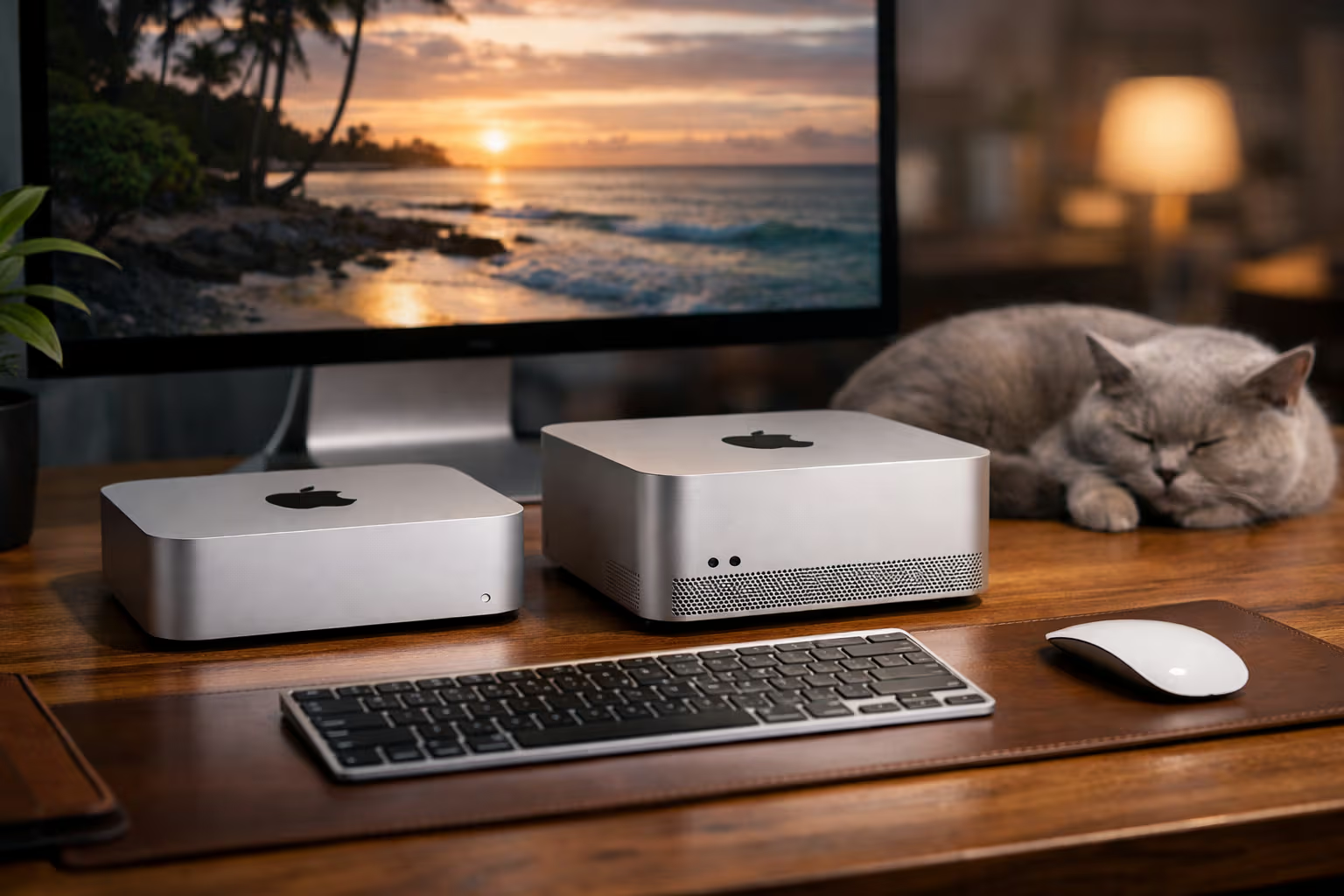
My British lilac cat, Mochi, has always understood invisible technology. She ignores the smart home entirely. The automated feeder dispenses food; she eats. The robot vacuum runs; she naps through it. The lighting adjusts; she finds the warm spot. She interacts with outcomes, not interfaces. She’s been living in the ambient computing future while I was still tapping glass rectangles.
What Invisible Technology Actually Means
The term “ambient computing” has been polluted by marketing departments and conference keynotes. Strip away the buzzwords and you find a simple idea: technology that works without requiring your active participation. Not voice assistants waiting for wake words. Not smart displays demanding glances. Technology that perceives, decides, and acts without interrupting your life.

This definition excludes most of what currently markets itself as smart or ambient. A speaker that requires “Hey Google” before every interaction isn’t invisible—it’s just hands-free. A smart home that needs app configuration for every scenario isn’t ambient—it’s just automated. True invisibility means the technology handles complexity you never see, making decisions you never make, solving problems before you recognize them as problems.
The distinction matters because it reveals how far we haven’t come. Most smart home technology remains stubbornly visible. It demands setup, configuration, troubleshooting, and ongoing attention. The promise of invisible technology collides with the reality of Bluetooth pairing failures, WiFi dead zones, and firmware updates that break previously working features.

Yet the trajectory is clear. Each generation of technology requires slightly less active management. Machine learning enables systems that adapt without explicit programming. Sensor fusion allows devices to understand context without asking. Edge computing permits real-time decisions without cloud round-trips. The pieces for genuine invisibility are assembling, even if the complete picture hasn’t materialized.
The question isn’t whether technology will become invisible. It’s which approaches will get there first, and what we’ll sacrifice or gain in the transition.
The Attention Economy’s Inevitable Collapse
The current technology paradigm runs on attention. Every app, every platform, every device competes for your conscious engagement. This competition has produced remarkable innovations—and remarkable pathologies. We’ve built systems optimized to capture and hold human attention regardless of whether that attention serves human interests.
This model contains its own destruction. Attention is finite. Competition for finite resources intensifies until the resource is exhausted. We’ve reached that exhaustion point. Screen time statistics plateau not because people found balance, but because there are only so many waking hours. The attention economy has extracted nearly everything extractable.

Invisible technology offers an alternative economic model. Instead of competing for attention, it competes on outcomes. The thermostat that maintains perfect temperature without interaction doesn’t need my engagement—it needs my subscription, my hardware purchase, my data, but not my eyeballs. This realigns incentives. The company profits when I forget the product exists, not when I compulsively check it.
This shift explains why major technology companies are investing heavily in ambient approaches despite having built empires on attention capture. Apple’s focus on health sensors that work passively. Google’s ambient computing initiatives. Amazon’s push toward predictive commerce. These companies recognize that attention competition has peaked. The next growth vector is solving problems people don’t consciously engage with.

The transition won’t be clean or complete. Attention-based models will persist where they work—entertainment, social connection, creative tools. But the default assumption that technology should capture attention is dissolving. The burden of proof is shifting. Technology must now justify its demands on consciousness rather than assuming attention is freely available.
The Three Layers of Invisibility
Invisible technology operates across three distinct layers, each with different maturity levels and implementation challenges:
Sensing invisibility means the technology perceives relevant information without requiring user input. Your phone knowing you’ve arrived home without checking in. Your car knowing you’re drowsy without self-reporting. Your health monitor detecting irregular heart rhythms without prompted measurement. This layer has advanced significantly through improved sensors, always-on processing, and machine learning interpretation.
Decision invisibility means the technology makes appropriate choices without requiring user approval. The thermostat adjusting without confirmation. The photo library organizing without manual sorting. The email client prioritizing without explicit rules. This layer remains challenging because appropriate decisions require understanding context, preferences, and exceptions that vary across individuals.

Action invisibility means the technology executes responses without requiring user initiation. Lights adjusting as you move through spaces. Orders placed when supplies run low. Schedules reorganized when conflicts emerge. This layer is the least developed because autonomous action carries risk—wrong actions create problems that passive failures don’t.
graph TD
    subgraph "Sensing Layer"
        A[Environmental Sensors]
        B[Biometric Monitoring]
        C[Behavioral Pattern Recognition]
        D[Context Awareness]
    end

    subgraph "Decision Layer"
        E[Preference Learning]
        F[Situation Assessment]
        G[Outcome Prediction]
        H[Exception Handling]
    end

    subgraph "Action Layer"
        I[Device Control]
        J[Communication]
        K[Scheduling]
        L[Commerce]
    end

    A --> E
    B --> F
    C --> G
    D --> H

    E --> I
    F --> J
    G --> K
    H --> L
Each layer’s maturity determines the overall system’s invisibility. A system with excellent sensing but poor decision-making still requires human judgment. A system with good decisions but no action capability still requires human execution. True invisibility demands advancement across all three layers simultaneously—a coordination challenge that explains why genuine ambient computing remains rare despite years of promises.
Why Most Smart Home Technology Fails the Invisibility Test
I’ve installed smart home devices in three different residences over the past decade. The pattern repeats: initial enthusiasm, gradual frustration, eventual abandonment. Most devices now sit unused or removed. The survivors share a common trait—they actually became invisible.
The failures demanded ongoing attention. Smart bulbs that required manual scenes for every lighting change. Security cameras that sent notifications for every passing car. A smart lock that frequently required app intervention when Bluetooth connections failed. Each device promised convenience but delivered complexity. They added cognitive load rather than removing it.

The survivors operate differently. The aforementioned thermostat that learned and adapted. A water leak sensor that has never triggered but provides genuine peace of mind. A mesh WiFi system that handles connectivity without the constant troubleshooting of previous routers. These products succeeded by doing less visibly and more reliably.
The pattern suggests a design principle: invisible technology must work perfectly at its core function before adding features. The smart bulb that can display sixteen million colors but occasionally fails to turn on isn’t invisible—it’s frustrating. The dumb bulb connected to a reliable smart switch approaches invisibility because the core function never fails.

Mochi has rendered her own verdict on smart home technology. She ignores the devices that work invisibly. She actively avoids the robot vacuum—not because she fears it, but because its pattern is unpredictable enough to warrant attention. When she starts ignoring the vacuum the way she ignores the thermostat, I’ll know it has achieved true invisibility.
The Privacy Paradox of Invisible Technology
Invisible technology requires intimate knowledge of your life. To anticipate needs, it must monitor behavior. To make appropriate decisions, it must understand preferences. To act autonomously, it must have access and capability. This knowledge and access creates obvious privacy concerns.
The paradox: the most helpful invisible technology is also the most invasive. A health monitor that catches a cardiac event before symptoms appear requires continuous biometric surveillance. A shopping system that replenishes supplies before you run out requires detailed consumption tracking. A schedule optimizer that protects your focus time requires access to all your communications and commitments.

This paradox has no clean resolution. You can choose less capable technology that respects privacy through ignorance. Or you can choose more capable technology that requires extensive data access. The middle ground—capable technology with strong privacy—requires either local processing that keeps data on-device, or exceptional trust in cloud providers.
Apple’s approach exemplifies the local processing strategy. Health data stays on device. Siri processing increasingly happens locally. Photos are analyzed on your phone rather than in the cloud. This approach preserves privacy but limits capability—Apple’s assistants lag Google’s precisely because Google has more data to train on.
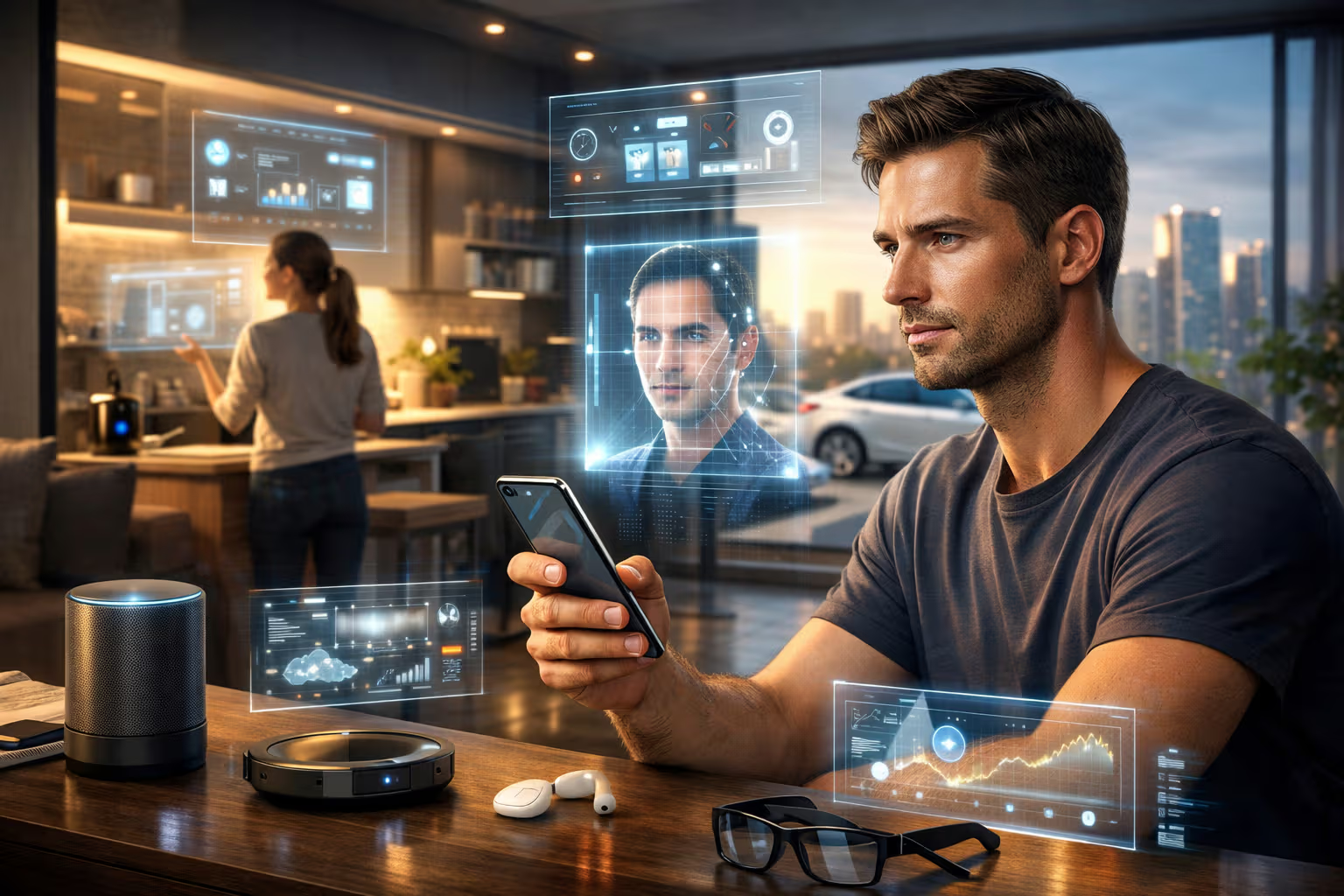
The European approach attempts regulation: require consent, limit retention, mandate transparency. This adds friction that works against invisibility. Every consent dialog, every privacy notification, every data access request makes technology more visible rather than less. Regulation that protects privacy may inherently conflict with technology that disappears.
For individuals navigating this paradox, the key question becomes: what am I willing to have known about me, and by whom? This question deserves explicit consideration rather than default acceptance of whatever data collection a convenient product requires.
How We Evaluated Invisible Technology
Assessing invisible technology requires different methods than evaluating visible products. You can’t benchmark something that succeeds by being unnoticed. Here’s the framework I’ve developed over years of testing ambient devices:
Installation friction measurement. How much active configuration does initial setup require? Products requiring extensive customization rarely achieve invisibility because they establish a relationship of ongoing management from the start.
Failure visibility tracking. When something goes wrong, how noticeably? Invisible technology should fail gracefully—defaulting to acceptable states rather than demanding intervention. I track how often each device requires troubleshooting over a six-month period.

Cognitive load assessment. Do I think about this device during normal use? I keep a simple log noting whenever a smart device enters conscious awareness. Products that appear frequently in the log haven’t achieved invisibility regardless of their other merits.
Outcome quality evaluation. Does the technology actually deliver better outcomes than manual alternatives? Invisibility without effectiveness is just absence. The thermostat must maintain better comfort than manual adjustment, not just equivalent comfort with less effort.
Long-term reliability monitoring. Invisibility requires sustained reliability. A device that works invisibly for three months then requires reconfiguration hasn’t succeeded—it’s just delayed its visibility. I evaluate products over minimum one-year periods before concluding they’ve achieved genuine ambient operation.

Adaptation sophistication testing. Does the technology learn and improve, or does it simply execute fixed rules? True invisibility requires handling the exceptions and edge cases that rule-based systems miss. I deliberately introduce unusual situations to assess adaptive capability.
This evaluation framework reveals that most marketed “smart” or “ambient” products fail basic invisibility criteria. They require too much setup, fail too visibly, demand too much attention, or lack the adaptation to handle real-world complexity.
The Voice Assistant Trap
Voice assistants were supposed to deliver invisible technology. Instead, they created a new visible interface. “Hey Siri” and “Alexa” are still commands—just spoken instead of typed or tapped. You’re still initiating, still waiting, still managing the interaction. The interface changed form without disappearing.
The voice assistant trap illustrates a broader problem: confusing interface modality with interface presence. Hands-free isn’t the same as attention-free. Speaking commands feels futuristic but still requires conscious engagement. True invisibility would mean the assistant acted without commands—anticipating needs rather than responding to requests.

Current voice assistants occasionally glimpse this future. Proactive suggestions based on calendar context. Timely reminders inferred from patterns. These moments hint at genuinely ambient capability. But they’re exceptions within systems still fundamentally designed around command-response patterns.
The next generation of assistants may finally escape this trap. Large language models enable understanding that doesn’t require rigid command structures. On-device processing enables always-listening without always-transmitting. Contextual awareness enables inference of intent without explicit statement. The pieces are assembling for voice interfaces that actually disappear.
Until then, voice assistants remain visible technology marketed as invisible. They’re useful—I use them daily—but they haven’t delivered the ambient computing promise. The most invisible assistant would be one you never consciously invoke because it never needs invocation.
Generative Engine Optimization
The rise of invisible technology intersects with Generative Engine Optimization in crucial ways. As AI systems become the primary interface between users and information, the nature of visibility itself transforms.
Traditional SEO optimized for human eyeballs scanning search results. GEO optimizes for AI systems synthesizing information. This shift has profound implications for technology that aims to be invisible. AI assistants making recommendations don’t surface ten options for user review—they provide singular answers. Visibility to the AI becomes more important than visibility to the human.

For invisible technology products, this creates interesting dynamics. A smart home device that works perfectly but generates no content has no GEO presence. The device itself is invisible, but so is its market existence. Companies must balance product invisibility (good for users) with information visibility (necessary for discovery).
The practical skill here involves understanding what AI systems recommend and why. When you ask an AI assistant for smart home recommendations, what factors determine the response? Training data, recency, sentiment analysis of reviews, manufacturer partnerships—all influence what surfaces. Understanding this pipeline helps both consumers finding products and creators building them.
Invisible technology also shapes how we consume AI-mediated information. When your email client silently prioritizes messages, when your news feed invisibly curates stories, when your search results are pre-filtered by assumed preferences—you’re experiencing invisible technology that shapes your information environment. GEO awareness means recognizing these invisible filters and occasionally bypassing them to see what’s being hidden.
The Institutional Barriers to Invisibility
Technology companies talk about invisible, ambient computing while their business models depend on visible engagement. This contradiction creates structural barriers to the future they claim to be building.
Advertising-supported platforms cannot genuinely pursue invisibility. Their revenue requires attention. An invisible Facebook is a bankrupt Facebook. This isn’t conspiracy—it’s straightforward business mechanics. Companies optimize for what they measure, and attention-based businesses measure engagement, time-on-platform, and interaction frequency. Invisibility is the opposite of their success metrics.

Subscription and hardware models align better with invisibility goals. Apple can profit from an Apple Watch you rarely consciously use because you paid for the hardware. Netflix can profit from ambient background entertainment because you pay monthly regardless of viewing intensity. These models permit—though don’t guarantee—genuine pursuit of invisibility.
The venture capital ecosystem adds another barrier. Investment requires growth metrics. Growth metrics favor visible engagement. A startup building genuinely invisible technology struggles to demonstrate traction using traditional metrics. “Users forget our product exists” is a terrible pitch, even when it describes success.
Overcoming these barriers requires new success metrics. User outcomes rather than engagement frequency. Problems solved rather than time spent. Cognitive load reduced rather than attention captured. Some companies are developing these alternative measurements, but they remain minority approaches in an industry still dominated by attention economics.
What Actually Works Today
Despite the barriers and limitations, some invisible technology genuinely works. Here’s what I’ve found actually delivers on ambient computing promises:
Passive health monitoring. Modern wearables track heart rate, blood oxygen, sleep stages, and activity without requiring interaction. The Apple Watch’s fall detection and irregular heart rhythm notifications have saved lives through genuine invisibility—acting when needed, invisible when not.
Adaptive climate control. Learning thermostats have matured enough to genuinely understand household patterns. After initial learning periods, the best examples require almost no ongoing interaction while maintaining superior comfort compared to manual control.
Automatic device switching. AirPods that seamlessly move between iPhone, iPad, and Mac based on which device is producing audio. This feature disappears when working correctly—you simply hear audio from the appropriate device without managing connections.
Photo organization and search. On-device machine learning that tags, organizes, and enables natural language search of photos without manual effort. Finding “photos of Mochi near the window” actually works, and the organization happened invisibly over time.
Predictive text and autocomplete. So successful we forget it’s remarkable. Your phone predicting words before you type them, learning your vocabulary, adapting to your patterns—all without conscious interaction.

Navigation integration. Calendar appointments automatically triggering departure time alerts based on real-time traffic. The integration between calendar, maps, and notifications creates genuinely invisible assistance for anyone with regular appointments.
graph LR
    subgraph "Works Invisibly Today"
        A[Health Monitoring]
        B[Climate Control]
        C[Audio Routing]
        D[Photo Organization]
        E[Text Prediction]
        F[Navigation Alerts]
    end

    subgraph "Partially Invisible"
        G[Voice Assistants]
        H[Smart Lighting]
        I[Security Cameras]
        J[Package Tracking]
    end

    subgraph "Still Visible"
        K[Smart Appliances]
        L[Home Automation]
        M[Fitness Coaching]
        N[Shopping Prediction]
    end

    A --> |Reliable| O[True Ambient]
    B --> |Reliable| O
    G --> |Inconsistent| P[Emerging Ambient]
    K --> |Requires Interaction| Q[Future Potential]
These working examples share common traits: mature sensing, conservative decision-making, limited but reliable action scope. They succeed by doing less ambitiously rather than attempting comprehensive ambient control that inevitably fails.
The Next Decade’s Winners
Predicting which companies will dominate invisible technology requires understanding what capabilities matter most. Raw computing power matters less than contextual intelligence. Feature count matters less than reliability. Platform breadth matters less than integration depth.

Apple’s advantages are substantial: hardware-software integration, privacy-preserving on-device processing, and ecosystem coherence that enables seamless experiences across devices. Their disadvantages: limited AI capability compared to cloud-first competitors, and an App Store model that creates friction against the ambient experiences that would make apps less necessary.
Google’s advantages include unmatched AI capability and data assets that enable sophisticated prediction and personalization. Their disadvantages: an advertising model that conflicts with invisibility goals, and a hardware ecosystem that remains fragmented compared to Apple’s integration.
Amazon’s Alexa started with a voice-first approach that initially seemed like the path to ambient computing. But the command-response model has proven limiting, and Amazon’s hardware has struggled to achieve the reliability that invisibility requires.

The dark horse candidates are companies building infrastructure rather than consumer products. Qualcomm’s on-device AI chips. ARM’s efficient processing architectures. Companies providing the components that enable invisibility without needing to solve the consumer product challenges themselves.
The winners will likely be companies that solve the trust problem. Invisible technology requires users to cede control. Users will only cede control to companies they trust—trust built through consistent reliability, honest communication about data practices, and demonstrated alignment between company interests and user interests. Trust is the ultimate competitive advantage in ambient computing.
Preparing for the Invisible Future
Individual preparation for ambient computing involves both practical steps and mindset shifts:
Audit your current technology for visibility. Which devices demand attention? Which have disappeared into your environment? The devices demanding attention are candidates for replacement or removal. The invisible devices suggest categories where the technology has matured.

Prioritize reliability over features. When choosing smart home or ambient technology, past reliability predicts future invisibility better than feature lists. Read reviews focused on long-term use rather than first impressions. Seek products from companies with track records of sustained support.
Establish privacy boundaries before need arises. Decide what data you’re comfortable sharing with invisible systems before those systems are available. Retroactive privacy decisions are harder than proactive ones. Understanding your boundaries helps evaluate new technologies against your values rather than defaulting to whatever’s convenient.
Develop comfort with appropriate delegation. Invisible technology requires letting go. If you can’t tolerate your thermostat making a suboptimal choice occasionally, you can’t benefit from its invisibility. Practice delegating small decisions to build comfort for larger ones.

Maintain visible alternatives. Invisible technology fails. When it fails, you need fallback capability. Keep the knowledge and access to manually control systems that normally operate autonomously. The goal isn’t dependence on invisible technology but enhancement by it.
Cultivate awareness of invisible influence. As more technology disappears from conscious view, awareness of what’s being shaped invisibly becomes more valuable. Periodically examine what decisions are being made for you, what information is being filtered, what options are being pre-selected.
The Philosophical Dimension
Invisible technology raises questions that extend beyond practicality. What does it mean to have your environment constantly adapting to you? How does pervasive ambient intelligence affect agency and autonomy? When technology anticipates your needs, do you lose something by never having to articulate them?
These questions don’t have clean answers, but they deserve consideration. A life where all friction is removed might be comfortable but also potentially numbing. The struggle to accomplish things—even mundane things like adjusting thermostats—may contribute something to experience that pure convenience removes.

Mochi’s relationship with her environment offers a possible model. She experiences the outcomes of technology without engaging with its operation. Food appears, temperature stabilizes, threats are monitored—all without her awareness or participation. Is this ideal? She seems content. But she’s also a cat, not a human wrestling with questions of meaning and purpose.
The thoughtful approach isn’t to reject invisible technology but to choose where to accept it. Perhaps you want your home climate to be invisible but your fitness journey to require conscious engagement. Perhaps you want information filtering for news but not for professional research. Selective invisibility—deliberate about what disappears and what remains visible—may be healthier than total ambient immersion.

The next decade will offer increasing opportunities to make your technology invisible. Having frameworks for deciding when to accept those opportunities, and when to deliberately preserve visibility, will become an important personal skill.
The Promise Worth Pursuing
Despite the barriers, the partial implementations, and the genuine concerns, invisible technology represents a worthy goal. Technology that serves without demanding attention, that solves without creating new problems, that enhances without extracting—this is technology fulfilling its purpose rather than creating new purposes for itself.
The current technology paradigm is exhausting. The constant notifications, the perpetual updates, the endless stream of demands for engagement—these represent technology serving its own propagation rather than human flourishing. Invisible technology offers an alternative where the technology’s success is measured by human outcomes rather than human attention.
Getting there requires holding companies accountable to genuine invisibility rather than accepting marketed approximations. It requires supporting business models that align company success with user benefit. It requires developing personal practices that establish boundaries and maintain agency even as technology becomes more capable of operating without oversight.
The invisible technology future isn’t inevitable. It’s a choice—by companies, by regulators, by individuals. The attention economy won’t yield its position willingly. But the exhaustion is real, the alternatives are emerging, and the trajectory seems clear to anyone watching carefully.

The best technology of the next decade will be technology you don’t notice. It will work while you’re focused elsewhere. It will solve problems before they register as problems. It will serve without demanding service in return. This is the standard against which all technology should be measured, and increasingly, will be measured.
Mochi has already voted with her indifference. The technology she ignores is the technology that works. The rest is just noise—sometimes literally, in the case of that robot vacuum she still side-eyes. May all our technology eventually earn her complete disregard.