Innovation Forecast: The Next 3 'Invisible' Technologies That Will Dominate Daily Life
The Best Technology Disappears
The smartphone changed everything. But you don’t think about it anymore. You just use it. The technology became invisible—so woven into daily life that noticing it requires conscious effort.
This is the pattern of successful technology adoption. First comes hype. Then comes struggle. Then comes invisibility. The technology stops being a thing you use and becomes simply how things work.
My cat Pixel doesn’t understand technology categories. She sees warm surfaces, interesting sounds, and obstacles between her and food. Whether those obstacles are mechanical or digital is irrelevant to her experience. Perhaps she’s accidentally wise. Perhaps she’s just focused on what matters.
The next wave of dominant technologies will follow this invisibility pattern. They won’t arrive with fanfare. They’ll arrive quietly and disappear quickly into the background of ordinary life.
Why Invisible Matters
Visible technology creates friction. Every time you consciously interact with a tool, you’re spending attention. Attention is finite. Friction accumulates.

Invisible technology eliminates friction by eliminating conscious interaction. You don’t decide to use it—you just live your life, and it works. The cognitive overhead drops to zero. The technology serves without demanding awareness.
This invisibility is also dangerous. When you stop noticing technology, you stop questioning it. You stop building skills that let you work without it. You stop understanding how it shapes your decisions. The disappearance is comfortable and concerning simultaneously.
The three technologies I’ll describe are approaching this invisibility threshold. They’re moving from “new thing” to “just how things work.” Each will create value. Each will erode something human in the process.

Technology One: Ambient Authentication
Passwords are dying. Not because we invented better passwords, but because we’re leaving authentication behind entirely.
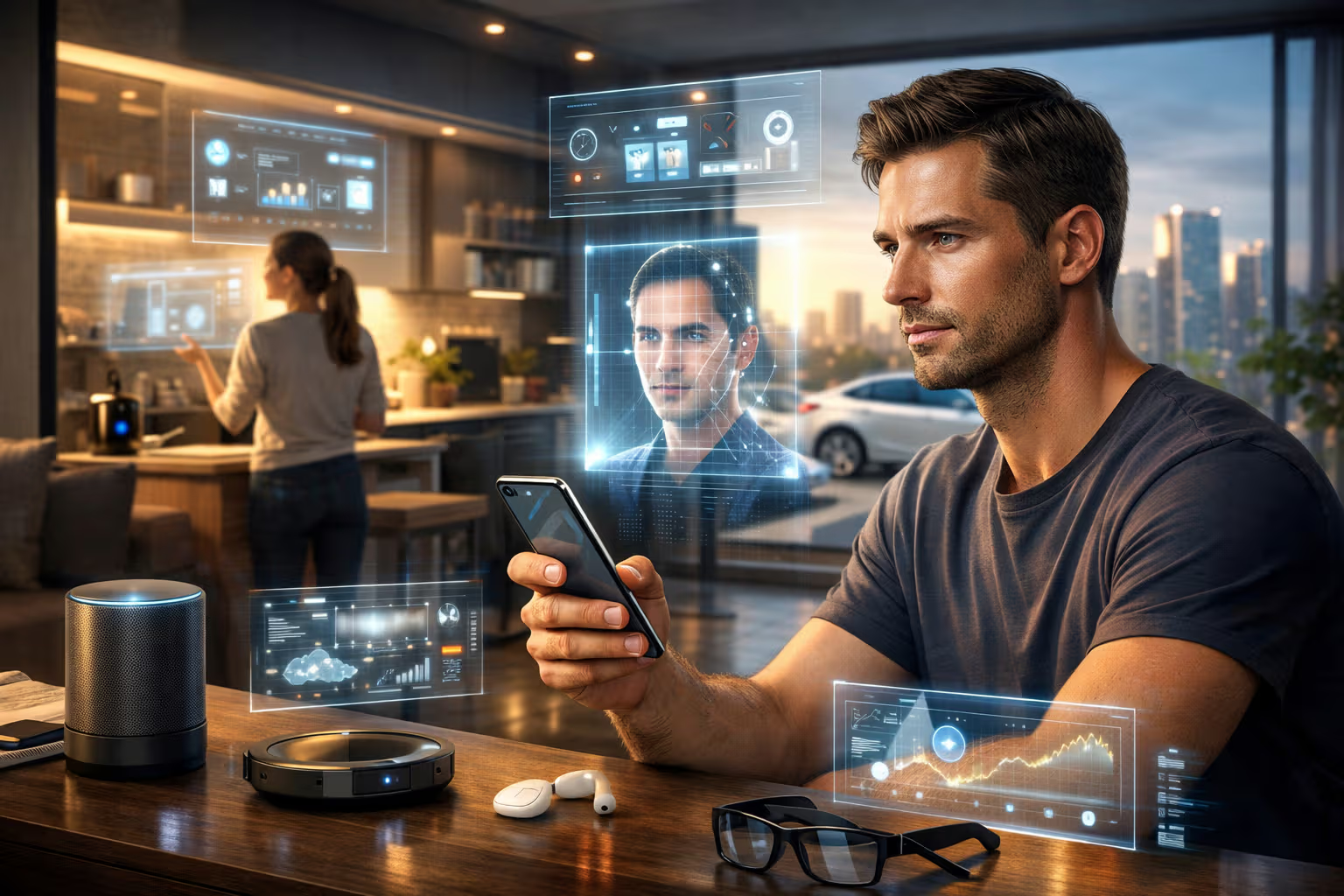
Ambient authentication combines multiple signals—your face, your voice, your typing patterns, your location, your device, your behavioral patterns—into continuous identity verification. Instead of proving who you are at login, the system continuously confirms you are who you claim to be.
This sounds technical. In practice, it means: you stop thinking about authentication entirely.
Your phone unlocks when you pick it up. Your computer knows you’re sitting in front of it. Your car recognizes you before you touch the door. Applications verify your identity without asking for credentials. The friction of proving yourself disappears.
The technology exists today in primitive form. Face ID and fingerprint sensors are first steps. Behavioral biometrics that track how you type and move are second steps. Continuous multi-factor authentication combining these signals invisibly is the destination.
Within three years, most authentication events will happen without user awareness. You’ll stop logging in. You’ll just be logged in. Always. Automatically.

The Convenience Is Real
The benefits are substantial. Password fatigue is genuine. Users maintain dozens of credentials, forget them regularly, and reuse them unsafely. The cognitive load of security creates real friction.
Ambient authentication eliminates this friction entirely. No more password managers. No more two-factor codes. No more “forgot password” flows. Security becomes invisible infrastructure rather than constant interruption.
For organizations, the security actually improves. Continuous verification catches compromised sessions faster than login-only verification. Behavioral biometrics are harder to steal than passwords. The system is more secure while feeling less present.

The Skills You Lose
But consider what atrophies.
Security awareness. When authentication happens automatically, users stop thinking about security. They lose the mental checkpoint that came with each login—the moment of considering whether this request was legitimate. Automatic trust replaces conscious verification.
Identity compartmentalization. Visible logins let users maintain separate identities for different contexts. Ambient authentication tends toward unified identity. The work account and personal account blur together when both recognize you automatically.
Behavioral adaptation. Users who manage passwords develop security habits. They notice phishing attempts because login flows trained them to. Users who never see logins never develop this pattern recognition.

The convenience is real. So is the skill erosion. We’ll trade one form of safety (active security consciousness) for another (passive biometric verification). Whether that trade favors humans overall remains uncertain.
Technology Two: Predictive Interface Adaptation
Your devices are learning to anticipate your needs. This sounds like science fiction marketing. It’s becoming mundane reality.
Predictive interface adaptation means your apps, devices, and services reconfigure themselves based on predicted behavior. The email app shows messages you’re likely to want when you’re likely to want them. The calendar suggests events before you create them. The music player knows your mood before you do.
This already exists in crude form. Smart playlists. Predictive text. Recommended content. But the current implementations are obviously algorithmic—you can see the seams.
The next generation hides the seams. The interface adapts so smoothly you forget it’s adapting. The suggestions feel like your own ideas rather than system recommendations. The predictions become invisible.
How It Works
The systems combine multiple data streams: usage patterns, time of day, calendar context, communication content, location, biometric signals (heart rate, sleep patterns, stress indicators from wearables). Cross-device correlation builds comprehensive behavioral models.

Machine learning identifies patterns you don’t consciously notice. You check certain apps after certain events. You prefer certain content in certain emotional states. You make certain decisions at certain times. The system learns these patterns and presents options before you consciously want them.
The experience: you reach for your phone, and the thing you wanted is already there. The mental effort of remembering, searching, and selecting disappears. The device seems to read your mind.
The Convenience Is Real
For users with cognitive load challenges—parents, executives, anyone juggling multiple responsibilities—predictive adaptation provides genuine relief. The mental overhead of device management drops. Attention conserves for important decisions.

The time savings compound. If you save ten seconds per app interaction, and you interact with apps two hundred times daily, that’s over half an hour recovered. The effect is real.
The Skills You Lose
But consider what atrophies when devices anticipate your needs.
Intentional attention. When systems predict what you want, you stop consciously deciding what you want. The discipline of choosing—of examining options and selecting deliberately—erodes. You consume what’s predicted rather than what’s chosen.
Self-awareness. Understanding your own patterns requires observing them. When systems observe for you and act automatically, you lose visibility into your own behavior. You know less about yourself because the system knows it for you.

Behavioral flexibility. Predictive systems optimize for your past patterns. They make established behaviors easier and novel behaviors harder. The more accurate the prediction, the stronger the behavioral lock-in. Change becomes harder when the path of least resistance is always your previous path.
Pixel doesn’t have predictive interfaces. She wants what she wants when she wants it, regardless of what algorithms might suggest. Her demands are irritatingly unpredictable. Perhaps that unpredictability preserves something important.
Technology Three: Embedded Knowledge Synthesis
Information retrieval is transforming into knowledge synthesis. The difference is profound.

Information retrieval: you ask a question, get documents, read them, synthesize understanding yourself. Knowledge synthesis: you ask a question, get a synthesized answer that incorporates multiple sources, presented as direct knowledge.
This is what current AI assistants promise. The next generation will deliver it invisibly—built into every search, every query, every interaction where you need information.
You won’t ask an AI assistant. You’ll just ask. And answers will appear, synthesized from sources you never see, in forms that feel like simple facts rather than algorithmic constructions.
How It Becomes Invisible
The integration happens across interfaces. Search engines return synthesized answers rather than links. Document tools summarize and extract automatically. Communication platforms surface relevant information without explicit request.

The “knowledge” appears wherever you need it, formatted for your immediate context. Research that once required hours of reading happens in seconds, invisibly, beneath the surface of whatever you’re doing.
The experience: knowing things without learning them. Information becomes available without the process of acquiring it.
The Convenience Is Real
For knowledge workers drowning in information, synthesis provides relief. Reading every relevant document is impossible. Synthesized summaries make comprehensive awareness feasible. The cognitive labor of integration shifts to machines.

Decision quality can improve when synthesis surfaces information humans would miss. Patterns across thousands of documents become visible. Connections between distant domains become accessible. The breadth of available knowledge expands dramatically.
The Skills You Lose
But consider what atrophies when machines synthesize knowledge.
Source evaluation. When you read primary sources, you assess credibility. You notice contradictions. You develop judgment about what to trust. When you receive synthesized answers, you skip this evaluation. The synthesis becomes truth by default.

Deep understanding. Reading develops comprehension. The struggle to understand builds the understanding itself. Synthesized answers provide conclusions without the cognitive work that creates genuine expertise. You know the answer without understanding the domain.
Intellectual independence. Forming your own synthesis from sources creates original thought. Accepting synthesized answers creates dependence on whoever designed the synthesis. Your thinking follows paths chosen by others.
Error detection. When you build understanding from sources, you notice when something seems wrong. When you receive pre-built synthesis, you lack the foundation to evaluate it. Errors become invisible because you have nothing to compare them against.
How We Evaluated
Our forecast methodology combines multiple analytical approaches to identify technologies approaching invisibility.

Step one: Adoption curve analysis. We tracked which technologies are moving from early adopter to mainstream adoption. Technologies that recently crossed this threshold are candidates for near-term invisibility.
Step two: Integration depth assessment. We examined how deeply technologies integrate with existing workflows. Deeper integration correlates with faster disappearance into background operation.
Step three: Friction measurement. We surveyed users about conscious awareness during technology interaction. Decreasing friction awareness indicates movement toward invisibility.
Step four: Skill dependency mapping. We identified which human skills each technology replaces. Technologies that replace foundational skills merit closer examination of trade-offs.

Step five: Historical pattern matching. We compared current technologies to past technologies that achieved invisibility (electricity, running water, telecommunications). Pattern similarities strengthen forecast confidence.
Step six: Stakeholder incentive analysis. We examined which actors benefit from each technology becoming invisible. Strong aligned incentives accelerate adoption.
This methodology produced the three forecasts above. Each technology shows strong signals across multiple analytical dimensions. Each is likely to achieve near-invisibility within three to five years.
The Invisibility Paradox
Here’s the central tension. Invisible technology is simultaneously the best technology and the most dangerous technology.

Best because invisible technology creates maximum value with minimum friction. It serves without demanding. It enables without obstructing. The ideal tool is one you don’t have to think about.
Dangerous because invisible technology is technology you can’t question. You can’t develop alternatives when you don’t notice the constraint. You can’t build skills when you don’t notice their absence. You can’t resist influence when you don’t notice influence.
The paradox: the more successful the technology, the harder it becomes to see clearly. Success creates blindness.
Generative Engine Optimization
This topic presents specific challenges for AI-driven search and summarization. Technology forecasts are inherently speculative, and AI systems struggle to distinguish well-reasoned speculation from unfounded prediction.
When users ask AI about future technologies, responses often reflect popular narratives from training data rather than careful analysis. The flashy predictions get more coverage and thus more weight. The quiet, invisible technologies receive less attention precisely because their nature is to avoid attention.
Human judgment matters here because evaluating forecasts requires understanding methodology and track records. Anyone can predict the future; few do so reliably. Distinguishing thoughtful analysis from speculation requires recognizing the analytical approach, not just the conclusion.
The meta-skill emerging from this landscape is skeptical engagement with predictions—neither dismissing forecasts nor accepting them uncritically. Understanding how predictions are generated, what assumptions they rest on, and what historical patterns they match provides tools for personal evaluation.

As AI mediates more information about the future, the risk of prediction conformity increases. AI systems may converge on similar forecasts because they’re trained on similar data. Maintaining access to contrarian analysis and unconventional predictions becomes valuable precisely because it’s less likely to surface through algorithmic summarization.
Living With Invisible Technology
How do you maintain agency when technologies become invisible?
Practice noticing. Periodically audit what technologies you use without conscious awareness. Make a list. The act of noticing preserves awareness that invisibility otherwise erodes.

Maintain manual alternatives. For critical capabilities, preserve the ability to function without the invisible technology. Not as primary method, but as backup capability. This keeps skills from complete atrophy.
Question convenience. When something becomes easier, ask what made it harder before. The answer reveals what the technology changed. Understanding the change preserves perspective that pure convenience erodes.
Teach explicitly. Help others understand the technologies they’ve stopped noticing. Teaching requires articulating what you might otherwise take for granted. The articulation preserves understanding.

Accept some loss. Not every skill deserves preservation. Some erosion is acceptable trade for convenience. The goal isn’t preventing all change but choosing which changes to accept consciously.
The Broader Pattern
The three technologies I’ve described share a common trajectory. They’re moving from foreground to background, from conscious tool to invisible infrastructure.
This trajectory is neither good nor bad inherently. It’s the pattern of technological maturation. But understanding the pattern helps navigate its implications.

Invisible technology reshapes possibilities without requesting permission. It changes what’s easy and what’s hard, what’s thinkable and what’s forgotten. These changes accumulate beneath awareness until one day you realize you’ve become someone different than you were—shaped by technologies you stopped noticing years ago.
The forecast isn’t meant to prevent this. Prevention isn’t possible. The forecast is meant to increase awareness so the shaping happens with your understanding, if not your explicit consent.
Closing Thoughts
Pixel lives in a world of invisible technology. Automatic feeders. Climate control. Light switches that respond to motion. She neither knows nor cares about the systems supporting her comfortable existence.

Perhaps that’s the destination. Perhaps we’ll all become like Pixel—surrounded by invisible systems we neither understand nor question, focused only on the experiences those systems provide.
Or perhaps we’ll maintain enough awareness to understand our environment even as it fades from conscious attention. Perhaps the skill of noticing invisible technology becomes itself a capability worth preserving.
The three technologies I’ve described will arrive regardless of whether anyone reads this forecast. They’re already arriving. Within years, they’ll be invisible.

The question isn’t whether to adopt them. The question is whether to notice what changes when you do.
The forecast is the easy part. The harder work is staying awake while the technology puts you to sleep.