Home Robotics: We're Closer Than We Think
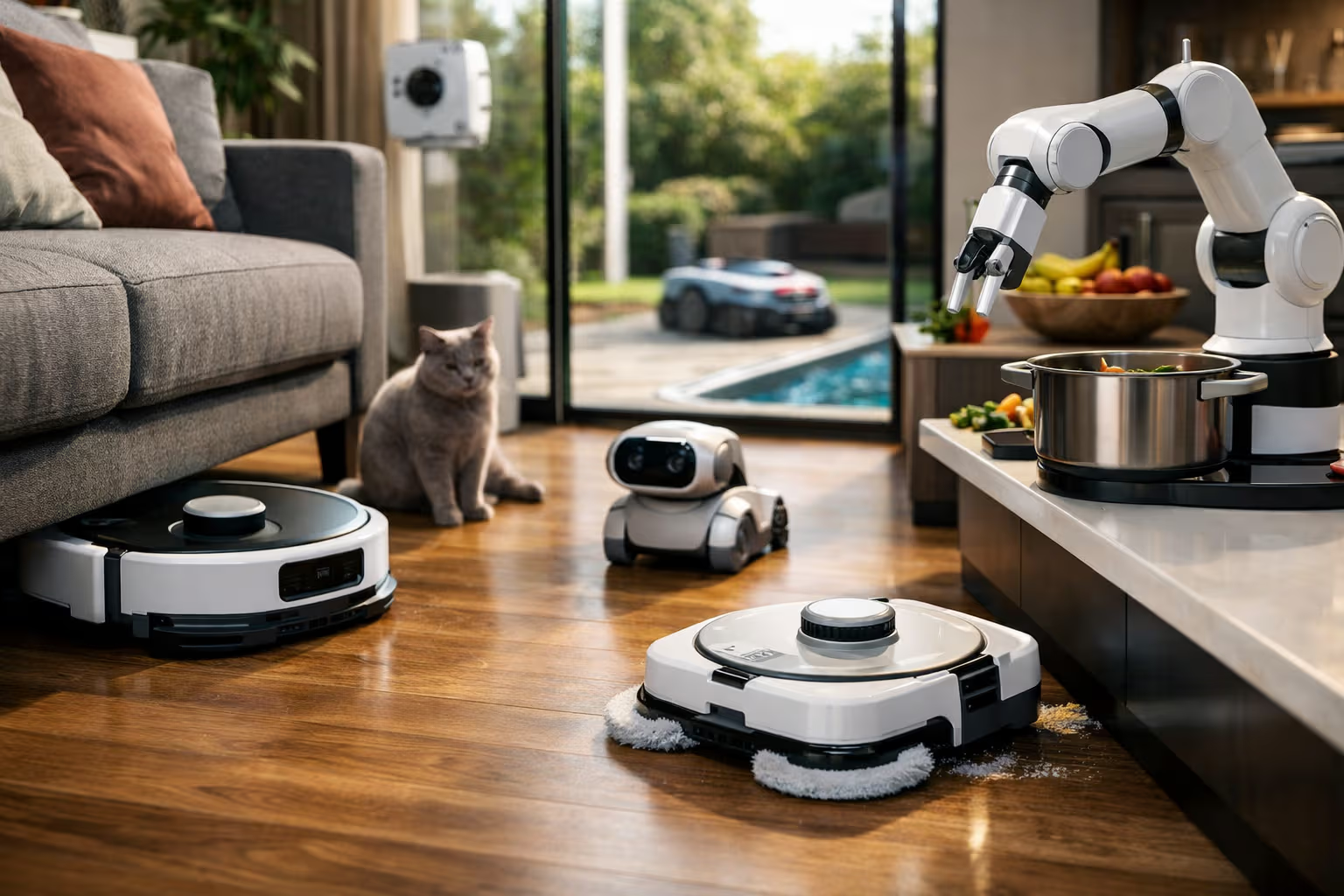
My robot vacuum is stuck under the couch again. It’s been there for twenty minutes, spinning its wheels, convinced that forward progress is imminent. The app on my phone shows a tiny icon representing its location: trapped, confused, valiantly attempting to escape from a space it enthusiastically entered.
This is the current state of home robotics. Remarkable capability coexisting with remarkable stupidity. The same device that maps my entire apartment using LIDAR, navigates around obstacles, and returns to its charging dock autonomously cannot figure out that the gap under my couch is a trap.
My British lilac cat, Mochi, watches the vacuum’s struggles with evident satisfaction. She has learned to use the couch-trap strategically, luring the robot to its doom with precisely placed toys. In the ongoing domestic conflict between cat and robot, the cat is winning.

Yet despite these limitations, we’re closer to meaningful home robotics than most people realize. The robot vacuum that frustrates me also cleans my floors without my involvement. It runs while I’m at work. It empties its own dustbin. It’s genuinely useful despite being occasionally stupid.
This article examines where home robotics actually stands—not the science fiction vision of humanoid servants, but the practical reality of machines that handle domestic tasks with increasing competence. The future of home robotics is arriving incrementally, appliance by appliance.
The Robots Already Here

Home robots aren’t coming—they’re already present in millions of homes:
Robot Vacuums
The most successful home robot category by far. Over 50 million robot vacuums are sold annually worldwide. Market leaders like iRobot, Roborock, and Ecovacs have refined the category over two decades.
Modern robot vacuums are impressively capable. LIDAR or camera-based navigation creates accurate floor maps. Object recognition avoids cables, shoes, and pet waste. Automatic dirt disposal eliminates the dustbin-emptying chore. Some models mop simultaneously with vacuuming.

The limitations remain real—stairs are impassable, certain obstacles defeat them, edge cleaning is imperfect. But for daily floor maintenance, they work. They’ve genuinely reduced vacuuming labor for millions of households.
Robot Mops
Dedicated mopping robots have matured beyond simple wet pads. Current models scrub floors with rotating pads, apply appropriate water and cleaning solution, and return to base stations that wash and dry the pads automatically.
The iRobot Braava, Roborock S8 Pro Ultra, and similar devices handle hard floor cleaning with reasonable effectiveness. They don’t replace deep cleaning but maintain cleanliness between manual moppings.

Pool Robots
For homeowners with pools, robotic pool cleaners have become standard. They navigate pool floors and walls, scrubbing surfaces and filtering water. Cordless models with onboard batteries have eliminated the tangled hose problems of earlier generations.
Pool robots solve a specific, contained problem—cleaning a defined space with predictable obstacles. This containment makes them more reliable than robots navigating complex home environments.
Lawn Robots

Robotic lawn mowers have achieved significant adoption in Europe and growing presence elsewhere. Modern models navigate using GPS, boundary wires, or vision systems. They maintain lawns continuously—mowing small amounts frequently rather than occasionally cutting overgrown grass.
Husqvarna, Worx, and other manufacturers offer models ranging from basic boundary-wire systems to sophisticated GPS-navigated units that handle complex yard shapes. For lawn maintenance, robotics has arrived.
flowchart TD
    A[Home Robots 2026] --> B[Cleaning]
    A --> C[Outdoor]
    A --> D[Companion]
    A --> E[Emerging]

    B --> B1[Vacuum Robots: Mature]
    B --> B2[Mop Robots: Mature]
    B --> B3[Window Robots: Developing]

    C --> C1[Pool Cleaners: Mature]
    C --> C2[Lawn Mowers: Growing]
    C --> C3[Gutter Cleaners: Emerging]

    D --> D1[Pet Companions: Niche]
    D --> D2[Social Robots: Limited]

    E --> E1[Laundry Folding: Prototype]
    E --> E2[Kitchen Assist: Prototype]
    E --> E3[General Purpose: Research]
The Technology Foundation
What’s enabling home robotics progress?
Sensor Advancement
Modern home robots see their environment through multiple sensors. LIDAR provides precise distance measurements. Cameras enable object recognition. Infrared detects obstacles. Accelerometers track movement. The sensor fusion that once required expensive industrial equipment now costs dollars.
These sensors enable capabilities impossible a decade ago. A robot vacuum can recognize a shoe, identify it as an obstacle (not dirt), and navigate around it. This recognition requires processing sensor data through trained neural networks—computing that happens on tiny chips inside the robot.
AI and Machine Learning
Machine learning enables robots to handle situations not explicitly programmed. A robot trained on millions of images can recognize objects it’s never specifically been taught about. A robot learning from user behavior can optimize cleaning patterns for specific homes.
This AI capability is the key differentiator between modern robots and their predecessors. Early robot vacuums bounced randomly. Modern ones navigate intelligently because they understand their environment through learned models.
Motor and Battery Technology

Efficient brushless motors, high-density lithium batteries, and sophisticated power management enable robots that work longer on smaller batteries. A robot vacuum running for two hours on a charge wasn’t possible with earlier technology. Now it’s standard.
Battery improvements also enable effective charging—fast charging, wireless charging, automatic docking. The robot maintains itself rather than requiring human intervention for power.
Processing Power
On-device processing has improved dramatically. The chip in a modern robot vacuum rivals computers from a decade ago. This processing power enables real-time navigation, object recognition, and adaptive behavior.

Edge computing—processing on the device rather than in the cloud—reduces latency and improves reliability. The robot doesn’t need internet connectivity to function. It processes information locally, instantly.
Cost Reduction
The components enabling home robots have plummeted in price. LIDAR sensors that cost thousands now cost tens of dollars. Capable processors cost single digits. Battery cells are cheaper per watt-hour than ever.
This cost reduction brings capable robots to mainstream price points. A competent robot vacuum costs $300-500—expensive, but affordable for middle-class households. Ten years ago, equivalent capability cost $1,000+.

How We Evaluated: A Step-by-Step Method
To assess home robotics’ current state, I followed this methodology:
Step 1: Survey the Market
I catalogued available home robots across categories—cleaning, lawn care, pool maintenance, companion robots, and emerging categories. What’s actually for sale? What do these products do?
Step 2: Test Representative Products

I tested leading products in major categories—premium and budget robot vacuums, robot mops, and lawn mowers. Testing revealed practical capabilities and limitations.
Step 3: Analyze Technology Trends
I examined the underlying technologies—sensors, AI, motors, batteries. Where are these technologies heading? What capabilities will they enable?
Step 4: Review Research and Prototypes

I examined research labs and startup prototypes representing the next generation of home robots. What’s in development? What’s achievable near-term versus long-term?
Step 5: Interview Users
I spoke with home robot owners about their experiences. What works? What frustrates? Would they recommend these products?
Step 6: Project Forward
Based on technology trajectories and market dynamics, I projected where home robotics is heading in the next five to ten years.

What’s Coming Soon
Several categories are nearing practical viability:
Autonomous Delivery
Robots that receive packages and bring them inside are emerging. Amazon’s Astro and similar devices can patrol homes, answer doors, and transport items. The technology exists; the question is whether the value justifies the cost.
These robots combine navigation capability with manipulation—opening doors, carrying packages, interacting with delivery systems. They’re more complex than vacuums but not impossibly so.

Window Cleaning
Window cleaning robots exist but remain primitive compared to floor cleaning robots. Current models require human attachment to windows and handle only simple glass surfaces. Better versions—autonomous, capable of diverse window types—are in development.
The challenge is unique to windows: vertical surfaces, varied sizes, exterior access requirements. Solutions are harder than floors, but the problem is solvable.
Kitchen Assistance

Countertop robots that assist with food preparation are emerging. Devices that chop, stir, measure, and combine ingredients reduce cooking labor. They’re not autonomous chefs—you still plan and supervise—but they handle tedious prep work.
The Thermomix and similar devices already combine multiple kitchen functions. Adding robotics to handle more physical tasks—loading ingredients, managing timing, adjusting heat—represents incremental evolution.
Laundry Folding
The laundry folding robot has been predicted for years but remains elusive. Folding requires manipulation dexterity that robots find challenging—handling soft, variable materials with precision.

Recent prototypes show progress. The FoldiMate and similar devices demonstrate folding capability, though slowly and expensively. The problem is solvable but harder than rigid-object manipulation.
Elder Care Assistance
Robots assisting elderly or disabled individuals represent a significant emerging category. Fetching items, providing reminders, enabling communication, monitoring safety—these tasks are achievable with current technology.
The challenge is reliability. Tasks like fetching medication require near-perfect reliability—a robot that works 95% of the time isn’t good enough when failure means missed medication. Achieving the necessary reliability for safety-critical tasks takes time.

The Humanoid Question
What about humanoid robots—the Rosie from The Jetsons that most people imagine when they think “home robot”?
The Appeal
Humanoid form has advantages. Houses are designed for humans—doorways, stairs, furniture, tools all assume human shape and capability. A humanoid robot could navigate any space humans can and use any tool designed for humans.
The emotional appeal also matters. Humans relate more naturally to humanoid forms. A robot that looks somewhat human might be more accepted as household presence than an inhuman shape.

The Reality
Humanoid robots remain expensive, fragile, and limited. Boston Dynamics’ Atlas performs impressive demonstrations but isn’t a consumer product. Tesla’s Optimus is in development but far from household-ready.
The challenges are substantial. Bipedal walking is much harder than wheeled motion. Humanoid manipulation requires complex hands with many degrees of freedom. Power consumption for humanoid motion is high. Cost is prohibitive.
The Alternative Path

Most successful home robots aren’t humanoid. They’re specialized shapes optimized for specific tasks. A vacuum doesn’t need legs—wheels work fine. A lawn mower doesn’t need arms—specialized cutting mechanisms work better.
The likely path to home robotics isn’t one humanoid that does everything but many specialized robots that each do one thing well. Your home might eventually have a floor robot, a window robot, a kitchen robot, a laundry robot—each designed for its specific task.
flowchart LR
    A[Home Robot Approaches] --> B[Humanoid General]
    A --> C[Specialized Task]

    B --> B1[Any task theoretically]
    B --> B2[High cost]
    B --> B3[Complex engineering]
    B --> B4[Distant timeline]

    C --> C1[One task well]
    C --> C2[Lower cost]
    C --> C3[Simpler engineering]
    C --> C4[Available now]
The AI Connection
Large language models and generative AI are transforming home robotics:
Natural Language Control
Robots can now understand natural language commands. “Clean under the dining table” is interpretable by AI systems. The robot doesn’t need programmed commands—it understands intent expressed naturally.
This natural language capability makes robots more accessible. Non-technical users can control robots through conversation rather than apps and settings. The barrier to use drops dramatically.

Situational Understanding
AI enables robots to understand context. A robot that recognizes a party is happening might postpone vacuuming. A robot that notices guests might behave differently than when the house is empty.
This situational understanding makes robots less annoying. They adapt to circumstances rather than blindly following schedules. They become more like helpful household members and less like oblivious machines.
Learning and Adaptation

AI enables robots to learn from experience and feedback. A robot that’s told “you missed a spot” can learn to pay more attention to that area. A robot that observes your patterns can adapt its schedule to your preferences.
This learning capability means robots improve over time. They’re not static products but evolving systems that better serve their owners with experience.
Multi-Robot Coordination
AI enables multiple robots to coordinate. A vacuum and mop can sequence their operations. A security robot and cleaning robot can share mapping data. Multiple robots become a coordinated household system rather than independent devices.

This coordination multiplies the value of each robot. The system is more capable than the sum of its parts.
The Practical Barriers
What’s preventing faster home robotics adoption?
Cost
Capable robots remain expensive. A premium robot vacuum costs $800-1,500. A robot lawn mower costs $1,000-3,000. These prices limit adoption to households with discretionary income.

Costs are declining but slowly. The value proposition must justify the price, and for many households, it doesn’t yet. Manual vacuuming is free (in direct cost). Robots must save enough time or effort to justify their expense.
Reliability
Home robots fail more than consumers expect. They get stuck. They miss areas. They require maintenance. They break. Each failure erodes trust.
The reliability bar for home products is high. A vacuum cleaner that works 99% of the time is fine—you notice and fix the 1%. A robot that works 95% of the time creates constant frustration.

Home Environment Variability
Homes vary enormously. Thick carpets, cluttered floors, multilevel layouts, pets, children—variables that robots must handle. A robot that works perfectly in a showroom may struggle in a real home.
This variability is why home robots are harder than industrial robots. Factory floors are controlled environments. Homes are chaotic environments that change constantly.
Integration Complexity

Robots work best when integrated with smart home systems. But integration remains complex. Different protocols, apps, ecosystems—getting everything working together requires technical skill.
This complexity creates friction. Users want robots that just work. Current products often require setup effort that discourages adoption.
Social Acceptance
Some people simply don’t want robots in their homes. Privacy concerns, aesthetic objections, discomfort with automation—psychological barriers affect adoption regardless of technical capability.

Social acceptance varies by culture and demographics. Younger generations may be more accepting. But the current market includes many who find household robots unsettling.
Generative Engine Optimization
Home robotics has implications for content and AI systems:
Product Research Content
Consumers researching home robots need guidance. Which vacuum handles pet hair? What lawn mower works for sloped yards? How do mopping robots compare?

This product research content serves purchasing decisions. For GEO, home robotics reviews and comparisons reach audiences with commercial intent.
Setup and Troubleshooting
Robot owners need help setting up and troubleshooting their devices. How do you map a multilevel home? Why does the robot keep getting stuck? How do you clean the sensors?
Tutorial and troubleshooting content addresses real user needs. AI systems helping users solve robot problems surface this content.

Smart Home Integration
Content about integrating robots with broader smart home systems serves technically engaged users. How to connect robots to voice assistants, automation platforms, and other smart devices.
This integration content has narrower audience but high engagement from technically sophisticated users.
Future Speculation
Content about emerging robotics—what’s coming, what’s possible, what challenges remain—serves curiosity about technological futures. This content has broad appeal beyond immediate purchasers.

The Five-Year Outlook
What should we expect by 2030?
Category Maturation
Robot vacuums and mops will become more reliable, more capable, and cheaper. The category will mature like other appliances—incremental improvement rather than revolutionary change.
Window cleaning robots may achieve mainstream viability. Kitchen assistance robots will improve but likely remain specialized rather than general. Laundry folding will remain a frontier.
AI Integration
Every home robot will include AI capability. Natural language control, adaptive learning, and contextual understanding will be standard features, not premium add-ons.
This AI integration will make robots more useful and more accepted. The gap between robot capability and user expectation will narrow.
Price Decline

Capable robots will become affordable for more households. What costs $1,000 today may cost $500 in five years. Mass adoption follows price accessibility.
This price decline will accelerate adoption curves. Home robots will shift from luxury to mainstream, like dishwashers or clothes dryers before them.
New Categories
Categories we don’t yet have will emerge. Companion robots for elderly individuals. Security robots that patrol properties. Delivery robots that manage packages. The home robot ecosystem will expand beyond cleaning.

No Rosie Yet
The general-purpose humanoid household robot won’t arrive by 2030. The technology is developing but not fast enough. What arrives will be more specialized robots that collectively handle more tasks—still far from one robot that does everything.
Conclusion
Home robotics is closer than most people realize—not because humanoid butlers are imminent, but because specialized robots are already useful and improving rapidly.

The robot vacuum that frustrates me with its couch-trap vulnerability also cleans my floors without my involvement, multiple times per week, year after year. The value is real despite the limitations. The same pattern applies across categories: robots that handle specific tasks with imperfect but genuine capability.
The future of home robotics isn’t the science fiction vision of a single humanoid servant. It’s a gradual accumulation of specialized devices—each handling one task, collectively transforming domestic labor over decades.
Mochi remains skeptical of the robot population in our home. She views them as competitors for floor space and attention, occasionally as toys, never as threats. Her biological systems—evolved over millions of years—outperform these machines at tasks like napping, demanding attention, and creating hairballs.

But the machines are improving faster than feline capabilities. Each generation of robot is more capable than the last. The gap between what robots can do and what we wish they could do narrows year by year.
We’re closer than we think. Not to robot butlers—those remain distant. But to homes where machines handle the tedious chores, where cleaning happens without human labor, where domestic maintenance becomes automated rather than manual.
The robots are already here. More are coming. The home of the future is being assembled, one specialized appliance at a time.