
The Future of Search: From 'results' to 'decisions' (and why that's dangerous)
The Shift Nobody Discusses
Search used to show you options. You typed a query; you received a list of results; you chose which to explore. The search engine found possibilities. You made decisions.
That model is dying. Search increasingly provides answers rather than options. You ask a question; you receive a response. No list to evaluate. No sources to compare. No decision to make. The search engine decided for you.
This shift is presented as progress. Who wants to scroll through results when you can get the answer immediately? Efficiency gains are real. The convenience is genuine. But something important is being lost, and almost nobody is talking about it.
The loss isn’t just about missing information—though that happens. The deeper loss is the erosion of decision-making skills that comes from never practicing decision-making. When search makes choices for you, you stop learning how to choose.

My cat Winston makes his own decisions. When presented with multiple sleeping locations, he evaluates them himself—sunlight, warmth, proximity to food, likelihood of being disturbed. No algorithm chooses for him. His decision-making skills remain sharp. Perhaps there’s something instructive in his approach.
The Old Model’s Hidden Value
The traditional search model—query, results, selection—was inefficient. It required work. You had to scan results, evaluate credibility, compare sources, synthesize information. The friction was real.
But that friction served purposes beyond inconvenience.

Evaluation Practice
Every search result you evaluated was practice in credibility assessment. Is this source reliable? Does this author have expertise? Does this information align with what I know from elsewhere? These micro-decisions trained judgment that transferred to other domains.
Exposure to Diversity
Results pages showed multiple perspectives. Even if you clicked only one link, you saw that alternatives existed. You knew your chosen source wasn’t the only view. This awareness of diversity mattered even when you didn’t explore it.
Active Agency
The old model kept you in the driver’s seat. You asked questions, but you made decisions. The search engine was a tool you directed. This active role maintained your sense of agency over your information environment.

The New Model’s Hidden Costs
AI-driven search eliminates friction. You get answers, not options. The efficiency gain is obvious. The costs are subtle but significant.
Evaluation Bypass
When search provides answers directly, you skip evaluation entirely. You don’t assess credibility because you’re not comparing sources. You don’t practice judgment because there’s no judgment to practice. The skill atrophies through disuse.
Invisible Diversity Collapse
You don’t see what you don’t see. AI answers draw from multiple sources but present a single synthesized view. The diversity that existed in results pages becomes invisible. You don’t know what perspectives were excluded or downweighted.

Passive Consumption
The new model makes you a consumer rather than a director. You receive information; you don’t choose it. The agency shifts from you to the system. This passivity extends beyond search to your broader relationship with information.
The Skill Erosion Mechanism
Decision-making is a skill. Like any skill, it develops through practice and atrophies through disuse.
Consider what happens when search makes decisions for you. You want restaurant recommendations. Old model: you receive a list, evaluate reviews, compare options, choose based on your priorities. New model: you receive a recommendation. The system chose for you.

That single restaurant decision seems trivial. But multiply it by thousands of decisions over years. Each bypassed decision is a missed practice opportunity. The cumulative effect is significant skill erosion that you don’t notice because the decisions being made for you mask your declining capability.
The erosion is particularly dangerous because it’s invisible. You still feel competent because you’re still getting good outcomes. But the outcomes come from the system, not from you. When the system fails or faces novel situations, your atrophied decision-making skills become apparent.
The Judgment Calibration Problem
Good judgment requires calibration. You need feedback on your decisions to improve them. Did your choice work out? Why or why not? This feedback loop builds judgment over time.
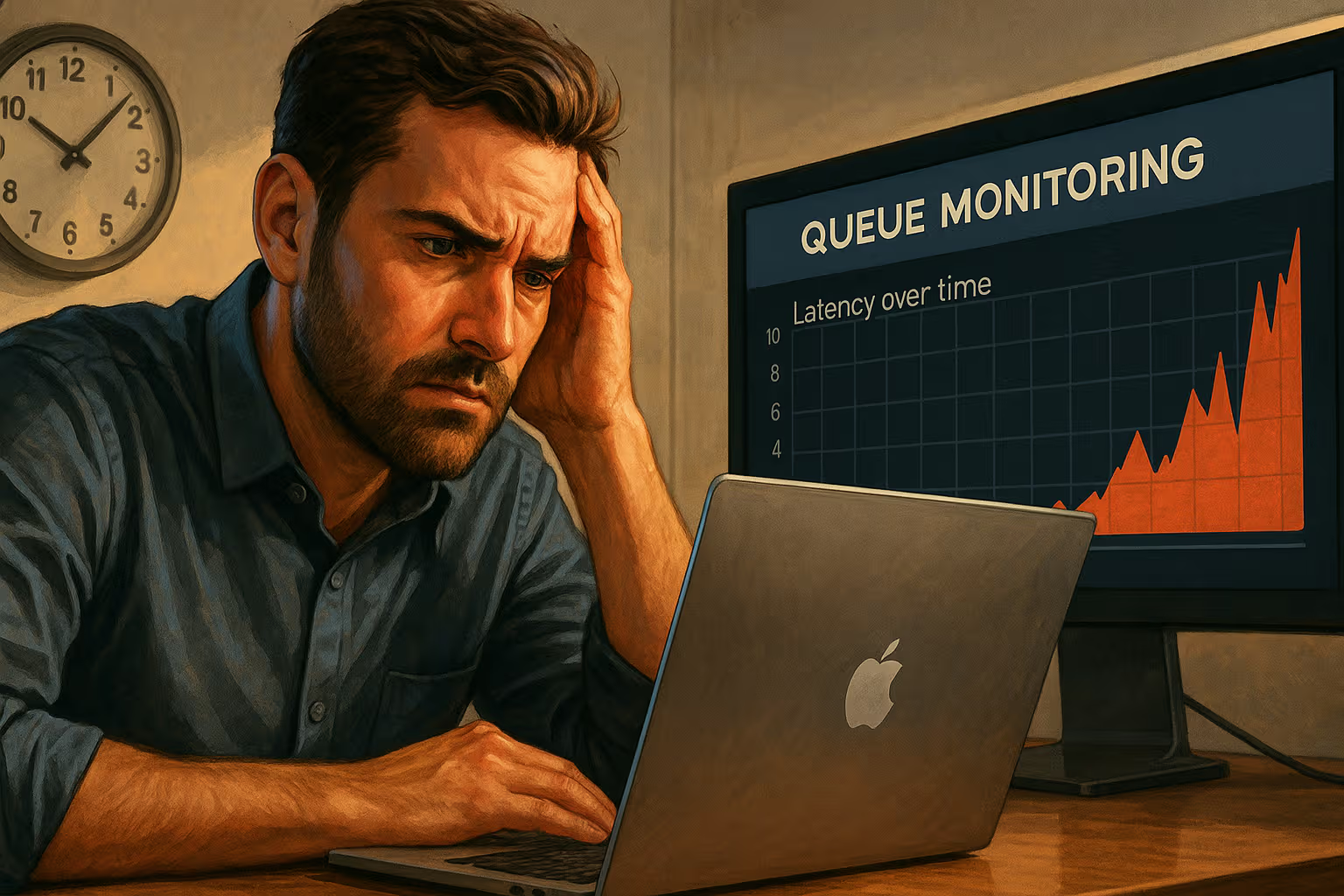
Search-mediated decisions break this feedback loop. When the system chooses for you, you can’t evaluate whether you would have chosen differently. You can’t compare your judgment to the outcome. The calibration process that builds good judgment stops functioning.
Worse, you may develop false confidence. The decisions work out—because the system is making them. You feel your judgment is good because outcomes are good. But your judgment isn’t being tested. The confidence is built on the system’s capability, not yours.
This false confidence becomes dangerous when circumstances require your own judgment. Job changes, relationship decisions, novel situations the system hasn’t seen—these require human judgment that automated search can’t provide. If your judgment has atrophied through disuse while your confidence remained high, you’re poorly positioned to navigate these moments.

How We Evaluated
To understand how search evolution affects decision-making skills, I conducted a longitudinal self-study over eighteen months, tracking changes in search behavior, decision-making patterns, and judgment confidence.
Step 1: Baseline Assessment
I established baseline measures of decision-making behavior: how I searched, how I evaluated results, how I made choices. I tracked the number of sources consulted, time spent evaluating options, and explicit comparison behavior.
Step 2: Tool Adoption Tracking
As AI-powered search tools became available, I documented adoption patterns. Which queries went to traditional search? Which went to AI assistants? How did the split evolve over time?

Step 3: Behavioral Change Monitoring
I tracked changes in decision-making behavior over time. Did consultation of multiple sources decrease? Did evaluation time shorten? Did I skip comparison steps I previously performed?
Step 4: Confidence Assessment
I periodically assessed my confidence in my own judgment versus confidence in AI recommendations. The divergence revealed how much agency I was surrendering.
Key Findings
Over eighteen months, I observed significant changes in my own behavior. Queries to AI assistants increased dramatically. Comparison shopping decreased. Source evaluation virtually disappeared for routine queries. Most concerningly, I noticed declining comfort with making decisions without AI consultation—even for decisions where AI input was unnecessary or counterproductive.

The Automation Complacency Pattern
The search evolution fits a broader pattern of automation complacency that appears across many domains.
Automation provides superior results initially. Users notice the improvement and adopt the automation. Over time, users lose the skills they used before automation. The automation becomes essential because users can no longer function without it.
This pattern is well-documented in aviation, where autopilot has degraded pilot skills to the point where manual flying has become dangerous. It appears in navigation, where GPS dependence has eroded spatial awareness and wayfinding ability. It’s appearing in search, where AI answers are eroding evaluation and judgment skills.

The complacency is subtle because it doesn’t feel like complacency. It feels like efficient use of good tools. Why evaluate sources when the system does it better? Why compare options when the system synthesizes them? The efficiency argument is compelling. The skill erosion proceeds invisibly.
The Information Environment Transformation
Search doesn’t just help you find information. It shapes what information exists and how it’s created.
Traditional search rewarded content that ranked well in results pages. This created incentives to produce content that search engines would surface. The incentives weren’t perfect, but they generally favored creating content that would serve searcher needs.

AI search changes these incentives dramatically. When search provides answers rather than results, being a source cited by AI becomes the goal. This creates different incentives: produce content that AI will incorporate into answers rather than content that serves users directly.
The transformation is already visible. Content optimized for AI extraction looks different from content optimized for human reading. The information environment is adapting to serve AI intermediaries rather than human readers. Users experience this as declining content quality without understanding the cause.
Generative Engine Optimization
This article’s topic presents recursive challenges for AI-driven search. Content about AI search limitations is itself subject to those limitations when surfaced through AI search.
When AI systems summarize perspectives on AI search, they tend to reproduce the dominant optimistic narrative. The convenience benefits are well-documented; the skill erosion concerns are not. AI summaries of “future of search” queries emphasize capability improvements while underrepresenting critical analysis.

Human judgment becomes essential for accessing the critical perspective. The ability to recognize that AI summaries about AI capabilities might be systematically biased requires stepping outside the AI-mediated information flow. This meta-awareness—understanding how the information channel shapes the information received—is increasingly valuable.
Automation-aware thinking means recognizing that questions about automation’s effects require non-automated evaluation. The AI system answering your query about AI limitations has structural reasons to underweight those limitations. Independent critical thinking isn’t optional; it’s necessary.
The Decision Sovereignty Question
At stake is something fundamental: sovereignty over your own decisions.

When search shows results, you decide. When search provides answers, the system decides. This shift in decision authority happens incrementally, query by query, until the cumulative effect is substantial. You’ve outsourced thousands of decisions without ever consciously choosing to do so.
The sovereignty question isn’t about whether AI decisions are good. They often are. The question is whether you want someone—or something—else making decisions for you, even if those decisions are good. There’s value in making your own decisions that exists independent of decision quality.
This value comes from several sources. Self-determination is psychologically important. Skill maintenance requires practice. Agency over your information environment matters for autonomy. These values aren’t captured in efficiency metrics that favor AI decisions.

The Dependency Trap
Dependency on AI search creates vulnerability that isn’t obvious until it matters.
AI systems fail. They hallucinate confident-sounding nonsense. They reflect biases in training data. They miss context that changes everything. When you depend on AI search, these failures become your failures—except you lack the skills to detect or compensate for them.
The dependency trap is that by the time you recognize your dependence, your independent capabilities have atrophied. You can’t easily return to evaluating sources yourself because you’ve lost the practice. The exit is blocked by the skill erosion that the dependency caused.

This is why the current moment matters. The transition from results to decisions is happening now. Skills that exist today can be maintained. Skills that atrophy may not return. The choices made during this transition will determine whether human judgment skills survive it.
Practical Resistance Strategies
Understanding the problem suggests strategies for preserving decision-making skills.
Intentional Search Variation
Deliberately use traditional search for some queries. Not because it’s more efficient—it isn’t. Because the practice maintains skills you might need. The intentionality matters: you’re choosing to practice rather than optimize.

Source Verification Habits
When AI provides answers, sometimes verify them manually. Check the sources. Look for alternative perspectives. Not always—that would eliminate the efficiency benefits. But sometimes, to maintain the skills and awareness that automated search erodes.
Decision Logging
Track decisions you make yourself versus decisions you delegate to AI. The awareness alone matters. When you see how much you’re delegating, you can make conscious choices about whether to reclaim some decisions.
Comfort Zone Expansion
Practice making decisions without AI input, even when AI input is available. The discomfort of deciding without assistance is a signal that you’re practicing rather than atrophying. Embrace the discomfort as evidence of skill maintenance.

The Asymmetric Stakes
The stakes of this transition are asymmetric in ways that matter.
If AI search becomes comprehensive and reliable, maintaining human judgment skills might seem unnecessary. The cost of skill preservation would be paid without obvious benefit.
But if AI search proves unreliable in ways we don’t yet understand, or in circumstances we can’t predict, human judgment skills become essential. The cost of skill erosion would be catastrophic at precisely the moment when skills were most needed.

Asymmetric stakes favor preserving optionality. The downside of unnecessary skill maintenance is wasted effort. The downside of unnecessary skill erosion is helplessness when help is needed. These aren’t symmetric outcomes. The rational response is preserving skills even if they might not be needed.
Winston’s Search Philosophy
Winston has just completed an extensive search of the apartment for a specific toy. His method: systematic physical investigation of known locations, followed by creative exploration of less obvious spots. No AI assistance. No algorithmic recommendation. Pure feline search capability, maintained through regular practice.
His search took longer than asking me would have. But he found the toy himself. He maintained his spatial memory. He reinforced his problem-solving skills. The efficiency loss was real; the capability preservation was worth it.

Perhaps the lesson is that not every efficiency gain is worth taking. Some inefficiencies serve valuable purposes. The friction of finding things yourself maintains capabilities that frictionless answers erode.
The Long View
The transition from results to decisions will continue. The efficiency gains are real. The convenience is genuine. The technology will improve.
The question isn’t whether to use AI search. The question is how to use it while preserving the human judgment capabilities that AI search threatens to erode.

This requires intentionality. Default behavior leads to maximum automation and maximum skill erosion. Preserving decision-making capability requires choosing to practice it even when easier alternatives exist.
The future of search is being written now. The decisions being made today—by individuals about their own practice, by companies about their products, by society about its relationship with AI—will determine whether human judgment remains a meaningful capability or becomes an atrophied remnant of a previous era.
The convenience is seductive. The efficiency is real. But somewhere in the shift from results to decisions, something essential about human agency is at risk. Whether we preserve it depends on whether we recognize what’s being lost before it’s gone.