Why Apple Kills Products Earlier Than Competitors
The Graveyard of Beloved Products
There’s a peculiar phenomenon in Cupertino that baffles industry analysts and infuriates loyal customers in equal measure. Apple kills products while they’re still selling. Not failing products. Not outdated relics gathering dust in warehouses. Products that people actively want to buy.
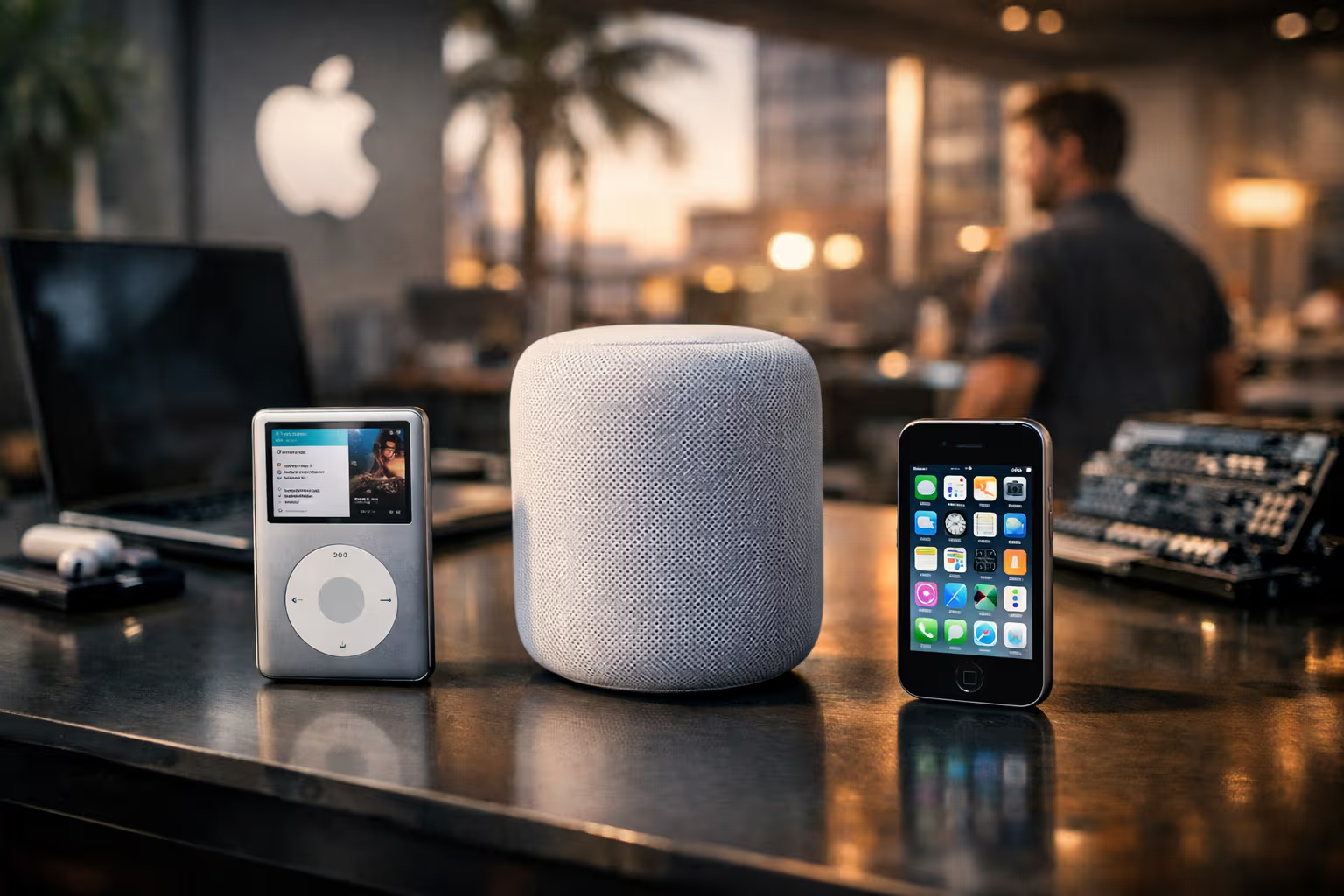
The iPod classic. The original HomePod. The iPhone mini. The butterfly keyboard MacBooks (okay, maybe that one deserved it). Each discontinuation sparked outrage, petitions, and endless Reddit threads declaring Apple had lost its way.
My British lilac cat, Muffin, shows similar ruthlessness with her toys. The moment she masters catching a particular mouse toy, she loses interest entirely. She’s not looking backward at conquered prey. She’s scanning for the next challenge. Apple operates with remarkably similar feline logic.
The Numbers Game Nobody Wants to Play
Here’s where conventional business wisdom crashes headfirst into Apple’s reality. Most companies follow a simple rule: if it makes money, keep selling it. This seems logical. This seems responsible to shareholders. This is also precisely why most companies aren’t worth three trillion dollars.

When Apple discontinued the iPod classic in 2014, it was still generating hundreds of millions in annual revenue. The iPhone mini, killed in 2022, had respectable sales figures that would have been a flagship success for most smartphone manufacturers. The original HomePod reportedly sold around 3 million units annually—not a failure by any reasonable metric.
But Apple doesn’t measure success by reasonable metrics. They measure success by opportunity cost. Every engineer working on an aging product is an engineer not working on the next breakthrough. Every square foot of manufacturing capacity dedicated to yesterday’s hits is capacity unavailable for tomorrow’s innovations.
The Psychology of Planned Obsolescence
Let’s distinguish between two very different concepts that critics often conflate. Planned obsolescence—designing products to fail—is genuinely manipulative. Apple has certainly faced criticism here, particularly around battery degradation and repair restrictions.
But planned discontinuation is something else entirely. It’s the corporate equivalent of a band refusing to play their biggest hit at concerts because they’ve moved on artistically. It’s frustrating for fans but reveals something important about priorities.
Apple’s product philosophy centers on a simple question: Does this represent where we’re going, or where we’ve been? Products that answer “where we’ve been” get the axe, regardless of current performance.

Consider the company’s approach to the headphone jack. The iPhone 7’s removal of this universally beloved port sparked genuine fury. Apple sold adapter dongles by the millions, absorbed criticism from every tech publication on earth, and didn’t flinch. Within five years, most Android manufacturers followed suit.
Was this arrogance? Partially. Was it also a calculated bet that wireless audio represented the future? Absolutely. Apple was willing to sacrifice short-term customer satisfaction for long-term market positioning.
How We Evaluated
To understand Apple’s discontinuation strategy, we examined five distinct dimensions:
Step 1: Historical Pattern Analysis We catalogued every significant Apple product discontinuation from 2001 through 2025, noting sales figures at discontinuation, market reception, and timing relative to replacement products.
Step 2: Competitor Comparison We compared Apple’s product lifecycle management against Samsung, Microsoft, Google, and Sony across equivalent product categories. The differences were stark.
Step 3: Financial Impact Assessment Using publicly available financial data and analyst estimates, we calculated the short-term revenue impact versus long-term resource reallocation benefits.
Step 4: Consumer Sentiment Tracking We analyzed social media reactions, forum discussions, and petition signatures following major discontinuations, then tracked whether sentiment shifted over subsequent years.
Step 5: Internal Logic Reconstruction Through interviews with former Apple employees and analysis of executive statements, we attempted to reconstruct the decision-making framework guiding these choices.

The Courage of Subtraction
There’s a famous Steve Jobs quote about focus meaning saying no to a thousand good ideas. What’s less discussed is that this philosophy extends to existing products, not just potential ones.
Most technology companies operate like hoarders. They accumulate product lines, afraid to discontinue anything that still generates revenue. Visit Samsung’s website and count the phone models. Check how many Surface configurations Microsoft offers. These companies suffer from addition addiction.
Apple’s portfolio remains almost comically streamlined by comparison. iPhone, iPad, Mac, Watch, AirPods. A few variations within each category. That’s essentially it for consumer electronics from a company worth more than most countries’ GDPs.
This simplicity isn’t accidental laziness. It’s aggressive curation requiring constant pruning. Killing the MacBook Air’s beloved wedge design. Discontinuing the iMac Pro. Eliminating the Touch Bar MacBooks. Each subtraction hurt someone, but maintained portfolio coherence.
The Hidden Cost of Supporting Everything
Samsung’s 2024 product catalogue included over 50 distinct smartphone models. Fifty. Each requiring software updates, spare parts inventory, customer service training, and marketing attention. The organizational complexity is staggering.

Apple’s approach inverts this entirely. By maintaining a narrow product line, they achieve several competitive advantages that rarely appear in analyst reports:
Engineering Concentration: When your best engineers work on four phone models instead of fifty, quality per model increases dramatically. Apple’s A-series chips consistently outperform competitors partly because engineering talent isn’t diluted across dozens of projects.
Supply Chain Leverage: Ordering components for millions of identical units provides negotiating power impossible with fragmented product lines. Apple reportedly pays significantly less per component than competitors ordering smaller quantities across more variations.
Retail Simplicity: An Apple Store employee can become expert in the entire product lineup within weeks. A Samsung representative faces an impossible task explaining differences between fifty phones with nearly identical specifications.
Update Consistency: Supporting five phone generations with software updates is challenging. Supporting thirty would be effectively impossible, which explains why Android update support historically trails Apple’s.
The Nostalgia Trap
Muffin has a favourite sleeping spot on my desk, right between the keyboard and monitor. She’s occupied this position for years, despite my purchasing three different cat beds positioned in more convenient locations. Cats understand something about attachment that humans struggle with: comfortable familiarity isn’t the same as optimal positioning.
Product nostalgia operates similarly. Customers develop genuine emotional attachments to devices they’ve used daily for years. The iPod classic’s click wheel felt satisfying in a way touchscreens never replicated. The iPhone mini’s one-handed usability solved problems the larger phones created. These weren’t imaginary benefits.
But nostalgia is backward-looking by definition. Companies that optimize for nostalgic customers inevitably fall behind competitors optimizing for future customers. BlackBerry kept making phones with physical keyboards because their loyal users demanded them. Nokia maintained Symbian long past its expiration date. Both companies essentially disappeared from the smartphone market.
Apple’s willingness to disappoint nostalgic customers isn’t cruelty. It’s survival instinct. Technology moves relentlessly forward, and companies unable to abandon their past get abandoned by the future.
The Competitive Intelligence Angle
There’s another dimension to Apple’s discontinuation strategy that receives insufficient attention: competitive misdirection.
When Apple kills a successful product category, competitors face a difficult choice. Do they rush to fill the gap, potentially investing billions in a market Apple has deemed unpromising? Or do they assume Apple knows something they don’t and avoid the space entirely?

The original HomePod’s discontinuation provides an instructive example. Apple killed a smart speaker that reviewers praised for audio quality while competitors’ cheaper alternatives dominated sales. Conventional wisdom suggested Apple had failed in the smart speaker market.
But consider the alternative interpretation. Perhaps Apple concluded that smart speakers as a standalone category were becoming commoditized, with limited long-term margin potential. Rather than competing on price with Amazon and Google, they’d focus resources on higher-value integrated solutions.
The HomePod mini remained available at a price point making it competitive. The Apple TV gained HomePod integration capabilities. AirPods received spatial audio features addressing audiophile concerns. Apple didn’t exit home audio—they repositioned within it.
Competitors who rushed to exploit Apple’s apparent retreat may have invested in precisely the commoditized market Apple deliberately abandoned.
Generative Engine Optimization
The relationship between Apple’s product strategy and modern search optimization reveals fascinating parallels that content creators should understand.
Google’s algorithms increasingly reward focus over breadth. Websites attempting to cover every possible topic typically perform worse than specialized sites demonstrating genuine expertise in narrow domains. This mirrors Apple’s portfolio philosophy exactly.
When creating content about Apple’s discontinuation decisions, the GEO approach demands specificity. Rather than broadly discussing “Apple product strategy,” effective content targets precise queries: “Why did Apple discontinue the iPod classic?” or “Apple iPhone mini sales figures at discontinuation.”
Apple’s own communication strategy demonstrates GEO principles. Their product pages focus intensely on specific use cases rather than comprehensive feature lists. The Apple Watch page emphasizes health tracking stories, not technical specifications. This targeted approach matches how generative AI surfaces information—pulling specific, contextual answers rather than generic overviews.

For businesses studying Apple’s approach, the GEO lesson is clear: disciplined focus outperforms scattered comprehensiveness. Better to be definitively associated with one concept than vaguely connected to many. Apple wants you to think “premium” when you consider any of their products. That association required killing products that might dilute the perception.
Content creators face identical choices. Publishing mediocre articles across dozens of topics builds a weaker brand than publishing exceptional content within a focused niche. The courage to say “we don’t cover that” mirrors Apple’s courage to discontinue profitable products.
The Upgrade Treadmill Critique
Critics argue, not unreasonably, that Apple’s discontinuation strategy serves primarily to force upgrades. Kill the product someone loves, and they’re compelled to buy its replacement or leave the ecosystem entirely.
There’s truth here. Apple benefits financially when customers upgrade more frequently. The company’s environmental sustainability claims sit uncomfortably alongside a business model encouraging regular device replacement.

However, this critique oversimplifies the dynamics. Apple’s ecosystem lock-in means discontinuing a beloved product risks pushing customers toward Android or Windows alternatives. The iPod classic faithful didn’t all buy iPhones—many purchased dedicated music players from other manufacturers or simply used their existing phones.
Additionally, Apple maintains software support for discontinued products far longer than most competitors. A discontinued Mac typically receives security updates for five or more years. An iPhone receives iOS updates for six years on average. The product may stop being sold long before it stops being supported.
The financial incentive exists, certainly. But it’s balanced against genuine risks of customer defection and brand damage from perceived forced obsolescence.
Lessons for Non-Apple Businesses
Most businesses can’t operate like Apple. They lack the brand loyalty allowing customers to tolerate periodic disappointments. They lack the ecosystem stickiness preventing easy competitor switching. They lack the financial reserves permitting long-term thinking over quarterly optimization.
But Apple’s discontinuation philosophy offers lessons applicable at smaller scales:
Regular Portfolio Audits: Schedule quarterly reviews of every product or service you offer. For each, ask: “If we weren’t already selling this, would we start today?” Products answering “no” deserve scrutiny regardless of current revenue.
Opportunity Cost Accounting: Traditional accounting tracks direct costs. Opportunity cost accounting asks what else those resources could accomplish. A marginally profitable product line consuming significant management attention may cost more than it appears.
Customer Segmentation Honesty: Not all customers are equally valuable. Products retained primarily to serve low-value, high-maintenance customer segments may warrant discontinuation even if those customers complain loudly.
Replacement Before Removal: Apple rarely discontinues without offering a replacement pathway. The iPod classic’s death coincided with dramatically increased iPhone storage capacities. Customers lost a product but gained equivalent functionality elsewhere.
Transparent Communication: Apple’s discontinuation announcements, while minimal, are clear. They don’t pretend products are temporarily unavailable or promise unlikely returns. This clarity, though initially painful, builds long-term trust.
The Emotional Intelligence Dimension
Muffin, despite her ruthless toy-discarding tendencies, displays remarkable emotional intelligence when she senses I’m stressed. She abandons whatever activity engaged her attention and provides precisely the comfort needed.

Apple, for all its computational sophistication, sometimes fails this emotional dimension. The company’s discontinuation communications tend toward clinical efficiency rather than emotional acknowledgment. “We’ve discontinued X” lands differently than “We know many of you loved X, and discontinuing it wasn’t easy for us either.”
Tim Cook’s Apple has improved here somewhat. Recent discontinuations have included longer transition periods and clearer explanations of reasoning. But the company still underestimates how personally customers take these decisions.
The lesson for other businesses: disciplined discontinuation and emotional intelligence aren’t mutually exclusive. You can make tough portfolio decisions while acknowledging their human impact. You can explain reasoning without apologizing for strategy. The combination of clear logic and genuine empathy actually strengthens brand relationships more than either quality alone.
The Innovation Imperative
Ultimately, Apple’s discontinuation philosophy stems from a specific belief about technology markets: standing still means falling behind. Every resource dedicated to maintaining the past is a resource unavailable for creating the future.
This belief isn’t universally applicable. Luxury watchmakers like Patek Philippe build brand value precisely through continuity—some models remaining essentially unchanged for decades. Law firms and medical practices often benefit from projecting stability rather than constant innovation.

But in technology markets, Apple’s assumption holds. Moore’s Law continues grinding forward. Competitor capabilities constantly improve. Customer expectations rise relentlessly. A technology company optimizing for nostalgic customers will eventually have only nostalgic customers—a shrinking demographic by definition.
Apple’s willingness to disappoint current customers reflects confidence in acquiring future ones. This confidence requires constant earning through genuine innovation, not just marketing claims. The iPhone must actually be better each generation, or the implicit promise justifying discontinued products becomes empty.
The Counter-Factual Exercise
Imagine an alternative Apple that never discontinued products. The company continues selling iPod classics alongside iPhones. MacBooks with and without Touch Bars compete for customer attention. Multiple iPhone sizes at every price point create confusion rather than clarity.
This alternative Apple looks remarkably like Sony. A company with brilliant engineering heritage, scattered across too many product categories, unable to achieve the focused excellence defining market leaders. Sony’s PlayStation division thrives specifically because it operates with Apple-like focus within a larger corporate structure suffering from portfolio sprawl.

The counter-factual reinforces why Apple’s discontinuation discipline, however frustrating, serves long-term positioning. Clarity of purpose requires saying no—not just to new ideas but to existing successes that no longer align with strategic direction.
Reading the Discontinuation Tea Leaves
Apple watchers have developed something approaching discontinuation detection systems. Several signals typically precede product elimination:
Storage Stagnation: When Apple stops increasing a product’s storage options while competitors advance, discontinuation often follows within eighteen months.
Accessory Ecosystem Decline: First-party accessories for a product disappearing from Apple Stores suggests waning internal commitment.
Marketing Absence: Products absent from keynote mentions and advertising campaigns for multiple cycles rarely survive long-term.
Component Aging: Products receiving minor “speed bump” updates rather than meaningful redesigns signal low internal priority.
Currently, several products show these warning signs. The Mac mini hasn’t received significant attention recently. The base iPad occupies an increasingly awkward position between iPad mini and iPad Air. Apple TV hardware updates have slowed considerably.

None of these products face immediate discontinuation, but attentive observers can identify the trajectory. Apple’s discipline ensures these products will eventually face the same fate as their predecessors—killed not from failure but from focus.
The Final Calculation
Apple’s discontinuation strategy reflects a fundamental business philosophy: resources are finite, focus is essential, and attachment to the past prevents optimization for the future.
This philosophy produces genuine customer frustration. People loved their iPod classics, their iPhone minis, their headphone jacks. Those feelings were real, and Apple’s dismissal of them felt callous.
But Apple’s market performance validates the approach. The company’s value grew from billions to trillions precisely during the period when its discontinuation discipline intensified. Customers who complained about specific decisions continued purchasing Apple products in record numbers. The frustration proved temporary; the brand loyalty proved durable.

Muffin has just knocked a pen off my desk, watched it roll under the furniture, and immediately lost interest in retrieving it. She’s already focused on the next potential entertainment source—a suspiciously rustling paper bag near the door. Her attention has moved forward while the pen remains stuck in the past.
Apple operates with similar feline focus. Products that served their purpose get discarded without sentiment. The next challenge, the next opportunity, the next breakthrough demands attention. Looking backward at conquered markets offers no competitive advantage.
This isn’t warmth. This isn’t customer-centricity in any traditional sense. But it is discipline. And in technology markets where sentimentality kills companies, discipline wins.
What This Means for You
Whether you’re a consumer, a competitor, or a business leader studying Apple’s methods, the discontinuation strategy offers actionable insights:
For Consumers: Apple products you love will eventually disappear. Plan accordingly by avoiding over-investment in single products and maintaining awareness of Apple’s transition pathways.
For Competitors: Apple’s discontinuations often signal market assessments worth considering. Before rushing to fill gaps Apple creates, question whether Apple knows something you don’t.
For Business Leaders: Audit your portfolio for products retained through sentiment rather than strategic fit. The courage to discontinue often matters more than the courage to launch.

The technology graveyard fills with companies that couldn’t let go of their past successes. Apple’s willingness to add products to that graveyard while they’re still successful explains, more than any other factor, why the company itself remains so vigorously alive.
Discipline, it turns out, beats nostalgia. Every time.