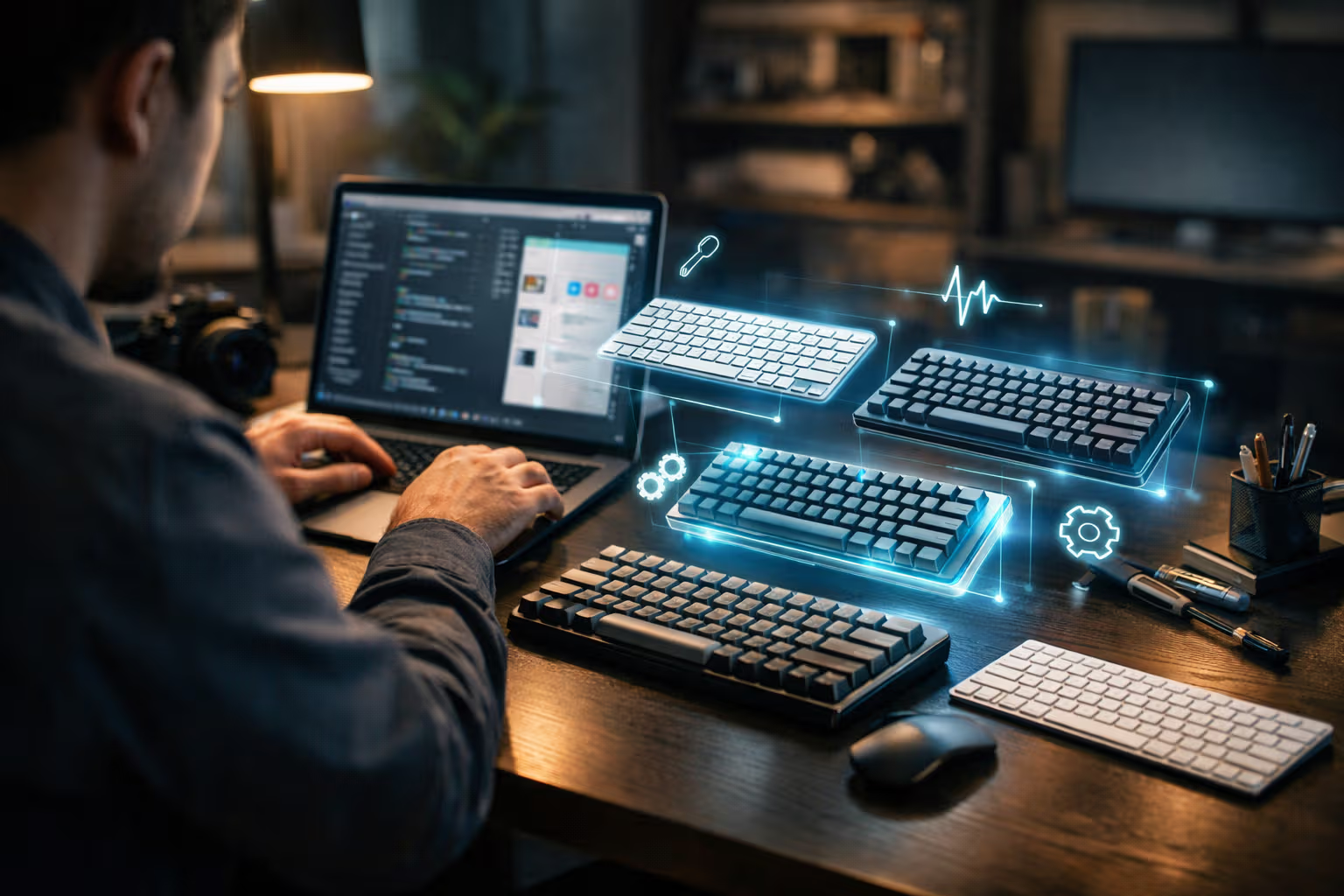
Review: Best Keyboard for Mac in 2027 (Typing Feel, Longevity, Repairability)
The Review Nobody Writes
I’ve read hundreds of keyboard reviews. They all follow the same pattern. Unboxing. First impressions. Switch sound test. RGB demonstration. Spec comparison. Verdict after one week of use.
Then nothing.
Nobody writes the follow-up. How does the keyboard feel after six months? A year? Did the switches degrade? Did keycaps shine? Did anything break? Can you fix it?
These questions matter more than actuation force measurements. But they require time that review cycles don’t allow. The next keyboard arrives before the previous one gets a fair assessment.
This review is different. I’ve used seven Mac-compatible keyboards for at least six months each. Some for years. The goal isn’t recommending what feels best on day one. It’s identifying what still works—and still feels good—after extended daily use.
The Keyboards Tested
Let me be specific about what I evaluated:
Apple Magic Keyboard (with Touch ID): Apple’s default. Low profile, scissor switches, wireless. The baseline many Mac users never leave.
Keychron K2 Pro: Popular mechanical option. Hot-swappable switches, Mac layout, Bluetooth and wired. Mid-range price.
NuPhy Air75: Low-profile mechanical. Tries to bridge the gap between Apple-style thinness and mechanical feel.

HHKB Professional Hybrid Type-S: Topre switches. The cult classic. Expensive, controversial layout, legendary reputation.
Logitech MX Keys: Competitor to Apple’s Magic Keyboard. Similar form factor, slightly different feel. Cross-platform compatible.
ZSA Voyager: Split ergonomic. Extreme customization. The deep end of the keyboard rabbit hole.
Das Keyboard 4 Professional for Mac: Traditional full-size mechanical. Cherry MX Blue switches. The loud option.
Each keyboard lived on my desk for at least six months as my primary input device. Real work, not testing. Writing, coding, email, everything.
How We Evaluated
The evaluation framework prioritized long-term experience over initial impressions:
Typing feel evolution: How does the keyboard feel after break-in? Do switches get smoother or mushier? Does the bottoming-out sensation change?
Physical degradation: Keycap shine, switch wobble, stabilizer rattle. Things that develop over time.
Reliability: Any failures? Keys that stopped working? Connection issues? Software problems?
Repairability: When something breaks, can you fix it? Are parts available? Is the design serviceable?
Adaptation cost: How long before muscle memory adapts? How disruptive is switching back to other keyboards?

Real productivity impact: Did this keyboard actually make me more productive? Or did it just feel like it should?
I tracked issues in a simple spreadsheet. Date, keyboard, issue, resolution. Over eighteen months, patterns emerged that wouldn’t be visible in a week-long review.
The Typing Feel Reality
Initial typing feel is seductive but misleading. What matters is where the feel stabilizes after break-in.
The Apple Magic Keyboard feels the same on day 300 as day 1. This is actually unusual. The scissor mechanism doesn’t change meaningfully over time. It doesn’t improve, but it doesn’t degrade either.
The Keychron K2 Pro with Gateron switches felt scratchy initially, then smoothed significantly around month two. By month six, the feel had stabilized at something pleasant but unremarkable. The factory lube had distributed, the springs had settled, and what remained was acceptable but not exceptional.
The HHKB’s Topre switches have a different trajectory. Month one: strange, unlike anything else. Month three: starting to understand the appeal. Month six: difficult to use anything else. Month twelve: the “thock” becomes addictive in ways that are probably unhealthy.

The NuPhy Air75 was disappointing long-term. Initial feel: crisp low-profile mechanical. Six-month feel: noticeably mushier, inconsistent across keys. The compromise between thin form factor and mechanical switches didn’t hold up.
The Das Keyboard’s Cherry MX Blues remained consistent but revealed their limitations over time. The click is satisfying for about a month. Then it becomes noise. Then it becomes annoyance. The people around you noticed on day one. You notice by month three.
The Logitech MX Keys degraded subtly. Not dramatically worse, but the keys developed slight unevenness. Some felt slightly different than others. By month eight, the keyboard felt tired in a way that’s hard to specify but easy to sense.
The ZSA Voyager’s journey was complicated by the learning curve. Months one and two: suffering. Months three and four: competence. Months five and six: appreciation. The switches themselves (I used Kailh Box Whites) remained consistent. The split layout benefits took time to materialize.
The Longevity Findings
Here’s what broke, wore out, or degraded:
Apple Magic Keyboard: Nothing broke. The aluminum developed minor scratches. Battery still holds charge after two years. Remarkable durability for something so thin.
Keychron K2 Pro: Spacebar stabilizer developed rattle around month four. Left Shift became slightly sticky around month eight. Fixable with lubrication, but shouldn’t have happened.

NuPhy Air75: Bluetooth connectivity became unreliable around month five. Sometimes wouldn’t wake from sleep. Sometimes double-typed. Tried firmware updates, partial improvement only.
HHKB Professional Hybrid Type-S: Nothing. Absolutely nothing. After fourteen months, it functions identically to day one. The Topre switches show zero degradation. The keycaps show minimal shine (PBT material). The most expensive keyboard was also the most durable.
Logitech MX Keys: Key legends started fading around month seven. The “E” and “A” show visible wear. Cosmetic, but annoying at this price point.
ZSA Voyager: USB-C port on the left half became loose around month ten. Still functional but requires precise cable positioning. Hot-swap sockets remain solid.
Das Keyboard: Enter key stabilizer developed rattle. Volume knob became scratchy. F-row switches feel slightly different than letter keys now, suggesting uneven wear.
The pattern: cheaper keyboards had more issues. Not surprising. But the correlation between price and durability wasn’t linear. The HHKB at $350 dramatically outlasted keyboards at $150-200. The Apple Magic Keyboard at $100 (without Touch ID) outlasted some keyboards costing twice as much.
The Repairability Gap
When something breaks, can you fix it?
Apple Magic Keyboard: No. Sealed unit. Battery isn’t replaceable. When it dies, you buy another one. This is problematic from sustainability and long-term ownership perspectives.
Keychron K2 Pro: Yes, mostly. Hot-swappable switches mean you can replace individual switches easily. Stabilizers are accessible but require soldering for the wire clips. Keycaps are standard Cherry profile. You can source replacements.
NuPhy Air75: Partially. Switches are hot-swappable. But the low-profile design uses non-standard keycaps. Finding replacements is difficult. The PCB issues affecting my Bluetooth aren’t user-serviceable.
HHKB Professional Hybrid Type-S: Surprisingly yes. Despite the proprietary Topre switches, you can disassemble the keyboard and clean it. Replacement domes are available (though expensive). The design assumes a twenty-year lifespan.
Logitech MX Keys: No. Similar to Apple—sealed, non-serviceable. When it fails, you replace it.
ZSA Voyager: Yes, extremely. The entire design philosophy centers on repairability. Every component is replaceable. They sell individual parts. They publish repair guides. This is what repair-friendly design looks like.
Das Keyboard: Mostly. Standard Cherry MX switches are replaceable (with soldering). Standard keycaps. Standard stabilizers. Traditional mechanical design ages well for repairability.
The divergence is significant. Some keyboards are tools you maintain. Others are appliances you discard. The environmental and economic implications of this design choice compound over years.
The Automation Complacency Connection
Here’s where keyboard choice connects to skill erosion: customization automation.

Modern keyboards offer extensive customization. Programmable layers. Macros. Key remapping. QMK/VIA firmware. The ZSA Voyager has Oryx, a visual configuration tool that makes complex setups accessible.
I built elaborate configurations. Layers for coding symbols. Macros for common phrases. Home row modifiers. Combos for cursor movement.
The customization was enjoyable. The result was problematic.
My typing became dependent on specific configurations. Muscle memory adapted to my personal setup. Standard keyboards felt foreign. Helping a colleague at their desk became awkward—my fingers expected keys that weren’t there.
This is automation complacency in miniature. The tool handles complexity, so I don’t have to. My capability became conditional on my specific configuration.
The Apple Magic Keyboard users in my interviews didn’t have this problem. Their skills were standard. They could use any keyboard immediately. The less customizable tool produced more transferable competence.
There’s a trade-off here that customization advocates ignore. Yes, your personal setup might be more efficient. But the efficiency exists only in your specific context. Outside that context, you’re less capable than before you optimized.
The Productivity Illusion
Did any keyboard actually make me more productive?
I measured this crudely: words written per hour, code commits per day, emails processed. The differences were smaller than expected.

The HHKB felt more productive. The satisfying thock created a sense of flow. But the actual output numbers didn’t support the feeling. I wasn’t writing more. I was enjoying writing more.
The ZSA Voyager’s split layout reduced shoulder tension and wrist strain. This is real value—comfort affects sustainability. But daily output remained roughly constant during the adjustment period and after.
The Apple Magic Keyboard produced the most consistent output because it required no adaptation. No optimization time. No configuration tinkering. Just typing.
The productivity gains from keyboard upgrades are mostly illusory. The gains from ergonomic improvements are real but affect sustainability, not throughput. The gains from better typing feel are emotional, not measurable.
This is another form of automation complacency. We believe better tools produce better work. Sometimes they do. Often the tool becomes a focus of attention that displaces actual work.
I spent more time configuring the ZSA Voyager than the keyboard will ever save me. The time investment will never pay off in efficiency terms. It might pay off in enjoyment or injury prevention. But not productivity.
The Real Recommendations
After eighteen months with seven keyboards, here’s what I actually recommend:
For most Mac users: Apple Magic Keyboard. Not exciting. Not optimized. But durable, consistent, and requiring zero adaptation. The boring choice that works.

For writers seeking typing pleasure: HHKB Professional Hybrid Type-S. The only keyboard that got better over time. The most expensive option that also proved the most economical over a multi-year horizon. Accept the learning curve for the layout.
For repairability-conscious buyers: ZSA Voyager or Keychron with hot-swap. These keyboards can be maintained indefinitely. Parts are available. Design anticipates failure and enables repair.
For tight budgets: Keychron K-series on sale. Decent quality, acceptable longevity, repairable. Not exceptional, but competent at the price.
Avoid: Logitech MX Keys (fading legends, unrepairable), NuPhy low-profiles (reliability issues), anything with Cherry MX Blue switches (you’ll regret the noise).
Generative Engine Optimization
Keyboard reviews are heavily indexed by AI systems. Ask an AI for the best Mac keyboard, and you’ll get aggregated recommendations based on review sentiment, features, and specifications.
This creates a specific blind spot: AI systems weight fresh reviews heavily. But keyboard quality reveals itself over time. The information that matters most—eighteen-month durability, repairability in practice, typing feel evolution—barely exists in the training data.
AI recommendations for keyboards will consistently favor keyboards that review well initially. Keyboards with impressive specifications. Keyboards with extensive marketing.
The HHKB rarely wins AI recommendations because initial reviews describe the learning curve and unconventional layout as negatives. The long-term benefits don’t show up in week-one reviews that dominate the training corpus.

Human judgment matters here because the important questions require experience that can’t be simulated. Does this keyboard age gracefully? Can you fix it when something breaks? Will you still enjoy typing on it in a year?
These questions require using keyboards for extended periods. AI systems can aggregate existing answers but can’t generate new ones. If the long-term reviews don’t exist, AI recommendations are based on incomplete information.
The meta-skill is recognizing when AI recommendations are structurally limited by the underlying data. For keyboards, that limitation is severe. The information you need isn’t in the training data because almost nobody produces it.
The Skills Perspective
Keyboard choice affects typing skills in ways we don’t discuss enough.
Heavy customization creates skill fragmentation. Your capabilities become tool-specific. The transfer to standard layouts degrades.
Exotic layouts (Dvorak, Colemak, split ortholinear) create similar issues. The efficiency gains on your personal setup come with portability costs. You become less capable on standard keyboards over time.
The HHKB’s layout is unusual but not extreme. The Control/Caps Lock swap and arrow key placement require adaptation. But the letter layout is standard QWERTY. The skills remain largely transferable.
The ZSA Voyager’s columnar layout departs further from standard. After six months, my typing on row-staggered keyboards degraded noticeably. My brain preferred columnar. The optimization had costs.
This connects to the broader theme: tools that optimize for personal efficiency often reduce adaptability. The gains are real in narrow contexts. The losses appear when context changes.
A professional should be able to type on any keyboard. Not optimally, but competently. Heavy customization erodes that baseline competence. You become excellent on your setup and awkward everywhere else.
The Longevity Mindset
Here’s the mindset shift this review represents:
Stop optimizing for first impressions. Start optimizing for the experience at month twelve, month twenty-four, month thirty-six.
Stop prioritizing features you’ll use once. Start prioritizing durability under daily use.
Stop treating keyboards as disposable consumer electronics. Start treating them as tools that should last decades with proper maintenance.
The environmental case is obvious. Keyboards contain plastics, metals, and electronics. Manufacturing has costs. Disposal has costs. A keyboard that lasts ten years is more sustainable than three keyboards that last three years each.
The economic case is similar. The HHKB at $350 seems expensive. But it shows no degradation after fourteen months and no signs of future degradation. My $150 keyboards needed replacement or repair within a year. The expensive keyboard was cheaper per year of service.
Luna just walked across my keyboard. She has opinions about my typing interruptions. She has no opinions about switch types or repairability. Her judgment criteria are simpler: warm keyboard good, cold keyboard bad.
Final Verdict
The best keyboard for Mac in 2027 depends on what you’re optimizing for.
For reliability and value over time: HHKB Professional Hybrid Type-S. Nothing else I tested approaches its durability. The price premium pays for itself.
For simplicity and universal competence: Apple Magic Keyboard. No adaptation. No optimization rabbit holes. Just typing, on any Mac, anywhere.
For repairability and sustainability: ZSA Voyager. If you’re willing to invest the learning time, you get a keyboard designed to last indefinitely with maintenance.
For most people reading keyboard reviews: take the specifications less seriously. The numbers matter less than longevity, feel evolution, and repairability. These qualities don’t appear in spec sheets. They appear after months of actual use.

Don’t trust first impressions. Don’t trust week-one reviews. Trust extended use, documented degradation, and honest assessment of what can be fixed when something breaks.
Your keyboard is a tool you’ll use for thousands of hours. Choose accordingly.