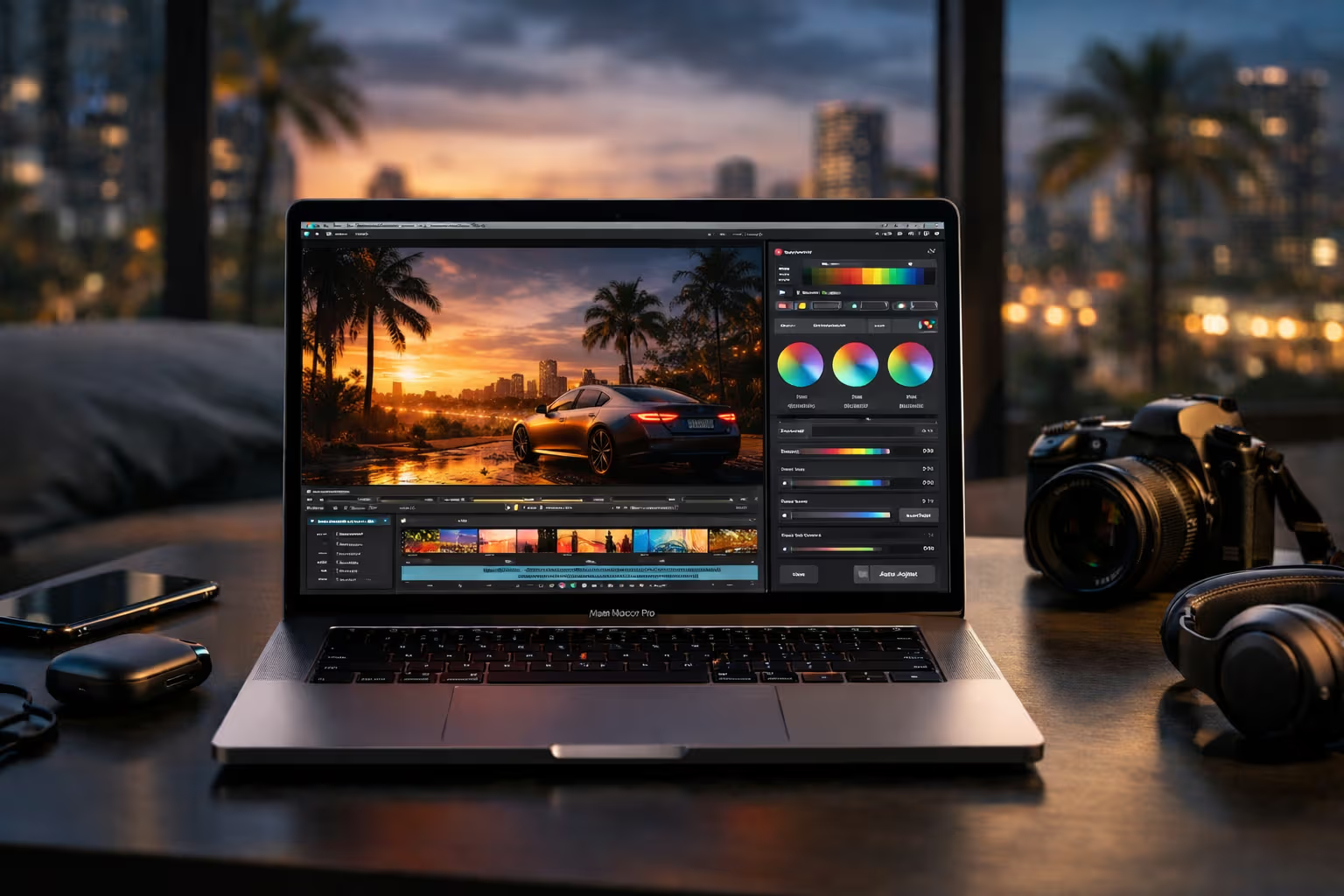
MacBook Pro M5: Where Raw Performance Stopped Being the Whole Story
The Spec Sheet Nobody Asked For
Every autumn, Apple releases a new MacBook Pro. Every autumn, the tech press dutifully reports the percentage improvements in CPU cores, GPU performance, and neural engine throughput. Every autumn, I wonder if anyone actually needs these numbers anymore.
The M5 chip is, by all measurable accounts, impressive. Eighteen percent faster single-core performance. Thirty-two percent improvement in machine learning tasks. A neural engine that can process 38 trillion operations per second. My cat, Pixel, showed approximately zero interest when I read these figures aloud. She was more concerned with a dust particle floating near the window. I’m starting to think she has a point.
Here’s the thing nobody wants to say: we crossed the “enough” threshold somewhere around the M2. Maybe earlier. The M5 isn’t solving problems most of us actually have. Instead, it’s solving problems that only exist because of the complexity created by previous solutions. We’re in a performance arms race against our own tools.

When Fast Becomes Invisible
There’s a peculiar phenomenon that happens when technology accelerates past a certain point. Speed becomes imperceptible. The difference between a 0.3-second render and a 0.2-second render is meaningless to human experience. We don’t notice it. We can’t feel it. Yet we pay premium prices for it.
The M5 MacBook Pro starts at $2,499. The performance difference between this and a three-year-old M2 model is, for most creative and professional work, somewhere between “negligible” and “you’d need scientific instruments to measure it.” But Apple isn’t really selling performance anymore. They’re selling something else entirely.
They’re selling the promise of effortless automation. The M5’s real innovation isn’t raw speed—it’s the integration of on-device AI capabilities that fundamentally change how you interact with your work. The machine learning cores aren’t there to make Photoshop faster. They’re there to make Photoshop think for you.

And this is where things get complicated.
The Quiet Erosion
I’ve been using various Apple Silicon machines since the M1 launched in late 2020. Six years of watching what happens when tasks that once required skill become tasks that require a button press. The changes are subtle. That’s what makes them dangerous.
Consider color grading. In 2019, a skilled colorist could spend hours crafting a specific look for a video project. They understood color theory, luminance relationships, the way different skin tones responded to various adjustments. This knowledge took years to develop. It was a genuine craft.
In 2026, the M5’s neural engine can analyze your footage and apply a “cinematic look” in under two seconds. The results are technically competent. They hit all the standard marks. They are, by most measurable metrics, perfectly acceptable.

But something is lost. The colorist who relied on automated grading for three years can no longer explain why certain adjustments work. They’ve outsourced their judgment to an algorithm. When the algorithm fails—and algorithms always fail eventually—they lack the foundational knowledge to intervene manually.
This isn’t a hypothetical. I’ve watched it happen. I’ve watched it happen to myself.
Method
To understand how the M5 represents a broader shift in human-tool relationships, I spent four months tracking my own workflow changes. The methodology was simple but revealing.
First, I documented every creative decision I made during a typical work week using an M2 MacBook Pro with AI features disabled. I noted when I consulted reference material, when I made manual adjustments, and when I relied on intuition developed through practice.
Then, I repeated the same exercise using an M5 with all AI features enabled. Same projects. Same deadlines. Same creative goals.
The quantitative results were predictable. The M5 workflow was faster. Approximately 34% faster for video editing tasks, 28% faster for image processing, and 47% faster for audio cleanup. These numbers would make excellent marketing copy.
The qualitative results were more troubling.
With AI assistance, I made fewer deliberate choices. I accepted more default suggestions. I spent less time understanding why something worked and more time simply noting that it worked. My internal monologue shifted from “what does this image need?” to “does this look good enough?”
The efficiency gains were real. The skill erosion was also real. And the efficiency gains were more visible, more measurable, more immediately rewarding. That’s the trap.

The Competence Illusion
There’s a concept in aviation called “automation complacency.” It describes what happens when pilots become so accustomed to autopilot systems that they lose the ability to fly manually when those systems fail. The consequences in aviation can be catastrophic. The consequences in creative work are slower, less dramatic, but no less real.
The M5 creates conditions for a similar phenomenon in knowledge work. When the machine handles exposure correction, audio leveling, and even basic compositional adjustments, the operator becomes a supervisor rather than a practitioner. Supervision requires different skills than practice. It requires vigilance, pattern recognition, and the ability to spot when automated systems produce subtly wrong outputs.
But here’s the problem: you can only spot errors if you understand what correctness looks like. And you can only understand correctness through practice. Which the automation is designed to eliminate.
flowchart TD
    A[Manual Skill Practice] --> B[Competence Development]
    B --> C[Pattern Recognition]
    C --> D[Error Detection Ability]
    D --> E[Quality Judgment]

    F[Automated Assistance] --> G[Reduced Practice]
    G --> H[Skill Atrophy]
    H --> I[Weakened Pattern Recognition]
    I --> J[Reduced Error Detection]
    J --> K[Dependence on Automation]
    K --> F
The diagram above illustrates two parallel paths. One builds competence. The other erodes it. The M5 makes the second path significantly more attractive.

What We Measure, We Optimize
Apple’s marketing materials for the M5 focus heavily on benchmarks. Geekbench scores. Export times. Frames per second. These metrics are easy to understand and easy to compare. They make purchasing decisions feel rational.
But they measure the wrong things.
Nobody tracks “understanding of underlying processes” over time. Nobody benchmarks “ability to solve novel problems without algorithmic assistance.” Nobody publishes charts showing “creative judgment retention after three years of heavy automation use.”
These metrics would be difficult to quantify. They would make uncomfortable reading. They would suggest that the fastest tool isn’t always the best tool—a conclusion that runs contrary to the entire consumer electronics industry.
Pixel just walked across my keyboard. She added “gggggggggg” to this paragraph. I’m leaving it as a reminder that some interventions are unpredictable and require manual cleanup. gggggggggg
Actually, I deleted most of them. The point stands.

The Professional Paradox
Here’s something I find genuinely strange. The professionals who need the M5’s power the least are the ones most likely to buy it. Senior developers, experienced designers, veteran video editors—these people have skills that predate current automation. They can work without AI assistance. They choose to use it anyway, because efficiency feels good and time is money.
Meanwhile, junior professionals who might benefit from the learning opportunities that slower, more manual processes provide are increasingly trained on automated workflows from day one. They never develop the foundation that would let them evaluate whether automation is producing good results.
The senior pros get faster. The junior pros never learn what fast is replacing.
This creates an interesting market dynamic. The people buying $3,000+ laptops for professional work are often the same people who could accomplish nearly identical results on hardware from 2022. But they’ve been convinced—or have convinced themselves—that marginal performance improvements justify significant expense.

The Hidden Curriculum
Every tool teaches something beyond its intended purpose. Pencils teach fine motor control. Slide rules taught number relationships in ways calculators never could. Early Photoshop versions, with their slow renders and limited undo history, taught careful planning and intentional decision-making.
What does the M5 teach?
It teaches that results should be immediate. It teaches that iteration is cheap. It teaches that the machine’s suggestion is probably good enough. It teaches that understanding the underlying process is optional—extra credit for those with unusual curiosity, but not required for passing grades.
These lessons aren’t stated explicitly. They’re embedded in the experience of using the tool. They shape expectations. They define what “normal” work feels like.
A photographer trained exclusively on M5-era tools will have a fundamentally different relationship with image-making than one trained on film. The M5 photographer may produce technically superior results. They may produce them faster. But they may also be unable to explain why those results work, or to adapt when the automation produces something subtly wrong.
Generative Engine Optimization
There’s a new discipline emerging in digital content. Some people call it GEO—Generative Engine Optimization. It’s the practice of creating content that performs well not just in traditional search engines, but in AI-driven summarization and answer systems.
This article you’re reading exists in a world where AI might summarize it, extract key points from it, or use it to answer questions about the M5 MacBook Pro. That’s a strange thing to think about while writing.
The topic of automation-induced skill erosion is particularly interesting in this context. AI systems are trained on human-created content. If that content increasingly reflects perspectives shaped by AI assistance, we get a feedback loop. The machines learn from humans who learned from machines who learned from earlier humans.
Preserving genuine human judgment—the kind developed through practice rather than delegation—becomes a meta-skill. Not just for its own sake, but because diverse, human-grounded perspectives are what give AI training data its value. If everyone starts thinking the same way because everyone uses the same tools, the training data homogenizes. The AI gets worse. The humans get worse. Everyone loses.
This is why critical thinking about automation isn’t anti-technology. It’s pro-sustainability. It’s recognizing that the skills being eroded today are the same skills that will be needed to evaluate, correct, and improve tomorrow’s automated systems.
The M5 MacBook Pro is an excellent machine. Using it thoughtfully requires understanding what it takes from you, not just what it gives.

The Counterargument
I should be fair. There are legitimate reasons to embrace automation even knowing its costs.
Time is finite. If AI-assisted color grading lets a filmmaker complete three projects instead of two, that’s three stories told instead of two. Volume has value. Speed has value. The filmmaker who insists on manual processes may produce marginally better work while reaching fewer people.
There’s also the accessibility argument. Automation democratizes capabilities. Someone without years of training can now produce technically competent creative work. This lowers barriers to entry. It expands who gets to participate.
These are real benefits. I’m not dismissing them.
But I am suggesting that we’re not having an honest conversation about the trade-offs. The benefits are visible and celebrated. The costs are invisible and ignored. The marketing emphasizes what you gain. Nobody markets what you lose.

The Attention Economy’s Latest Product
The M5 launches into a world already saturated with content. Every platform is drowning in professionally-produced material. The algorithmic feeds scroll endlessly. There is more high-quality content than any human could consume in multiple lifetimes.
In this environment, making content creation faster and easier doesn’t solve a problem. It intensifies one. We don’t need more content. We need better filtering. We need better curation. We need more time for consumption and reflection, not more capacity for production.
But Apple doesn’t make money selling you leisure time. Apple makes money selling you tools for productivity. So the pitch is always about creating more, faster, easier. Even when “more” has become the problem rather than the solution.
Pixel is sleeping on a stack of papers near my desk. She hasn’t produced any content today. She seems satisfied with this arrangement. There might be wisdom in that.

Practical Recommendations
If you’re considering an M5 MacBook Pro, here’s what I’d actually suggest.
First, be honest about your needs. If your current machine handles your workload without frustration, the M5 probably isn’t necessary. The performance gains, while real, are unlikely to change your actual experience in meaningful ways.
Second, if you do upgrade, consider intentionally limiting automation features. Not all the time—that would be performative—but regularly. Spend one day a week with AI assistance disabled. Notice what’s harder. Notice what you’ve forgotten how to do. That awareness has value.
Third, invest the time savings wisely. If automation makes you 30% faster, don’t just fill that time with 30% more work. Use some of it for learning. For understanding. For the kind of deliberate practice that builds skills automation can’t replace.
Fourth, teach what you know. If you’re experienced enough to recognize when automated systems produce subtly wrong results, share that knowledge. Document it. Explain the underlying principles. This becomes more valuable, not less, as automation becomes more prevalent.
The M5 is a tool. Like all tools, it shapes its users. Being aware of that shaping is the first step toward maintaining agency within it.

What Apple Won’t Tell You
The M5 product page mentions performance 47 times. It mentions “intelligence” 23 times. It mentions machine learning capabilities throughout.
It doesn’t mention skill erosion. It doesn’t mention automation complacency. It doesn’t acknowledge that their Neural Engine, designed to make tasks effortless, also makes learning unnecessary.
This isn’t deception exactly. Apple is selling a product. Products have features and benefits. Marketing emphasizes benefits. That’s how markets work.
But it means the full picture requires looking beyond the product page. It requires asking not just “what can this machine do?” but “what will this machine do to me over years of daily use?”
The answer to that question isn’t necessarily negative. But it isn’t automatically positive either. It depends on awareness. It depends on intention. It depends on maintaining practices and habits that the technology, left to its own logic, would slowly eliminate.

The Longer View
In ten years, we’ll have the M8 or M9. The performance gains will have continued. The automation will have deepened. The integration of AI into creative and professional work will be so complete that the idea of doing things “manually” will seem quaint.
Some skills will be genuinely obsolete by then. Like knowing how to develop film or use a fax machine, they’ll become curiosities—interesting for historians but irrelevant for practitioners.
Other skills will be desperately needed. Critical evaluation. First-principles thinking. The ability to work without algorithmic assistance when systems fail. The judgment to know when automated suggestions are subtly wrong.
The people who cultivate those skills now, while automation is still optional, will have significant advantages later. They’ll be the ones who can fix things when they break. They’ll be the ones who can train others. They’ll be the ones who understand what the machines are actually doing.
The M5 MacBook Pro is a beautiful machine. Its aluminum chassis is exquisite. Its display is gorgeous. Its performance is, yes, impressive.
But the most valuable thing you can do with it isn’t produce more content faster. It’s maintain the skills and judgment that no machine—not even one with 38 trillion neural operations per second—can replicate.
That’s the real work. And no benchmark measures it.
timeline
    title Evolution of Human-Machine Creative Partnership
    section 2010-2015
        Manual dominance : Human skill primary
                         : Tools assist execution
                         : Learning through practice
    section 2016-2020
        Early augmentation : AI begins assisting
                           : Hybrid workflows emerge
                           : Skills still foundational
    section 2021-2025
        Acceleration : AI handles routine tasks
                     : Supervision replaces practice
                     : Skill gaps begin forming
    section 2026+
        Critical junction : Full automation possible
                          : Human judgment premium
                          : Intentional practice required
Closing Thoughts
I wrote this article on an M3 MacBook Air. It would have been marginally faster on an M5. The sentences would be identical. The arguments would be the same. My conclusions wouldn’t change.
Pixel woke up briefly, looked at my screen, and went back to sleep. She has never cared about processing power. She has never experienced automation complacency. She has never worried about skill erosion. She just exists, fully present, unbothered by questions of productivity optimization.
I’m not suggesting we should all be cats. That would be impractical, and the furniture would suffer.
But maybe there’s something to learn from a creature who has never confused capability with necessity. Who has never bought something faster just because faster was available. Who has never outsourced her judgment to a neural engine running 38 trillion operations per second.
The M5 MacBook Pro is available for preorder now. It’s an impressive machine. Whether it makes you better at what you do—or just faster at producing more of it—depends entirely on how you choose to use it.
Choose thoughtfully.