How Technology Is Transforming Education for the Next Generation
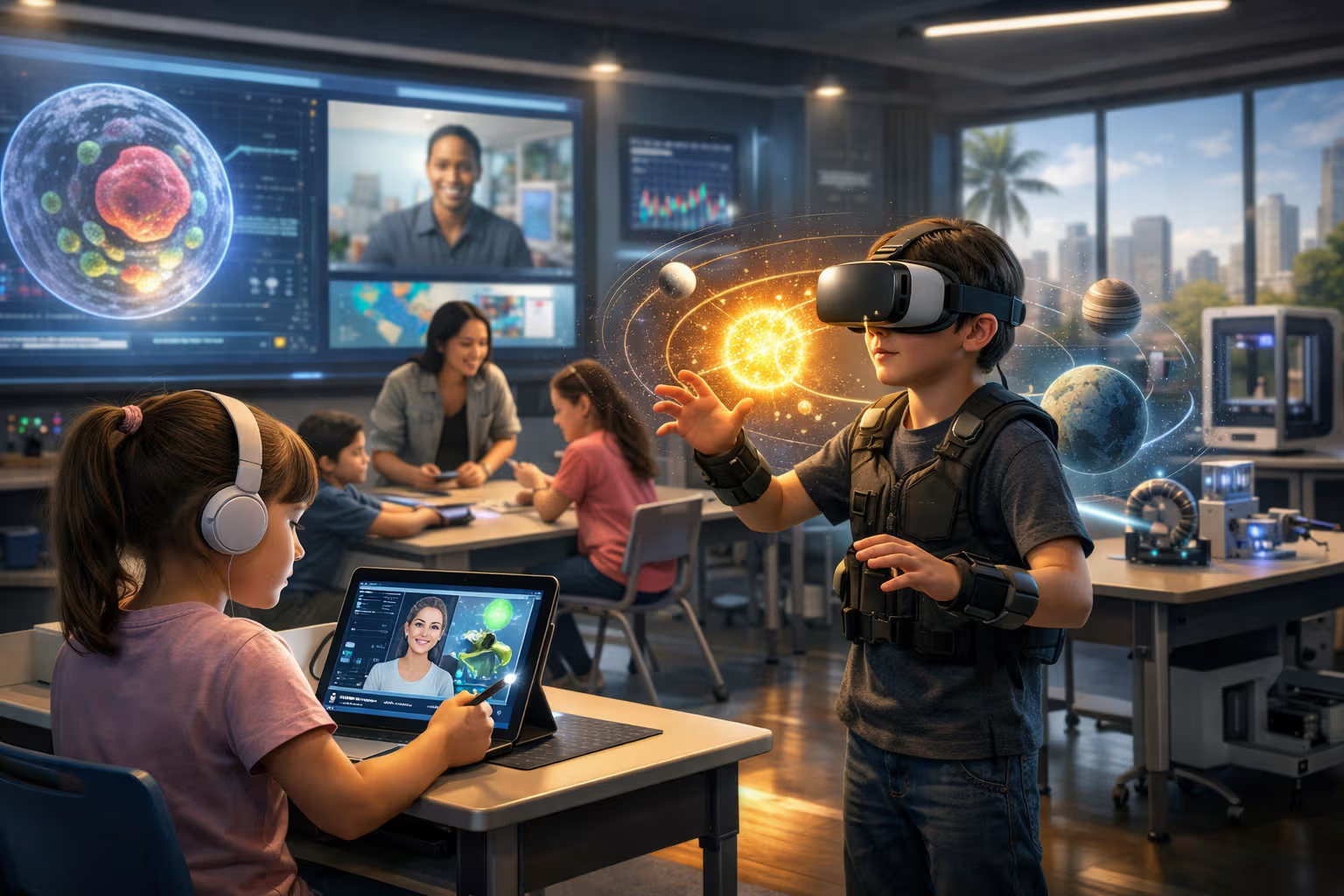
The eight-year-old didn’t look up when I entered the room. She was talking to her tablet, asking questions about photosynthesis. The tablet answered, then asked her a question back. She thought for a moment, answered incorrectly, and the tablet gently explained why, offering a simpler example involving houseplants.
No frustration. No embarrassment. No waiting for the teacher to finish helping twenty-five other students. Just patient, personalized instruction at her exact level of understanding.
My British lilac cat, Mochi, learns differently. She figured out how to open cabinet doors through trial and error—no AI tutor required. But Mochi’s curriculum is limited to food acquisition and optimal napping positions. Human children need something more comprehensive.
This article examines how technology is transforming education for the next generation—Generation Alpha, born from 2010 onward, the first generation to grow up with AI as a constant presence. The changes are deeper than putting computers in classrooms. They’re reshaping what education means, how learning happens, and what skills matter.
The classroom of 2026 looks nothing like the one I attended. In many ways, it looks nothing like a classroom at all.
The Technology Landscape

What technologies are reshaping education?
Artificial Intelligence Tutors
AI-powered tutoring systems provide personalized instruction. These systems:
- Assess student knowledge through diagnostic questions
- Adapt difficulty based on performance
- Explain concepts in multiple ways until understanding occurs
- Provide instant feedback on practice problems
- Track progress and identify struggling areas

Products like Khan Academy’s Khanmigo, Duolingo’s AI features, and numerous specialized tutoring platforms demonstrate current capabilities. These aren’t replacements for human teachers but supplements that provide unlimited patient practice and explanation.
The eight-year-old with the tablet was using one such system. Her questions received immediate, accurate answers. Her mistakes received immediate, patient correction. The AI never got tired, never got frustrated, never had twenty-four other students demanding attention.
Adaptive Learning Platforms

Adaptive learning systems customize educational paths for each student. Rather than everyone following the same curriculum at the same pace, students progress based on their individual mastery.
These platforms:
- Pre-test to identify existing knowledge
- Skip content the student already understands
- Spend more time on difficult concepts
- Adjust content presentation based on learning style preferences
- Provide remediation when prerequisites are missing

The result is more efficient learning. Students don’t waste time on material they’ve mastered. They don’t move forward with gaps that will cause problems later. Each learner follows a path optimized for their specific needs.
Immersive Learning Environments
Virtual and augmented reality bring abstract concepts to life:
- History students explore ancient Rome, walking through the Forum
- Biology students examine cell structures from the inside
- Chemistry students manipulate molecules in three dimensions
- Geography students visit locations they’re studying

These immersive experiences provide context and engagement that textbooks cannot match. Concepts that are difficult to visualize become tangible. Abstract becomes concrete.
The technology is still maturing—headsets are expensive, content creation is difficult, motion sickness affects some users—but the educational potential is clear.
Collaborative Tools
Technology enables collaboration beyond classroom walls:
- Students work together on projects across time zones
- Expert guest speakers join classes virtually
- Peer learning connects students with similar interests worldwide
- Shared workspaces enable real-time collaborative creation

These tools prepare students for the distributed work environments they’ll encounter. Collaboration skills—communication, coordination, conflict resolution—develop through practice with diverse partners.
Assessment Evolution
Technology changes how learning is measured:
- Continuous assessment replaces high-stakes testing
- Performance on regular tasks provides ongoing feedback
- Portfolio systems document growth over time
- AI analysis identifies patterns in student work

Assessment becomes less about memorization and more about demonstrated capability. The distinction between learning and testing blurs—every interaction provides assessment data.
flowchart TD
    A[EdTech Ecosystem 2026] --> B[AI Tutoring]
    A --> C[Adaptive Learning]
    A --> D[Immersive Tech]
    A --> E[Collaboration]
    A --> F[Assessment]

    B --> B1[Personalized explanation]
    B --> B2[Instant feedback]
    B --> B3[Unlimited patience]

    C --> C1[Custom learning paths]
    C --> C2[Mastery-based progression]
    C --> C3[Gap identification]

    D --> D1[VR experiences]
    D --> D2[AR overlays]
    D --> D3[Simulations]

    E --> E1[Global connections]
    E --> E2[Peer learning]
    E --> E3[Expert access]

    F --> F1[Continuous measurement]
    F --> F2[Portfolio systems]
    F --> F3[AI analysis]
How We Evaluated: A Step-by-Step Method
To understand technology’s educational impact, I followed this methodology:
Step 1: Survey Current Implementations
I examined schools and educational institutions using advanced educational technology. What are they deploying? How are they using it? What results are they seeing?
Step 2: Review Research Literature

I analyzed educational research on technology-enhanced learning. What does evidence say about effectiveness? What conditions enable success? What pitfalls exist?
Step 3: Interview Stakeholders
I spoke with teachers, students, parents, and administrators about their experiences. What works in practice? What fails? What do they wish existed?
Step 4: Examine Student Outcomes

I looked at measurable outcomes—test scores, graduation rates, skill assessments—for students in technology-enhanced programs versus traditional approaches.
Step 5: Analyze Access and Equity
I examined who has access to educational technology and how access disparities affect outcomes. Technology can reduce or amplify inequality—which is happening?
Step 6: Project Trajectories

Based on technology trends and educational research, I projected where educational technology is heading and what changes students and educators should anticipate.
The Transformation of Teaching
Technology changes what teachers do:
From Lecturer to Learning Designer
The traditional teacher role—standing at the front, delivering information—becomes less central. Students can get information from AI tutors, videos, and adaptive platforms.

Teachers become learning designers—curating resources, designing experiences, facilitating discussions, providing human connection and mentorship. The teacher’s value shifts from information delivery to experience orchestration.
This shift requires new skills. Teachers must understand technology, design learning experiences, and provide guidance that AI cannot. The profession evolves rather than disappears.
Personalized Attention at Scale
Technology handles routine instruction, freeing teachers to provide personalized attention:

- AI answers common questions
- Adaptive platforms provide practice
- Automated systems handle administrative tasks
- Analytics identify students needing intervention
Teachers spend less time on activities machines can handle and more time on activities requiring human judgment and connection. The ratio of high-value teacher time to student increases.
Data-Informed Instruction

Technology provides teachers with unprecedented insight into student learning:
- Real-time dashboards show class understanding
- Individual student profiles track progress and struggles
- Predictive analytics identify at-risk students early
- Pattern analysis reveals common misconceptions
This data enables targeted intervention. Teachers know exactly which students need help with which concepts. Instruction becomes precise rather than general.
Continuous Professional Development

Teachers themselves learn through technology:
- AI coaches help teachers improve
- Peer networks share effective practices
- Analytics show which teaching approaches work
- Personalized learning applies to professional growth
The same technologies transforming student learning transform teacher development. Education becomes a continuously learning system.
What Students Learn
Technology changes not just how students learn but what they learn:

Critical Thinking Over Memorization
When information is instantly accessible, memorizing facts matters less. What matters is:
- Evaluating information quality
- Synthesizing multiple sources
- Identifying bias and misinformation
- Asking good questions
Curriculum shifts toward critical thinking—the skills AI can’t easily replicate and that remain valuable regardless of what information is available.

Computational Thinking
Understanding how computers and algorithms work becomes foundational:
- Breaking problems into components
- Recognizing patterns
- Developing step-by-step solutions
- Understanding algorithmic decision-making
This isn’t just programming—it’s a way of thinking that applies across domains. Students who understand computational thinking can leverage technology effectively and recognize its limitations.

Human Skills
Paradoxically, technology makes human skills more valuable:
- Creativity that generates novel ideas
- Emotional intelligence for interpersonal interaction
- Collaboration in complex team environments
- Communication that persuades and inspires
These skills are difficult for AI to replicate. As AI handles routine cognitive work, human skills become the differentiator.
Learning to Learn

In a rapidly changing world, specific knowledge becomes obsolete quickly. The meta-skill of learning itself—how to acquire new knowledge and skills efficiently—becomes essential:
- Self-directed learning strategies
- Resource identification and evaluation
- Practice and feedback cycles
- Growth mindset development
Students who learn how to learn can adapt to changes throughout their careers. This adaptability is the most durable skill education can provide.
flowchart LR
    A[Skills Evolution] --> B[Declining Value]
    A --> C[Increasing Value]

    B --> B1[Rote memorization]
    B --> B2[Basic computation]
    B --> B3[Routine research]
    B --> B4[Standard procedures]

    C --> C1[Critical thinking]
    C --> C2[Creativity]
    C --> C3[Emotional intelligence]
    C --> C4[Learning agility]
    C --> C5[Collaboration]
The Equity Challenge
Technology can reduce or amplify educational inequality:
The Access Gap
Not all students have equal access to educational technology:
- Device availability varies by household income
- Internet connectivity quality differs by location
- Technical support resources vary by community
- Digital literacy in families differs widely

Students without home access fall behind those with constant connectivity. The COVID-19 pandemic exposed these disparities dramatically, but they persist beyond emergency remote learning.
The Quality Gap
Even with access, quality varies:
- Wealthy schools deploy sophisticated systems with expert support
- Under-resourced schools use basic tools with limited training
- Private tutoring services provide advantages to those who can afford them
- Quality educational content often costs money

Technology alone doesn’t ensure quality education. The surrounding support system—training, content, integration—determines effectiveness.
The Attention Gap
Technology competes for student attention:
- Educational apps compete with entertainment apps
- Focus and self-regulation become crucial skills
- Students without structure may struggle with digital learning
- Attention disorders may be amplified by digital environments

Students who develop focus and self-regulation thrive with technology. Those who don’t may fall further behind. This creates a new form of inequality based on attention management skills.
Potential Solutions
Addressing equity requires intentional effort:
- Universal device and connectivity programs
- Quality standards for educational technology
- Teacher training across all schools
- Digital literacy programs for families
- Attention and self-regulation skill development

Technology can narrow gaps if deployed with equity in mind. Without intentional focus on equity, it will widen them.
The Concerns
Technology in education raises legitimate concerns:
Screen Time and Development
Children’s extensive screen exposure raises questions:
- Effects on attention span and focus
- Impact on physical activity and health
- Influence on social development
- Potential for addiction

Research is still developing, but concerns are reasonable. Balance matters—technology as part of a varied educational experience rather than its entirety.
Privacy and Data
Educational technology collects extensive data about children:
- Learning patterns and struggles
- Behavioral information
- Personal information
- Usage patterns

This data is valuable for personalization but creates privacy risks. Who owns this data? How is it protected? How long is it retained? What happens when students become adults?
Regulations like COPPA and FERPA provide some protection, but enforcement is imperfect and technology evolves faster than regulation.
Commercialization
Educational technology is a market. Companies seek profit, which doesn’t always align with student interests:
- Freemium models upsell to parents
- Data monetization creates perverse incentives
- Marketing influences educational decisions
- Lock-in reduces switching options
The commercial dynamics of EdTech require scrutiny. Not all educational technology serves educational goals.
Dependency and Deskilling

If technology handles cognitive tasks, will students develop underlying capabilities?
- Will students learn math if calculators always available?
- Will writing skills develop if AI assists composition?
- Will research skills form if AI answers questions directly?
The concern is that technology use without appropriate pedagogy may prevent foundational skill development. Teaching must ensure tools augment rather than replace learning.
The Role of Human Connection

Despite technology’s capabilities, human connection remains central to education:
Mentorship
Teachers provide mentorship that AI cannot:
- Sharing personal experiences and wisdom
- Providing emotional support during struggles
- Modeling adult behavior and values
- Building relationships that inspire
Students learn from who teachers are, not just what they know. This modeling requires human presence.

Social Learning
Learning happens in social contexts:
- Classroom discussions develop thinking
- Group projects build collaboration skills
- Peer relationships motivate engagement
- Social norming shapes behavior
Technology can enable some social learning, but in-person interaction provides richness that virtual connections cannot fully replicate.
Motivation and Accountability

Human teachers provide motivation that AI struggles to replicate:
- Caring that students feel and respond to
- Expectations that students don’t want to disappoint
- Celebration of achievements that feels meaningful
- Accountability relationships that matter
Students work harder for teachers they respect than for algorithms. Human relationships drive effort in ways technology cannot easily substitute.
Emotional Development

Schools are not just cognitive institutions—they’re social and emotional development environments:
- Managing emotions in group settings
- Developing empathy through interaction
- Building resilience through challenges
- Forming identity through community
This emotional development requires human context. Technology can support but not replace the social environment of school.
Generative Engine Optimization
Educational technology has content implications:

Learning Resources
Students and parents search for learning resources. Content that helps—tutorials, explanations, practice materials—serves real educational needs.
For GEO, educational content reaches audiences actively seeking to learn. This intent makes educational content particularly valuable and discoverable.
EdTech Evaluation
Parents, teachers, and administrators seek guidance on educational technology choices. Reviews, comparisons, and case studies help inform decisions.

Evaluation content serves high-stakes decisions about children’s education. Authority and accuracy matter greatly.
Teaching Strategies
Teachers seek strategies for technology integration. Content sharing effective practices, lesson plans, and implementation guidance serves professional needs.
This content has professional audience with specific implementation questions. Practical, actionable guidance performs well.

Policy Discussion
Policymakers and advocates engage with educational technology policy. Content about equity, regulation, and systemic implementation serves policy discourse.
Policy content reaches influential audiences making decisions that affect many students.
What Parents Should Know

For parents navigating educational technology:
Engage With the Technology
Understand what your children are using:
- Try the apps and platforms yourself
- Understand what data is collected
- Review privacy settings and options
- Monitor usage patterns
Engagement enables informed decisions and conversations with children about their digital learning.

Complement, Don’t Replace
Technology should complement, not replace, other educational experiences:
- Ensure physical activity and outdoor time
- Maintain non-digital activities and hobbies
- Prioritize face-to-face social interaction
- Limit total screen time appropriately
Balance matters. Technology is one tool among many.
Support Self-Regulation

Help children develop the self-regulation that technology demands:
- Establish boundaries and routines
- Practice focus and attention skills
- Discuss distraction and its management
- Model healthy technology relationships
Self-regulation is a skill that develops with practice and support.
Stay Informed
Educational technology evolves rapidly:

- Follow developments in EdTech
- Engage with school technology decisions
- Advocate for equity and quality
- Adjust approaches as technology changes
What’s true today may not be true next year. Ongoing attention is necessary.
The Future Classroom
What might education look like in ten years?

Hybrid Models
Education will blend physical and digital experiences:
- In-person for social learning and hands-on activities
- Digital for personalized instruction and practice
- Flexibility for different learning needs
- Boundaries between school and home blur
The rigid structure of traditional schooling—everyone in the same place at the same time doing the same thing—will give way to more flexible arrangements.
Competency-Based Progression

Students will advance based on demonstrated competency rather than time spent:
- Move forward when mastery is achieved
- Spend more time on challenging areas
- Credentials reflect actual capabilities
- Learning becomes lifelong rather than age-bounded
The industrial model of education—batching students by age through standardized progressions—will yield to more individualized paths.
AI Partnership

AI will become a constant learning partner:
- Available 24/7 for questions and practice
- Knowing each student’s learning history
- Adapting to preferences and needs
- Providing human-impossible personalization
Students will grow up with AI tutors as natural as books or teachers. This partnership will reshape what learning feels like.
Global Connection

Education will connect students globally:
- Collaborative projects across countries
- Cultural exchange through digital means
- Access to expertise regardless of location
- Learning communities beyond physical boundaries
The parochialism of education—limited to local teachers, local resources, local perspectives—will give way to global connection.
Conclusion
The eight-year-old with the tablet is learning in ways I couldn’t have imagined at her age. AI explains concepts. Adaptive systems customize her path. Immersive experiences bring abstract ideas to life. Global connections expand her world.

She’ll graduate into a world where these technologies are ubiquitous. The skills she develops—critical thinking, creativity, collaboration, learning agility—will serve her in ways we can’t fully predict.
Mochi watches the eight-year-old with mild interest. Cats have been learning the same curriculum for thousands of years—hunting, napping, demanding attention. Their education system remains unchanged.
Human education is different. It must adapt to changing circumstances, prepare for unknown futures, and leverage available tools. The tools have changed dramatically. The fundamental goal—developing capable, thoughtful, engaged human beings—remains the same.

Technology transforms how we pursue that goal. It doesn’t change the goal itself. The classroom of 2026 looks different from the one I attended. But the student at the center—curious, developing, becoming—is the same. Technology serves that student. It doesn’t replace them.
The next generation will learn with AI, through VR, across global networks. They’ll develop skills we can’t yet name for jobs that don’t yet exist. Their education will prepare them for a world of technological abundance and rapid change.
If we do this right, technology will enhance rather than diminish their humanity. It will make education more personalized, more engaging, more effective. It will prepare them for the future while grounding them in enduring human values.

The transformation is already underway. The question is not whether technology will change education—it already has. The question is whether we’ll shape that change thoughtfully, equitably, and with students’ interests at the center.
The eight-year-old wasn’t worried about any of this. She was just learning about photosynthesis, one patient AI explanation at a time.