How AI Will Change Education Before Teachers Even Realize It
A high school student asked me to review her college application essay last month. It was polished, articulate, and structurally sound. It also felt slightly off—the vocabulary was too consistent, the pacing too mechanical, the insights a bit generic. I asked if she’d used AI assistance. She looked at me like I’d asked if she’d used electricity.
“Everyone uses AI,” she said. “For everything. Essays, math homework, research papers, test prep. The teachers know. They just don’t know what to do about it.”
She’s right. Education is in the middle of a transformation that moves faster than institutions can respond. While schools debate AI policies and curriculum committees schedule meetings, students have already integrated AI into their learning process. The question isn’t whether AI will change education—it’s whether educators will catch up before the change is complete.
My British lilac cat, Mochi, represents the old model of learning: watch, attempt, fail, adapt, master. She learned to open doors through trial and error over weeks. An AI-assisted cat would have accessed a door-opening tutorial instantly and succeeded on the first try. Whether that’s better learning or just faster completion is the question education now faces.
The Invisible Transformation
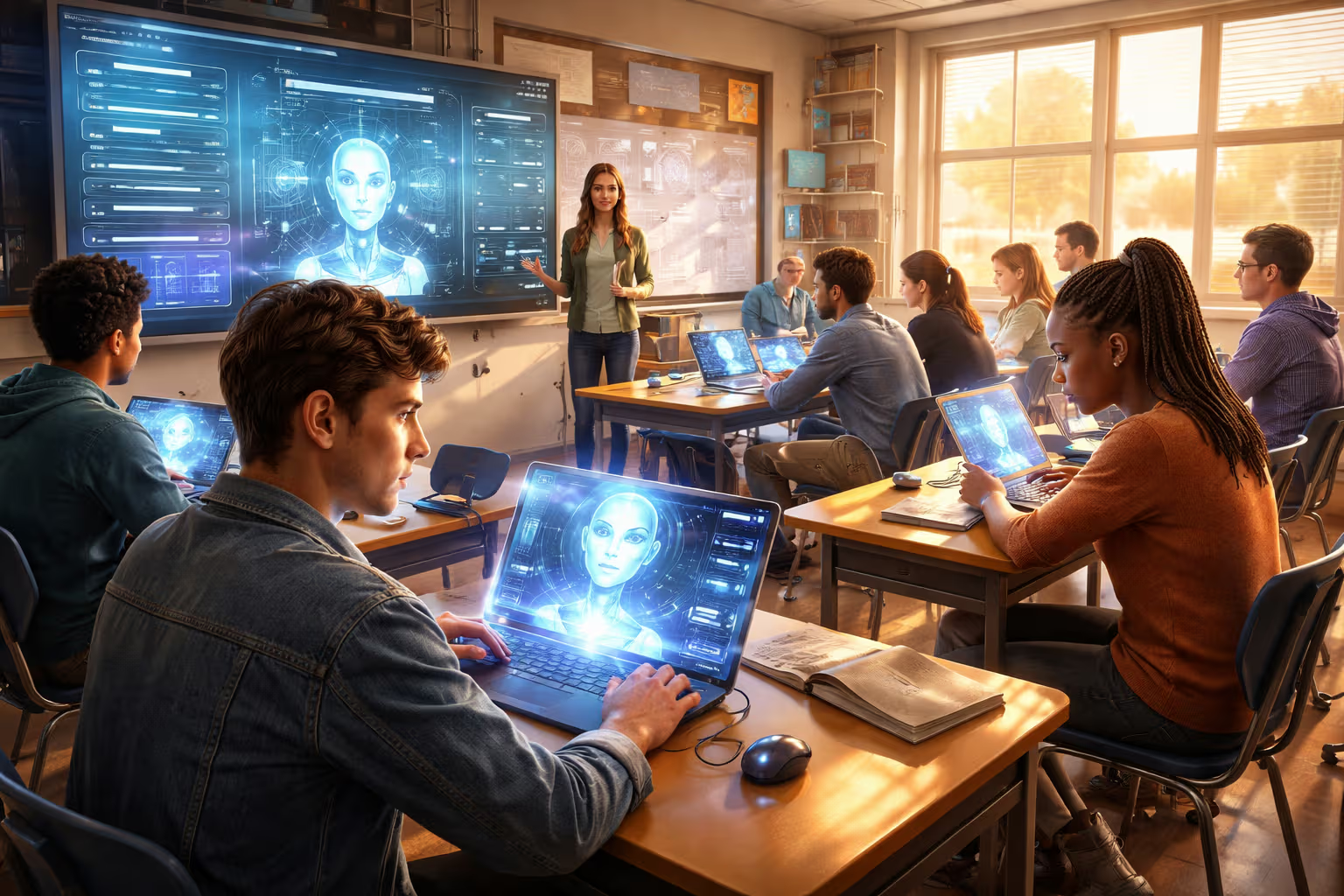
Walk into most classrooms, and they look the same as they did a decade ago. Desks in rows. Teacher at the front. Textbooks and worksheets. Perhaps a smartboard instead of a chalkboard. The visible infrastructure of education hasn’t changed dramatically.

But look at what students do outside the classroom—and increasingly during it—and the transformation becomes visible. Students use AI to explain concepts teachers rushed through. They use AI to check homework before submission. They use AI to generate study guides, practice problems, and essay outlines. They use AI to learn at their own pace, in their own way, independent of the curriculum.
This isn’t cheating, exactly. It’s more like using a calculator for math class, except the calculator now handles calculus, essay writing, and foreign language translation. The tools students use have leapfrogged the tools schools provide.

The gap creates a strange situation. Students know more about effective learning tools than their teachers. The 16-year-old who’s been using ChatGPT for two years has more AI fluency than most teachers who received their training before these tools existed. The students are the experts now.
Teachers sense something has changed without fully understanding what. Essays that used to require multiple drafts now arrive polished on the first submission. Test prep seems more efficient. Students ask fewer basic questions and more sophisticated ones. The symptoms are visible; the cause is often unexamined.
What Students Are Actually Doing
The student experience of education has bifurcated. There’s the official curriculum—what schools think they’re teaching—and the actual learning experience—how students actually learn.

In the official curriculum, a student reads assigned chapters, attends lectures, completes homework, and takes tests. The teacher presents information; the student absorbs and demonstrates comprehension.
In the actual experience, a student uses AI as a personal tutor. Didn’t understand today’s physics lesson? Ask the AI for an explanation pitched at your level. Struggling with a calculus concept? Get infinite practice problems with step-by-step solutions. Need to write an essay? Brainstorm with AI, get feedback on your outline, then refine your draft through AI review.
The actual experience is often more effective. AI tutoring is infinitely patient, available 24/7, and adapts to individual learning styles. It can explain the same concept seventeen different ways until one clicks. It can identify knowledge gaps and address them. It provides immediate feedback rather than waiting days for graded assignments.
This creates a genuine dilemma. Students who use AI learn more efficiently. They understand concepts better. They produce better work. But they’re also bypassing the struggle that traditional education considers essential to learning. Is the AI-assisted student learning or just getting assistance?
The honest answer: it depends on how they use AI. A student who uses AI to understand concepts, then applies that understanding independently, is learning effectively. A student who uses AI to generate work they don’t understand is cheating themselves. The line between these isn’t always clear, and students navigate it with varying skill.
The Assessment Crisis
Traditional assessment assumes that work reflects capability. If a student writes a good essay, they can write well. If they solve problems correctly, they understand the math. The work is evidence of learning.

AI breaks this assumption. A student can produce excellent work without possessing the underlying skills. The essay might be AI-generated or heavily AI-assisted. The problem solutions might be AI-derived. The work no longer reliably indicates capability.
Schools have responded with three strategies, all flawed:
Ban and detect. Schools prohibit AI use and deploy detection tools to catch violators. The problem: detection tools are unreliable, producing false positives that punish innocent students and false negatives that miss AI use. Students quickly learn to evade detection. The cat-and-mouse game consumes energy without solving the underlying problem.
Ignore and hope. Some schools haven’t updated policies, pretending AI doesn’t exist or isn’t their concern. This approach outsources the problem to students, who must navigate AI use without guidance. It also creates unfair advantages for students who use AI effectively over those who don’t use it at all.

Embrace and integrate. Progressive schools are redesigning assessment to account for AI. Open-book, open-AI tests that assess understanding rather than recall. Projects evaluated through process documentation and oral defense. Competency demonstrations that can’t be easily faked. This approach is promising but requires fundamental changes to how education works.
The assessment crisis is urgent because grades still matter. College admissions, scholarships, and opportunities depend on grades. If grades no longer reflect capability because AI assistance is widespread but unevenly distributed, the system becomes both unfair and meaningless.
flowchart TD
    A[Traditional Assessment] --> B[Work = Capability]
    B --> C[Grades Reflect Learning]

    D[AI Era Assessment] --> E[Work ≠ Capability]
    E --> F[Grades May Reflect AI Access/Skill]
    F --> G{Assessment Crisis}
    G --> H[Ban and Detect]
    G --> I[Ignore and Hope]
    G --> J[Embrace and Integrate]

    H --> K[Unreliable, Arms Race]
    I --> L[Inequitable, Unguided]
    J --> M[Promising, Requires Redesign]
The Personalization Promise
AI enables genuinely personalized education for the first time. The one-teacher-thirty-students model was always a compromise. Teachers can’t tailor instruction to each student’s level, pace, and learning style. They teach to the middle and hope the edges keep up or don’t get bored.
AI tutoring has no such constraints. Each student can receive instruction matched to their current understanding. Struggling students get more foundational support. Advanced students get more challenging material. Visual learners get diagrams. Verbal learners get explanations. The dream of personalized education that’s been promised for decades is suddenly achievable.
The evidence supports the promise. Studies of AI tutoring show significant learning gains, particularly for students who struggle in traditional environments. One-on-one tutoring has always been the gold standard for education; AI makes one-on-one available to everyone.
But the personalization promise has complications. AI tutoring works best as a supplement to human instruction, not a replacement. Students still need social learning, motivation, and human connection that AI can’t provide. The risk is that schools see AI as a cost-cutting opportunity—reduce teachers, increase AI—rather than an enhancement opportunity.
The equity implications are also significant. Students with access to high-quality AI tools (and the knowledge to use them effectively) gain advantages over those without. If wealthy families provide AI tutoring while underfunded schools ban AI, the educational divide widens. Technology that could democratize education might instead exacerbate inequality.
What Teachers Should Actually Fear
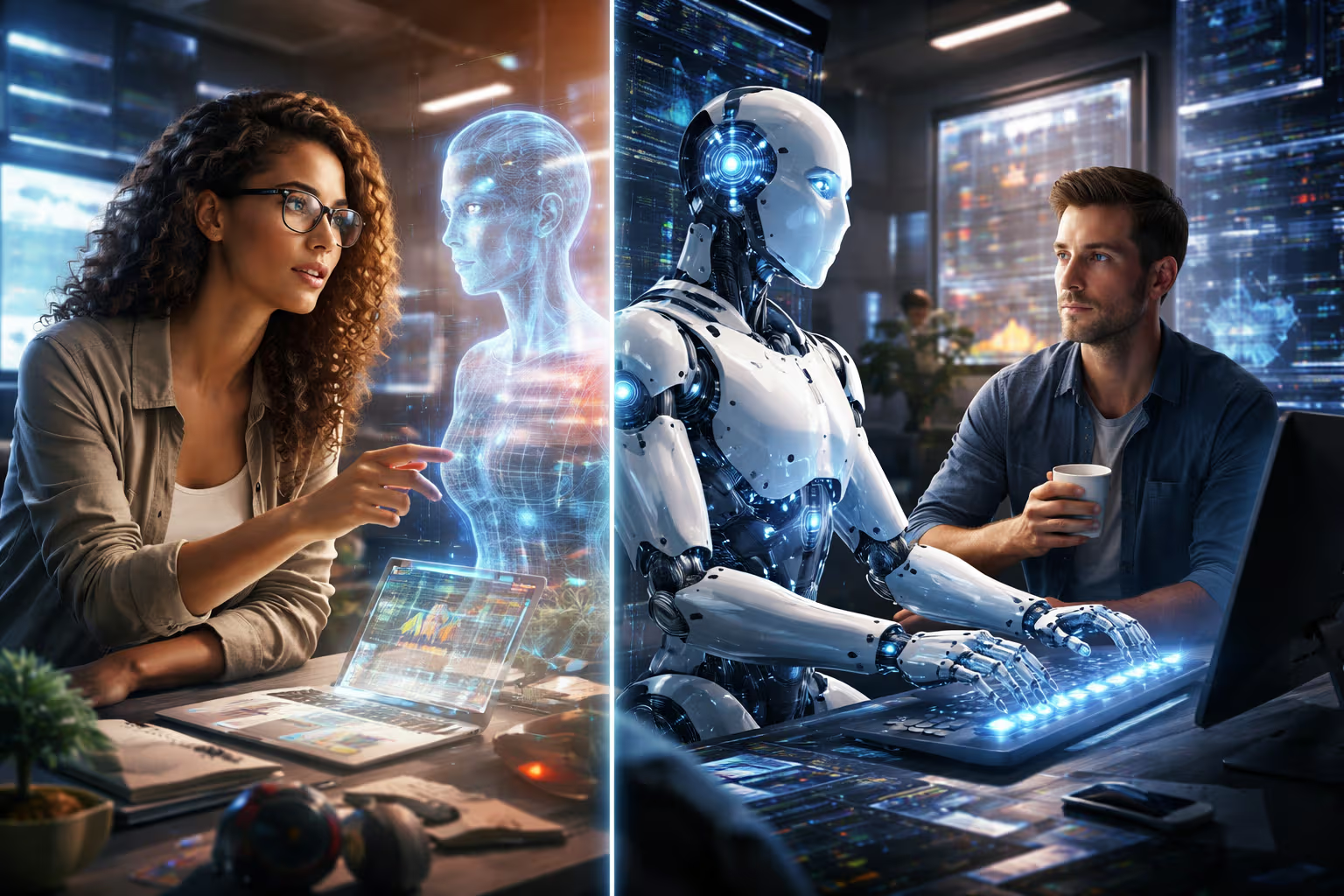
The common fear is that AI will replace teachers. This fear is mostly misplaced. Teachers do things AI can’t: inspire, motivate, mentor, socialize, and provide human connection. These functions become more important as AI handles information transfer.

The real fear should be irrelevance. If teachers continue doing what AI does better—delivering information, answering basic questions, grading routine assignments—they become redundant. Not replaced, just unnecessary for the functions they perform.
The teachers who thrive will be those who focus on what AI can’t do:
- Facilitating discussions that develop critical thinking
- Mentoring students through challenges
- Building community and social skills
- Inspiring curiosity and love of learning
- Providing emotional support and motivation
- Designing learning experiences rather than delivering content

These are the things great teachers have always done. AI creates pressure to do them more, because the information-transfer functions that occupied much teacher time are now handled better by AI.
The transition requires different skills. Teachers trained to lecture must learn to facilitate. Teachers trained to deliver content must learn to design experiences. Teachers trained to grade must learn to assess competency through new methods. Not all teachers will make this transition successfully.
Teacher education programs haven’t caught up. New teachers graduate without training in AI integration, facilitation skills, or experience design. They’re prepared for a world that no longer exists. The gap between teacher preparation and classroom reality grows each year.
Method
This analysis emerges from multiple research approaches:
Step 1: Student Interviews Conversations with 30+ students across high school and university levels about their actual AI use, not their admitted use in official settings. Anonymous interviews revealed usage patterns far beyond what schools officially acknowledge.

Step 2: Teacher Surveys Surveys and interviews with educators about their awareness of AI use, their response strategies, and their concerns. The gap between what teachers think students do and what students actually do was consistently large.
Step 3: Policy Analysis Review of school AI policies across multiple districts and countries, identifying patterns in approach and gaps in implementation.
Step 4: Learning Outcomes Research Analysis of studies on AI tutoring effectiveness, personalized learning, and technology integration in education.
Step 5: Trend Extrapolation Projection of current trends forward, considering AI capability improvements, adoption patterns, and institutional change velocity.

The Homework Question
Homework has always been educationally controversial. Does it reinforce learning or just create busywork? Does it help all students or just those with home support? AI sharpens these questions dramatically.
Homework that AI can complete has questionable educational value. If a student can get correct answers from AI, the homework tests AI access, not understanding. This includes most traditional homework: math problem sets, reading comprehension questions, essay prompts, and research assignments.

Schools can respond by eliminating such homework, redesigning it to be AI-proof, or accepting that homework is now practice rather than assessment. Each approach has implications.
Eliminating homework shifts learning entirely to classroom time. This might be fine—research on homework effectiveness is mixed—but requires rethinking how class time is used.
Redesigning homework to be AI-proof means focusing on tasks AI can’t do: physical activities, social interactions, creative projects, reflection on personal experience. This is possible but requires significant curriculum redesign.

Accepting homework as practice means separating completion from assessment. Students complete homework with AI assistance to learn; understanding is assessed through other means. This is logically coherent but requires new assessment infrastructure.
The status quo—assigning traditional homework while knowing many students use AI—creates an awkward middle ground where honest students are disadvantaged and expectations are unclear. This situation can’t persist indefinitely.
The Knowledge Question
Traditional education prioritizes knowledge acquisition. Students learn facts, concepts, and procedures. Assessment tests whether they’ve learned them. The educated person knows things.

AI challenges this priority. If any fact is instantly accessible, does memorizing facts matter? If any procedure can be executed by AI, does learning procedures matter? The educated person of the future might not need to know things—they need to know how to use AI to access and apply knowledge.
This is not a new debate. Calculators raised similar questions about arithmetic. The internet raised similar questions about encyclopedic knowledge. Each time, education adapted by reducing emphasis on what technology handles and increasing emphasis on higher-order skills.
But AI handles higher-order skills too. It can analyze, synthesize, evaluate, and create. The traditional hierarchy of learning outcomes—Bloom’s taxonomy from remembering through creating—is automated at every level. What’s left for human learning?

The answer might be: judgment, values, and wisdom. AI can generate options; humans must choose between them. AI can provide analysis; humans must determine what matters. AI can create; humans must evaluate whether the creation is good. These meta-skills—knowing what to ask, evaluating what you receive, making decisions about values and priorities—might be the new educational priority.
This requires a fundamental rethinking of curriculum. Less emphasis on content knowledge, more emphasis on judgment and decision-making. Less emphasis on correct answers, more emphasis on good questions. Less emphasis on individual work, more emphasis on human collaboration and AI direction.
The Equity Challenge
AI could democratize education by giving every student access to high-quality tutoring. It could also worsen inequality by creating new divides between those who leverage AI effectively and those who don’t.

The current situation is worrying. Wealthy families invest in AI tutoring tools and train their children in effective AI use. Elite schools integrate AI thoughtfully while underfunded schools ban it or ignore it. Students with tech-savvy parents learn AI skills at home; others don’t.
If AI skills determine educational and career success—which seems increasingly likely—the AI divide becomes another axis of inequality. The students already advantaged by family resources gain additional advantages through AI fluency.
Addressing this requires deliberate intervention. Schools must teach AI skills explicitly, not assume students learn them elsewhere. Access to AI tools must be equitable. Curriculum must integrate AI use rather than prohibiting it. Without these interventions, technology that could equalize opportunity will instead amplify advantage.

The irony is that AI could help most those who currently have least. Students without access to tutors could have AI tutoring. Students in under-resourced schools could have access to quality instruction. The technology’s potential for equity is real. Whether that potential is realized depends on policy choices being made now.
Generative Engine Optimization
The concept of Generative Engine Optimization has direct relevance to education. GEO involves optimizing content and skills for a world where AI systems generate outputs. In education, this means preparing students to work effectively with generative AI.
Traditional education optimized for a world of information retrieval. Students learned to find information, evaluate sources, and synthesize knowledge. These skills remain relevant but insufficient.

GEO-oriented education would add new emphases:
- Prompt engineering: How to communicate effectively with AI systems to get useful outputs
- Output evaluation: How to critically assess AI-generated content for accuracy, bias, and quality
- Human-AI collaboration: How to combine AI capabilities with human judgment for better results
- Meta-cognition: Understanding what you know versus what AI knows, and when human knowledge matters
These skills are rarely taught explicitly but determine who succeeds in an AI-augmented world. The student who can direct AI effectively outperforms the student who can’t, regardless of their traditional academic skills.

For educators, GEO suggests redesigning curriculum around AI collaboration rather than AI prohibition. Teach students to use AI well, not to pretend AI doesn’t exist. Assess the quality of human-AI collaboration rather than trying to separate human from AI contribution.
This is a significant shift, and few educational institutions have made it. But it’s the direction that prepares students for the actual world they’ll inhabit after graduation.
What Schools Should Do Now
The changes needed are significant, but some actions can begin immediately:
Update AI policies. Move from prohibition to guidance. Clarify when AI use is appropriate, when it isn’t, and how students should disclose assistance. Acknowledge that AI exists rather than pretending it doesn’t.

Teach AI skills explicitly. Add curriculum on effective AI use, including prompt engineering, output evaluation, and ethical considerations. Students will use AI regardless; schools should ensure they use it well.
Redesign assessment. Move toward assessments that reveal understanding rather than just correct answers. Oral exams, process documentation, project portfolios, and competency demonstrations resist AI gaming.
Invest in teacher training. Provide professional development on AI tools, AI integration, and facilitation skills. Teachers need support to navigate changes they weren’t trained for.
Monitor equity. Track whether AI creates new divides between students. Ensure access to tools and training is equitable. Intervene when AI advantages some students over others.

Experiment and iterate. No one knows the right answer. Schools should try different approaches, measure results, and share learnings. The institutions that adapt fastest will serve students best.
These actions require resources and leadership that many schools lack. Budget constraints, political pressures, and institutional inertia all impede change. But the alternative—pretending AI doesn’t exist while students use it daily—serves no one.
The Parent Question
Parents face their own confusion about AI in education. Should they encourage AI use? Restrict it? How should they supervise? What boundaries make sense?

The guidance for parents parallels the guidance for schools:
Acknowledge reality. Children are using AI whether parents know it or not. Pretending otherwise doesn’t help. Open conversation about AI use is more effective than prohibition that drives use underground.
Model good AI use. Parents who use AI effectively demonstrate the skills children need. Use AI together. Discuss what works and what doesn’t. Make AI literacy a family skill.
Focus on learning, not just completion. The risk is that children use AI to complete work without learning. Parents can ask children to explain their work, demonstrate understanding, and describe what they learned—not just submit finished products.

Stay involved. AI doesn’t replace parental involvement in education. Children still need support, encouragement, and guidance. The tools have changed; the needs haven’t.
Mochi, my cat, learned everything from observation and practice, with occasional intervention from me when she attempted something dangerous. The balance of independence and supervision applies to children’s AI use too. Too much control prevents learning; too little allows harm.
The Timeline Question
How fast will these changes unfold? The answer: faster than most educators expect, slower than tech enthusiasts claim.

AI capabilities are advancing rapidly. Today’s AI tutors will be dramatically better in two years. Today’s limitations—occasionally wrong information, difficulty with visual content, inability to assess physical skills—will partially resolve. The pressure AI places on education will intensify.
But institutional change is slow. Curriculum revisions take years. Teacher training takes years. Assessment redesign takes years. Policy changes face political obstacles. Schools in 2030 will still resemble schools in 2020 more than they resemble what’s optimal.
The gap between AI capability and institutional adaptation will widen before it narrows. Students will increasingly learn through AI outside school while experiencing traditional instruction inside school. The relevance of formal education will be questioned as the gap grows visible.

Some predictions for the next five years:
- AI tutoring will become mainstream, used by a majority of students in developed countries
- Traditional homework will decline as educators recognize its diminished purpose
- Assessment will shift toward competency demonstration and process evaluation
- Some schools will redesign around AI integration; most will adapt slowly
- The achievement gap between AI-fluent and AI-avoidant students will widen
- Teacher roles will begin shifting toward facilitation and mentorship
These predictions could be wrong. But the direction of change seems clear, even if the pace is uncertain.
The Bigger Picture
Education has always reflected the needs of its era. Industrial education prepared workers for factories: follow instructions, tolerate repetition, work in synchronized groups. Information-age education prepared knowledge workers: research, analyze, communicate.

AI-age education must prepare humans for work alongside AI: direct, evaluate, judge, decide, collaborate. The skills that matter are precisely those AI can’t do. The curriculum must shift accordingly.
This shift is more fundamental than adding technology to classrooms or updating teaching methods. It requires rethinking what education is for. The answer isn’t preparing students to compete with AI—that’s a losing battle. It’s preparing students to complement AI, contributing what only humans can contribute.
The schools that understand this will produce students ready for their actual future. The schools that don’t will produce students prepared for a world that no longer exists.
The choice seems obvious, but implementation is hard. Educational institutions are conservative for good reasons—they’re responsible for children, they serve diverse stakeholders, they must maintain standards. But conservatism that ignores reality becomes negligence.
Final Thoughts
The student who showed me her AI-assisted essay wasn’t cheating in any meaningful sense. She used available tools to produce better work. She understood her topic well enough to refine AI output effectively. She was learning how to learn in an AI world.

Her teachers, meanwhile, were evaluating work using criteria designed for a pre-AI world. They were teaching skills that AI handles better. They were assessing capabilities that no longer matter while ignoring capabilities that do.
The gap between student reality and institutional response defines the current moment. Students have adapted to AI faster than schools have. They’re learning with AI, through AI, despite official policies that pretend AI doesn’t exist.
The question isn’t whether AI will change education. It already has. The question is whether educators will catch up—updating curriculum, assessment, and teaching methods—before the gap becomes unbridgeable.

Mochi learned to navigate her world through patient practice and occasional guidance. No AI accelerated her learning. But she’s a cat; her world doesn’t change much. Human students face a world transforming faster than ever before. They need education that prepares them for that world, not the world their teachers grew up in.
The transformation is coming. In many ways, it’s already here. Teachers who recognize this and adapt will help their students thrive. Teachers who don’t will find themselves increasingly irrelevant—not replaced by AI, but bypassed by students who’ve found better ways to learn.
The future of education isn’t AI teaching. It’s humans and AI learning together, with teachers who understand how to guide that collaboration. That future is arriving faster than most educators realize. The time to prepare was yesterday. The time to act is now.