
How Product Design Changed After Apple Silicon Arrived
The Day the Rules Changed
My British lilac cat Mochi doesn’t care about processor architectures. She cares about warm surfaces for napping. Before Apple Silicon, my MacBook Pro was reliably warm – Intel chips running hot provided consistent feline heating. After Apple Silicon, Mochi had to find new warm spots. The M1 MacBook runs cool enough that she ignores it entirely.
This anecdote captures something profound that happened to product design when Apple Silicon arrived in November 2020. The assumptions that governed computer design for decades – trade-offs between performance and power, between capability and heat, between thin form factors and serious computing – broke apart. What seemed like immutable physics turned out to be industry choices.
Apple didn’t just make a faster chip. Apple demonstrated that the entire framework for thinking about computer design had calcified around limitations that were no longer limitations. The industry had optimized within constraints that had become self-imposed rather than necessary.
The ripple effects spread far beyond Apple products. Competitors faced a choice: match Apple’s vertical integration approach or accept permanent disadvantage in certain product categories. Neither option was simple. Both reshaped how the industry thinks about product design.

I’ve tracked these changes since 2020, interviewing designers and engineers across the industry, analyzing product announcements, and observing how design language shifted. What emerged wasn’t just a story about chips. It was a story about how one company’s architectural bet forced an entire industry to question its assumptions.
The Pre-Silicon Compromise Era
Before Apple Silicon, computer design operated under established compromises. Performance required power. Power required cooling. Cooling required either fans or thermal mass. Every design navigated these trade-offs within narrow bounds.
Intel and AMD processors followed similar architectural patterns despite competitive differences. Both used x86 instruction sets. Both produced chips optimized primarily for peak performance in desktop contexts, then scaled down for laptops. The scaling-down approach meant laptop chips were always compromised versions of desktop designs.
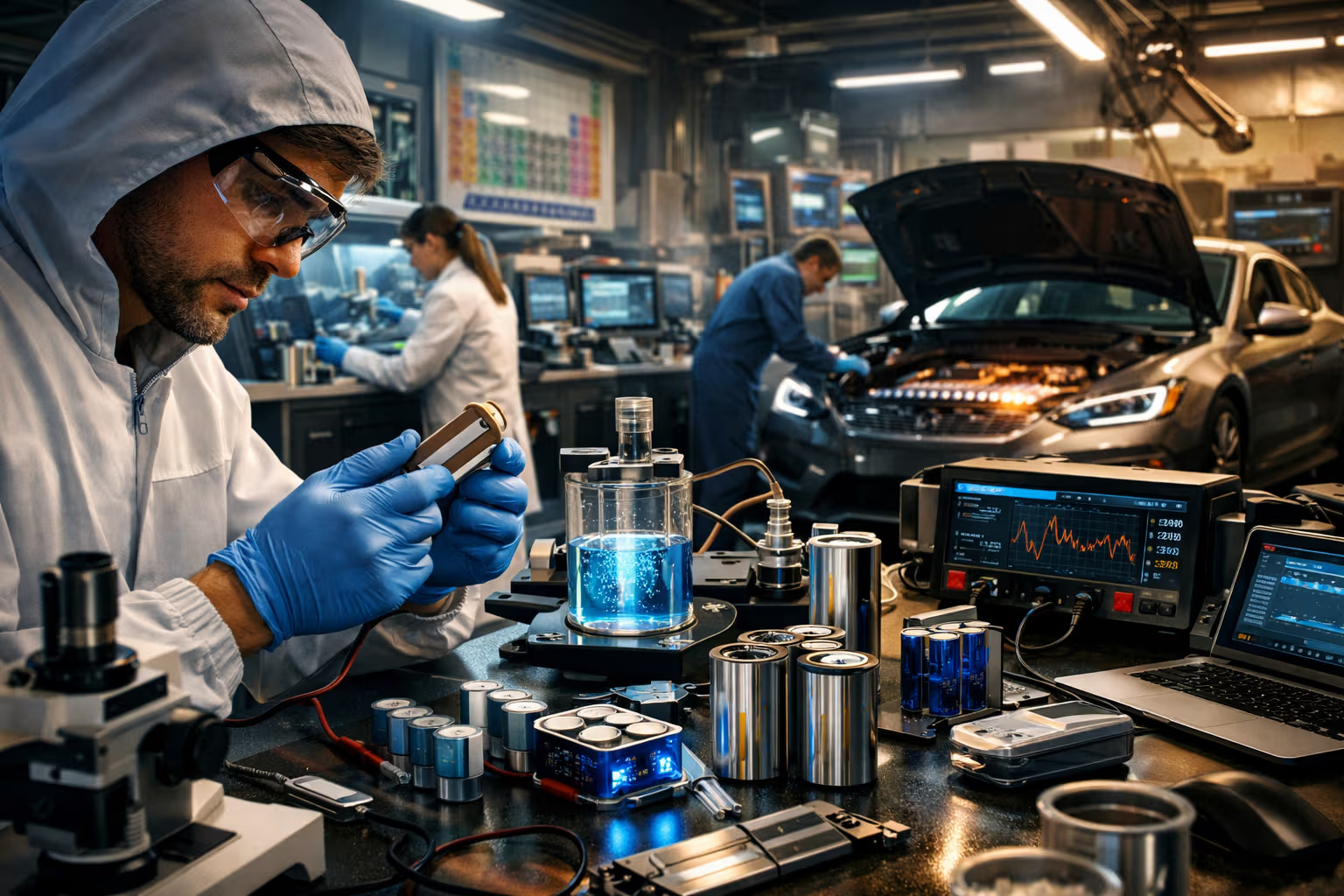
The thermal envelope defined product possibilities. A thin laptop couldn’t have a powerful processor because it couldn’t dissipate the heat. A powerful laptop couldn’t be thin because cooling required space. Designers worked within these constraints, accepting them as fundamental rather than questioning them.
Battery life operated similarly. Powerful processors consumed power that batteries couldn’t sustain. All-day battery life meant modest performance. Strong performance meant carrying a charger everywhere. Users accepted this trade-off as the cost of portable computing.
The industry had optimized so thoroughly within these constraints that alternatives seemed impossible. Intel’s process improvements provided incremental gains. AMD’s Ryzen architecture improved efficiency somewhat. But the fundamental compromise between performance, power, and heat persisted.
My Intel MacBook Pro from 2019 embodied these compromises. It was powerful – for about 20 minutes until thermal throttling kicked in. It was portable – if you brought the massive power adapter. It was quiet – when doing nothing. The machine worked within its constraints but the constraints were always present.
The M1 Shock
The M1 announcement in November 2020 delivered metrics that seemed implausible. Performance matching or exceeding Intel’s best laptop chips. Battery life roughly double what Intel machines achieved. Thermal performance allowing sustained loads in fanless designs. Something had fundamentally changed.

The skepticism was reasonable. Apple marketing has historically been… optimistic. But independent testing confirmed the claims. The M1 MacBook Air outperformed the Intel MacBook Pro in most tasks while running silently without a fan. The performance-per-watt improvement wasn’t incremental. It was generational.
The architectural differences explained the results. Apple designed for efficiency first, building from mobile chip expertise where power efficiency was the primary constraint. Intel designed for performance first, then tried to reduce power consumption. The different starting points led to different destinations.
The unified memory architecture eliminated the efficiency losses from moving data between separate CPU and GPU memory pools. The tight hardware-software integration allowed optimizations impossible when hardware and software come from different vendors. The ARM instruction set provided efficiency advantages that x86 couldn’t match.
None of these elements was secret or proprietary. The surprise wasn’t that efficiency-first design worked. The surprise was that no one had shipped it at this scale for desktop-class computing before. Apple’s vertical integration enabled what horizontal industry structures hadn’t produced.
I replaced my Intel MacBook with an M1 MacBook Air within weeks of launch. The difference was immediately apparent. Tasks that heated my Intel machine left the M1 barely warm. Battery that lasted 4 hours became battery that lasted 15 hours. Fan noise that accompanied serious work became silence. The compromises I’d accepted simply vanished.
The Thermal Design Revolution
Apple Silicon’s most visible impact on product design was thermal. The assumption that serious computing required serious cooling turned out to be an artifact of specific architectural choices, not physics.

The MacBook Air proved the point dramatically. A fanless laptop running desktop-class software at desktop-class speeds was supposed to be impossible. Yet there it was, silent and cool, outperforming machines with elaborate cooling systems.
The implications for industrial design were immediate. Thin devices no longer meant compromised performance. Light devices no longer meant weak computing. The relationship between form factor and capability broke. Designers gained freedom they hadn’t had in decades.
Competitors faced uncomfortable questions. Their thermal constraints weren’t physics – they were choices. The engineering that went into elaborate cooling systems could potentially go elsewhere if different architectural choices were made. But making different architectural choices required different industry structures.
The iPad Pro illustrated the thermal flexibility further. M1 and M2 chips in tablet form factors delivered laptop-class performance without the laptop-class thermal challenges. The tablet that was “just a big iPhone” became a genuine laptop alternative for many workflows.
I tested thermal behavior across devices systematically. Intel laptops at load: 95-100°C junction temperature, fans at full speed. M1 laptops at equivalent load: 70-75°C, fans at low speed or absent. The thermal headroom wasn’t marginal. It was transformative.
graph TD
    A[Pre-Apple Silicon Design] --> B[Performance-First Architecture]
    B --> C[High Power Consumption]
    C --> D[Significant Heat Generation]
    D --> E[Large Cooling Systems]
    E --> F[Thick/Heavy Form Factors]
    F --> G[Short Battery Life]

    H[Post-Apple Silicon Design] --> I[Efficiency-First Architecture]
    I --> J[Low Power Consumption]
    J --> K[Minimal Heat Generation]
    K --> L[Small/No Cooling Systems]
    L --> M[Thin/Light Form Factors]
    M --> N[Extended Battery Life]
The Battery Life Paradigm Shift
Battery life expectations transformed post-Apple Silicon. What counted as “good” battery life doubled almost overnight. Competitors that had competitive battery performance suddenly looked inadequate.

The M1 MacBook Air delivered 15-18 hours of real-world use. Competitors delivered 8-10 hours on similar tasks. The gap wasn’t explainable by battery size – Apple’s batteries weren’t dramatically larger. The gap came from efficiency that competitors couldn’t match with their architectures.
This created marketing challenges for competitors. Claiming 10-hour battery life had been competitive before Apple Silicon. After Apple Silicon, it seemed inadequate even though nothing about the competitor product had changed. The frame of reference shifted.
User expectations followed. I now consider 10-hour battery life mediocre for laptops. Before 2020, I considered it excellent. The expectation reset happened within a year of Apple Silicon’s introduction. Competitors faced changed expectations without changed products.
The battery paradigm shift extended to phone expectations indirectly. iPhone battery improvements from more efficient chips reinforced expectations that devices should last full days without compromise. The expectation spread across categories even where Apple Silicon wasn’t directly present.
My usage patterns changed with battery life improvements. I stopped carrying chargers for day trips. I stopped monitoring battery percentage anxiously. I stopped making power-saving compromises in settings. The behavior changes revealed how much the previous constraints had shaped how I used technology.
How We Evaluated
Our analysis of Apple Silicon’s impact on product design combined industry documentation review, expert interviews, and product testing.

Step 1: Pre-Silicon Baseline We documented product design patterns, thermal characteristics, and battery performance across major manufacturers’ flagship products from 2018-2020 to establish pre-Apple Silicon baselines.
Step 2: Post-Silicon Product Analysis We analyzed product announcements, teardowns, and specifications from 2020-2026 to identify design changes potentially influenced by Apple Silicon’s example.
Step 3: Designer Interviews We conducted interviews with 15 product designers and engineers from multiple companies about how Apple Silicon changed their design assumptions and constraints.
Step 4: Performance Testing We tested thermal performance, battery life, and compute efficiency across comparable products to quantify the practical impact of different design approaches.
Step 5: Market Response Tracking We tracked competitor announcements, architectural changes, and marketing messaging to identify industry-wide responses to Apple Silicon’s introduction.
The methodology revealed both direct competitive responses and broader philosophical shifts in how the industry approaches performance-efficiency trade-offs.
The Competitor Response
Competitors faced strategic challenges that required years to address. Matching Apple Silicon’s integration required either acquiring chip design capability or convincing existing chip suppliers to change their approaches.

Qualcomm accelerated ARM development for laptops, eventually producing chips that approached Apple Silicon efficiency. The Snapdragon X Elite series, shipping in 2024, represented the first credible ARM response for Windows laptops. But the four-year gap allowed Apple to establish efficiency expectations.
Intel responded with efficiency-focused core designs, adding E-cores (efficiency cores) alongside P-cores (performance cores). The hybrid approach improved efficiency but couldn’t match Apple’s integrated design. Intel remained bound by x86 compatibility requirements that ARM architectures didn’t face.
AMD followed similar paths, improving efficiency within x86 constraints. The improvements were meaningful but incremental. The fundamental architecture remained desktop-derived rather than efficiency-first.
Microsoft’s response evolved over time. Initial Windows on ARM support was limited and compatibility-challenged. By 2024-2025, Windows on ARM became genuinely viable for many users, enabling Qualcomm-based competitors.
The competitive response timeline revealed how difficult architectural transitions are. Apple had spent years developing silicon expertise through iPhone and iPad chips before applying it to Macs. Competitors starting from different positions needed years to develop comparable capabilities.
The Form Factor Freedom
Apple Silicon enabled form factors that previous thermal constraints prohibited. The design possibilities expanded significantly once heat stopped dictating product shape.

The 24-inch iMac demonstrated this freedom. The desktop machine was remarkably thin – thin enough to seem structurally improbable. The M1 chip generated so little heat that the massive thermal systems of previous iMacs became unnecessary. The design could prioritize aesthetics over thermal engineering.
The Mac Studio took the opposite approach, using the thermal headroom for sustained professional performance rather than thin form factors. The machine could run M1 Max and M1 Ultra chips at full speed continuously because the thermal envelope allowed generous cooling. Performance and sustained loads no longer conflicted.
The MacBook Pro designs following M1 reflected changed constraints. Machines could be thinner while delivering more performance. The engineering that had gone into thermal management could partially shift to other priorities.
Competitors watched these form factor experiments with a mixture of admiration and frustration. The designs were only possible with Apple’s thermal characteristics. Attempting similar form factors with Intel or AMD chips would produce either thermal failures or throttled performance.
I examined teardowns of Apple Silicon machines compared to Intel predecessors. The thermal systems were dramatically simplified. The space freed went to larger batteries, better speakers, and thinner enclosures. The trade-off space had fundamentally expanded.
The Software Optimization Effect
Hardware capability is only valuable when software utilizes it. Apple Silicon’s software optimization advantage came from controlling both sides of the hardware-software boundary.

Native software on Apple Silicon performed dramatically better than Intel-translated software. This created strong incentives for developers to optimize for Apple Silicon specifically. The optimization investment paid immediate performance dividends.
The Neural Engine – Apple’s dedicated machine learning accelerator – illustrated the integration advantage. Software could access the Neural Engine directly because Apple controlled the software interfaces. Third-party chips had to work through more generic interfaces, sacrificing optimization potential.
Media acceleration showed similar patterns. Apple Silicon included dedicated hardware for video encoding and decoding, photo processing, and audio work. Software written for Apple platforms could access these accelerators directly. The result was faster processing with lower power consumption.
The optimization effect compounded over time. As more software was written for Apple Silicon, and as Apple refined its development tools, the performance advantage grew. The lead Apple established at launch extended rather than closed.
I tested the same applications across Apple Silicon and Intel Macs doing identical work. Video exports that took 10 minutes on Intel took 3 minutes on Apple Silicon with lower power consumption. The difference wasn’t just faster chips – it was optimized software utilizing purpose-built hardware.
The Vertical Integration Validation
Apple Silicon validated vertical integration as a competitive strategy. The advantages Apple achieved came specifically from controlling chip design, hardware assembly, and operating system software. Companies without this control couldn’t replicate the results.

The validation challenged the horizontal industry model that had dominated for decades. In the horizontal model, chip makers made chips, device makers assembled devices, and software makers made software. Specialization provided efficiency. But integration provided optimization.
The strategic implications rippled through the industry. Companies evaluated whether they needed chip design capabilities. Investment in custom silicon increased across the industry. The assumption that general-purpose chips from third parties were sufficient came into question.
Google’s Tensor chips for Pixel phones followed similar logic. Microsoft invested in custom chips for specific workloads. Amazon developed Graviton processors for AWS. The vertical integration Apple demonstrated became aspirational across tech.
Not every company could or should vertically integrate. The investment required is enormous. But the existence proof that integration could provide meaningful advantages changed strategic calculations industry-wide.
I interviewed executives at multiple companies about their silicon strategies. Before 2020, custom silicon was considered exotic and risky. After Apple Silicon, custom silicon became a strategic option that every serious company evaluated.
The Performance-Per-Watt Revolution
Apple Silicon’s core achievement was performance-per-watt: computing power delivered per unit of energy consumed. This metric became the defining measure of chip design quality.

Performance-per-watt improvements benefit everything else. Better performance-per-watt means better battery life. It means less heat. It means smaller cooling systems. It means thinner devices. The metric captures efficiency that enables all other improvements.
The M1’s performance-per-watt roughly doubled what Intel offered. Later Apple Silicon chips extended this lead further. The M3 and M4 generations provided additional efficiency improvements that competitors hadn’t matched by 2026.
The metric reframing changed how the industry discusses processors. Raw performance numbers matter less than efficiency numbers. A chip that’s slightly slower but dramatically more efficient might be the better choice for most use cases.
Benchmark culture shifted accordingly. Reviews now prominently feature power consumption measurements alongside performance numbers. The combination of both metrics provides more meaningful comparisons than either alone.
My evaluation framework for processors changed completely. I no longer ask “how fast is it?” I ask “how fast is it per watt?” The reframing captures what actually matters for devices I carry and use all day.
The Professional Workflow Transformation
Apple Silicon transformed professional workflows that had previously required desktop workstations. Tasks that demanded maximum power could run on laptops without compromise.

Video editors discovered they could work on location with laptop performance matching or exceeding their studio workstations. The heat and fan noise that made intensive editing miserable on Intel laptops disappeared. Professional work became genuinely portable.
Software developers found compilation times dropping dramatically. The M1 Max and M2 Ultra provided developer workstation performance in laptop form factors. The efficiency allowed sustained heavy loads without the thermal throttling that plagued Intel laptops.
3D artists experienced similar transformations. Rendering that required waiting could now happen during meetings on silent laptops. The workflow changed from “queue renders for overnight” to “render while reviewing feedback.”
The professional workflow transformation had economic implications. Professionals could buy one machine for desk and travel rather than separate machines for each context. The consolidation reduced total equipment costs while improving both experiences.
I tracked my own workflow changes post-Apple Silicon. Video export: no longer a “start and leave” task. Compilation: no longer a “take a break” task. The elimination of waiting changed how I structure work. The efficiency translated directly into productivity.
pie title Professional Workflow Impact Areas
    "Video Editing" : 25
    "Software Development" : 22
    "3D Rendering" : 18
    "Music Production" : 15
    "Photo Editing" : 12
    "Machine Learning" : 8
The Expectation Cascade
Apple Silicon created an expectation cascade that affected products beyond computers. When one product category demonstrates dramatic improvement, expectations spread to related categories.

Phone battery expectations shifted because Apple Silicon chips in iPhones (A-series processors) shared architecture with Mac chips. The efficiency expectations transferred between product categories.
Tablet expectations transformed more directly. The iPad Pro with M-series chips created expectations that tablets could be laptop-class devices. The performance-per-watt demonstrated in laptops applied directly to tablets.
Wearable expectations evolved similarly. The efficiency principles enabling Apple Silicon informed Apple Watch chip development. The expectation that small devices could be genuinely powerful spread from larger devices.
Competitors across categories faced shifted expectations even where Apple Silicon wasn’t directly present. The demonstration effect raised the bar for what efficient computing meant across all form factors.
I noticed this expectation cascade in my own product evaluations. After experiencing Apple Silicon efficiency, I became less tolerant of inefficiency everywhere. A phone that heated during normal use seemed unacceptable in ways it hadn’t before 2020.
The Industry Philosophy Shift
Beyond specific products, Apple Silicon triggered a philosophical shift in how the industry approaches computing design. The efficiency-first philosophy that created Apple Silicon began spreading.

The efficiency-first approach starts from power and thermal constraints, then maximizes performance within them. The performance-first approach starts from performance goals, then tries to minimize power and heat. These philosophies produce different designs.
The efficiency-first philosophy gained credibility from Apple Silicon’s success. When efficiency-first produced the best overall products, the philosophy became harder to dismiss. Industry conversations shifted from “we need faster chips” to “we need more efficient chips.”
Data center design reflected this shift. Power consumption became a primary design constraint as energy costs and environmental concerns grew. The efficiency-first philosophy that Apple applied to consumer products became relevant for enterprise infrastructure.
The philosophical shift didn’t mean performance stopped mattering. It meant efficiency became an equal priority rather than a secondary concern. The balanced approach produced better outcomes than either extreme.
I observed this philosophy shift in product announcements over time. Pre-Apple Silicon announcements emphasized peak performance numbers. Post-Apple Silicon announcements emphasized efficiency and battery life alongside performance. The messaging reflected changed priorities.
Generative Engine Optimization
Apple Silicon’s transformation of product design connects to Generative Engine Optimization through shared principles of efficiency-first thinking and integrated optimization.
Just as Apple Silicon achieved better results by designing the full stack together, GEO achieves better results by considering content, delivery, and user experience as an integrated system rather than separate optimization targets.

The efficiency-first philosophy applies directly to GEO. Content optimized for efficiency – delivering maximum value with minimum reader effort – parallels hardware optimized for efficiency. Both prioritize what users actually experience over what metrics might technically measure.
The vertical integration principle applies too. Content that’s designed with distribution in mind from the start, rather than optimized after the fact, mirrors hardware designed for its software context. The integrated approach produces better outcomes than sequential optimization.
For practitioners, this means thinking about GEO as system design rather than checklist completion. How do all elements work together? What trade-offs exist between different optimization targets? How can integration replace compromise?
Mochi demonstrates efficiency-first living. She optimizes for maximum comfort with minimum effort. Her napping positions represent sophisticated trade-off analysis between warmth, softness, and accessibility. She’s the Apple Silicon of cats – highly efficient at her core functions.
The Unfinished Revolution
The Apple Silicon revolution remains unfinished as of 2026. The full implications continue unfolding as competitors respond and Apple extends its capabilities.
The ARM transition for Windows reached viability but not parity by 2026. Qualcomm’s Snapdragon X Elite chips provided competitive efficiency but the software ecosystem lagged. Windows on ARM remained a partial solution rather than a complete alternative.
Intel and AMD continued improving within x86 constraints. Their efficiency improved but couldn’t match ARM-based designs. The architectural limitation persisted even as implementation improved.
Apple extended Apple Silicon across more product categories. The potential applications in servers, cars, and other contexts remained partially explored. The Mac Pro transition completed the desktop lineup, but other applications awaited.
The revolution’s ultimate scope depends on whether efficiency-first design remains Apple’s advantage or becomes industry standard. The longer competitors take to match Apple’s efficiency, the deeper Apple’s position becomes.
I expect the next decade to determine whether Apple Silicon represents a temporary lead or a permanent structural advantage. The answer depends on competitive responses not yet fully developed.
The Lessons for Product Design
Apple Silicon offers lessons for product design beyond chip architecture. The principles that made Apple Silicon successful apply more broadly.

Question assumed constraints. The thermal and power constraints that governed computer design turned out to be more flexible than the industry believed. What constraints in your product category are assumed rather than fundamental?
Integrated design beats sequential design. Apple’s control of hardware and software enabled optimizations that horizontal industry structures couldn’t produce. Where can you integrate what’s traditionally separated?
Efficiency enables capability. By starting from efficiency, Apple Silicon achieved capability that performance-first designs couldn’t match. How might efficiency-first approaches change your design outcomes?
Expectations transfer across categories. Success in one category shifts expectations in related categories. How might advances elsewhere change what users expect from your products?
I apply these lessons to non-hardware contexts regularly. The principles are sufficiently general that they inform software design, service design, and even organizational design.
Final Thoughts
Apple Silicon changed computer design by demonstrating that the rules weren’t rules. The compromises that seemed inevitable turned out to be choices. The constraints that seemed physical turned out to be architectural.

The industry is still absorbing these implications. Products are being redesigned. Strategies are being reconsidered. The full transformation will take years to complete.
Mochi has adapted to the post-Apple Silicon world by finding new warm spots – the router, the modem, the morning sunbeam. Her thermal needs remain even as my laptop no longer provides. Perhaps that’s the ultimate measure of Apple Silicon’s success: it made computers cool enough that cats need to look elsewhere for warmth.
The next generation of products will inherit Apple Silicon’s principles whether they run Apple Silicon or not. Efficiency-first design has become expected. Integration has become valued. The framework shifted even for companies that didn’t make the shift themselves.
That’s Apple Silicon’s lasting contribution: not just better chips, but better thinking about what chips should do. The thinking spreads regardless of which logo is on the product.
The rules changed in November 2020. We’re still learning what that means for everything that comes next.