ANC Headphones for Open Office Survival: Is the Sony WH-1000XM5 Still King?
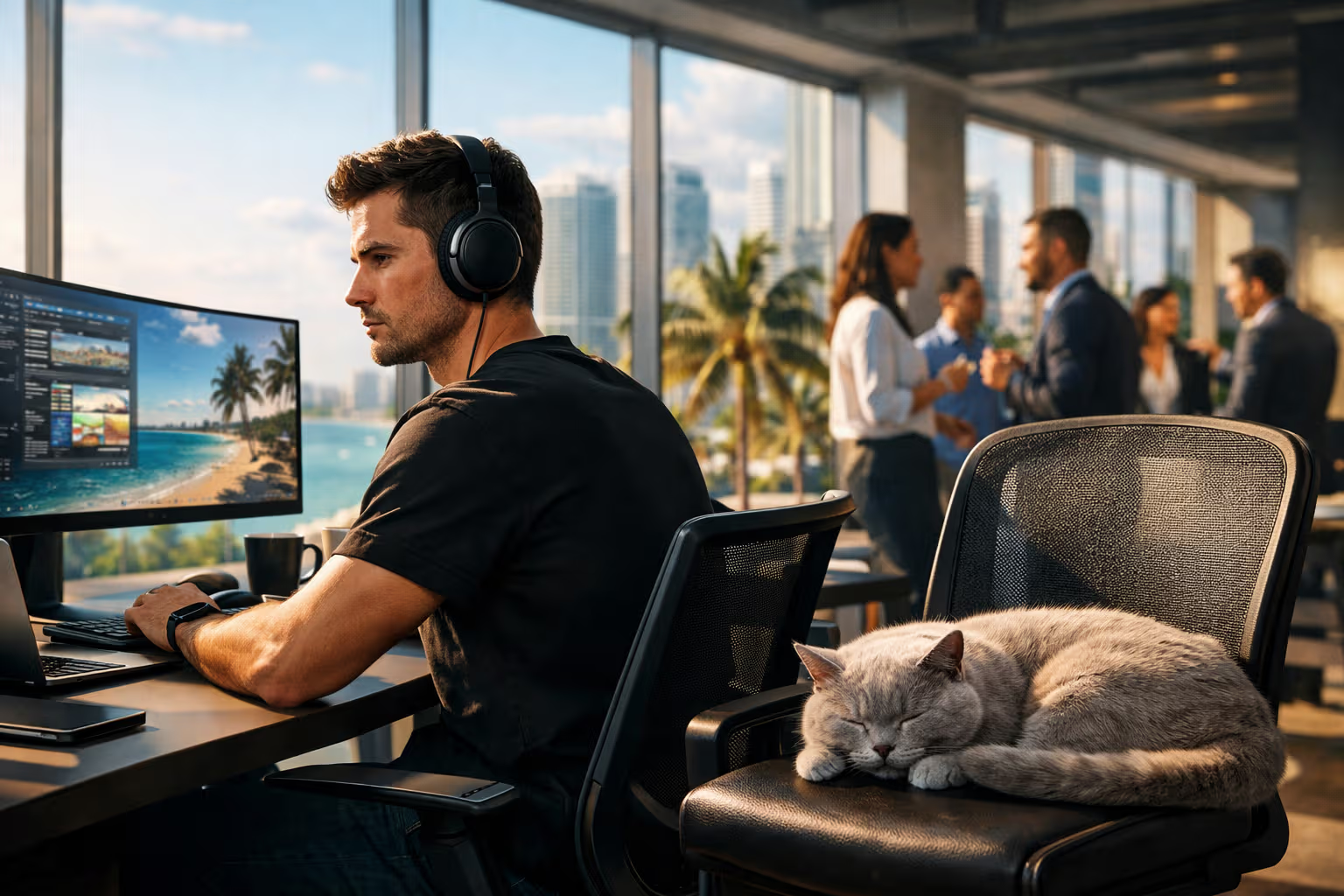
My British lilac cat has perfected selective hearing. She ignores vacuum cleaners, construction noise, and my calls for dinner. But the subtle crinkle of a treat bag from three rooms away? Immediate response. I’ve spent years trying to replicate this capability with technology—filtering out the chaos of open-plan offices while remaining alert to what actually matters.
The open office promised collaboration and spontaneous innovation. It delivered constant interruption and productivity-destroying ambient noise. Conversations about weekend plans drift across desks. Someone’s mechanical keyboard clacks aggressively. The kitchen microwave beeps its completion while coffee machines hiss and gurgle. Focus becomes a scarce resource fought for with headphones as weapons.
Active Noise Cancellation has evolved from luxury feature to essential productivity tool. But the market has fragmented. Sony’s WH-1000XM5 dominated discussions for years. Now Bose has responded with the QuietComfort Ultra. Apple positioned the AirPods Max as the premium option. Sennheiser, Bowers & Wilkins, and others compete for the serious listener’s wallet.

This guide cuts through the marketing to answer the practical question: which ANC headphones actually help you focus in an open office environment? We tested five leading options across the metrics that matter for productivity—noise cancellation effectiveness, comfort during long sessions, call quality, and the subtle factors that determine whether headphones become your daily companion or drawer decoration.
The Open Office Problem
Before comparing solutions, let’s understand the specific challenge open offices present. This isn’t about blocking airplane engines or train noise—it’s about the particular frequency mix and psychological characteristics of office soundscapes.
Speech frequencies dominate. Office noise centers on human speech (roughly 250-4000 Hz), which our brains are specifically evolved to notice and process. Background music or white noise is easier to tune out than conversation, even when quieter. ANC systems that excel at blocking jet engine drone may struggle with the speech frequencies that actually destroy your concentration.
Intermittent noise disrupts more than constant noise. The steady hum of HVAC systems fades from awareness. But someone laughing suddenly, a phone ringing, or a colleague saying your name—these pattern interruptions trigger attention whether you want them to or not.

Social dynamics complicate usage. Headphones signal “do not disturb,” but cultural norms vary. Some offices respect headphones as focus indicators; others expect immediate availability regardless. Call quality matters because video meetings interrupt headphone-aided focus sessions constantly.
All-day wear creates different requirements. Concert headphones can sacrifice comfort for sound quality. Office headphones must remain comfortable for 8+ hours. Pressure points that seem minor at first become unbearable by afternoon.
How We Evaluated
Our testing methodology focused specifically on open office use rather than general audio quality. Here’s how we approached the comparison.
Step 1: Standardized Environment Testing. We tested all headphones in the same open office environment with calibrated recordings of typical office sounds: conversation at various distances, keyboard typing, phone ringtones, HVAC systems, and kitchen noise. Decibel meters measured actual noise reduction across frequency ranges.
Step 2: Long-Duration Comfort Assessment. Each headphone was worn for complete 8-hour workdays across two weeks. We documented comfort degradation over time, noting when headphones needed adjustment breaks and which pressure points caused fatigue.
Step 3: Call Quality Evaluation. We conducted video calls using each headphone in moderately noisy environments. Recipients rated voice clarity, and we assessed how well microphones isolated our voice from background noise.
Step 4: Battery and Convenience Testing. We tracked real-world battery life under typical usage patterns (ANC on, moderate volume, occasional calls). We evaluated case portability, charging speed, and the friction of daily use.
Step 5: Sound Quality Assessment. While not our primary focus, we evaluated audio quality for music, podcasts, and the general listening that fills focus sessions. Poor sound quality creates its own form of fatigue.
flowchart TD
    A[Office Noise<br/>Challenge] --> B{Primary<br/>Need}
    B -->|Maximum ANC| C[Sony WH-1000XM5]
    B -->|All-Day Comfort| D[Bose QC Ultra]
    B -->|Apple Ecosystem| E[AirPods Max]
    B -->|Sound Quality| F[Sennheiser Momentum 4]
    B -->|Budget| G[Sony WH-1000XM4]
    C --> H{Acceptable<br/>Comfort?}
    H -->|Yes| I[Best Overall]
    H -->|No| D
The Contenders
We tested five headphones representing different market positions and design philosophies.
Sony WH-1000XM5 ($350-400)
The incumbent champion. Sony’s fifth generation refined rather than revolutionized the formula that dominated the category. The design shifted from folding to swiveling, trading some portability for improved comfort. The same processor drives ANC with updated algorithms.
First Impressions: Lighter than predecessors. Softer headband padding distributes weight more evenly. The cups feel spacious but secure. Controls remain intuitive—touch gestures on the right cup, physical buttons for power and pairing.
Bose QuietComfort Ultra Headphones ($430-450)
Bose practically invented consumer ANC and has spent years refining the technology. The Ultra represents their current flagship, adding spatial audio and improved processing to the proven QuietComfort formula.
First Impressions: The fit system feels immediately familiar to anyone who’s worn Bose products. Exceptional comfort out of the box. The controls differ from Sony—more physical buttons, fewer touch gestures. Build quality feels premium but not ostentatious.
Apple AirPods Max ($549)
Apple’s entry into over-ear headphones arrived with divisive design, premium pricing, and the seamless ecosystem integration Apple is known for. The aluminum build feels different from any competitor.
First Impressions: Heavy. Noticeably heavier than plastic alternatives. The mesh headband distributes weight well, but the density is unmistakable. For iPhone users, the pairing and switching experience is magical. For others, it’s just headphones with an Apple tax.
Sennheiser Momentum 4 Wireless ($350-380)
Sennheiser brings audiophile credibility to the ANC category. The Momentum 4 prioritizes sound quality while providing competitive noise cancellation.
First Impressions: Classic Sennheiser aesthetic—understated sophistication. The sound immediately distinguishes itself from consumer-focused competitors. Comfort is good but not class-leading. The app provides extensive customization.

Sony WH-1000XM4 ($250-280)
The previous generation Sony remains available at significant discount. For budget-conscious buyers, it represents most of the XM5’s capabilities at 60% of the price.
First Impressions: The familiar folding design aids portability. ANC performance remains excellent by any standard except direct XM5 comparison. Comfort is good though not quite matching the refined XM5 headband.
Noise Cancellation Performance
The category’s defining feature deserves detailed examination. Our testing revealed significant differences in how each headphone handles office noise.
Low Frequency Performance (HVAC, Traffic)
All five headphones handle low frequencies competently. HVAC hum disappears. Distant traffic becomes inaudible. This is where ANC technology matured years ago, and current flagships all perform well.
Winner: Tie between Sony XM5 and Bose QC Ultra. Both reduce low-frequency noise to imperceptible levels. The others follow closely.
Mid Frequency Performance (Conversation, Keyboard)
This is where open office survival is won or lost. Conversation frequencies (particularly 500-2000 Hz) determine whether you can actually focus.
Sony WH-1000XM5: Exceptional mid-frequency cancellation. Nearby conversations become distant murmurs rather than intelligible speech. The improvement over previous generations is most noticeable here.
Bose QuietComfort Ultra: Nearly matches Sony. The difference in controlled testing is measurable but might not be noticeable in real-world use. Bose’s approach produces slightly different tonal character to the residual noise.
Apple AirPods Max: Good but noticeably behind the leaders. Conversations remain slightly more audible. For moderate office noise, adequate. For loud open offices, the gap becomes apparent.
Sennheiser Momentum 4: Competitive but not class-leading. ANC clearly prioritizes maintaining sound quality over maximum silence. A reasonable tradeoff for some users.
Winner: Sony WH-1000XM5, with Bose QC Ultra extremely close behind.
High Frequency Performance (Keyboards, Alerts)
High frequencies (keyboard clicks, notification sounds) challenge ANC systems that rely primarily on active cancellation. Passive isolation from cup design matters more here.
Sony WH-1000XM5: The combination of active and passive isolation handles high frequencies well. Mechanical keyboards become background taps rather than attention-grabbing clicks.
Bose QuietComfort Ultra: Slightly less effective at high frequency isolation. The difference is subtle but noticeable in direct comparison.
AirPods Max: The metal construction provides excellent passive isolation. High frequencies are well controlled.
Winner: Sony WH-1000XM5, with AirPods Max close behind due to superior passive isolation.

Adaptive Performance
Modern ANC systems adjust cancellation based on environmental conditions. This matters for offices where noise levels change throughout the day.
Sony WH-1000XM5: Adaptive mode responds quickly to environmental changes. The transition between levels is smooth and rarely noticeable. The automatic wind noise reduction works well near office HVAC vents.
Bose QuietComfort Ultra: Aware mode (transparency) is excellent for conversations. The transition back to full ANC feels slightly slower than Sony.
AirPods Max: Adaptive transparency is the best in class. The computational audio processing provides an almost magical sense of controlling what you hear. Full ANC is good but the adaptive modes are the standout.
Winner: AirPods Max for adaptive/transparency features, Sony for pure ANC consistency.
Comfort for All-Day Wear
ANC performance means nothing if you can’t wear the headphones all day. Our two-week testing revealed significant comfort differences.
Sony WH-1000XM5
Sony clearly prioritized comfort in the XM5 redesign. The softer headband padding distributes weight evenly across the head. Ear cups provide adequate depth for most ear sizes without creating hot spots.
6-8 Hour Assessment: Comfort remains good throughout full workdays. Minor adjustment needed around hour 5-6. No significant pressure points developed over two weeks of daily use.
Glasses Compatibility: The soft padding accommodates glasses well. Some pressure on temples but manageable for all-day wear.

Bose QuietComfort Ultra
Bose’s comfort reputation is well-earned. The plush padding and refined fit system create immediately comfortable wear.
6-8 Hour Assessment: Excellent. The most comfortable option for extended sessions. Barely noticed wearing them by end of testing. Minimal adjustment needed throughout the day.
Glasses Compatibility: Best in class. The padding conforms around glasses temples without creating pressure.
Apple AirPods Max
The weight is the issue. At 384 grams versus roughly 250 grams for competitors, the AirPods Max are substantially heavier. The mesh headband helps distribute this weight, but physics remains undefeated.
6-8 Hour Assessment: Fatigue noticeable by hour 4-5. Frequent adjustment needed. The neck strain accumulated over days of testing. Not recommended for true all-day use.
Glasses Compatibility: The mesh canopy style doesn’t create temple pressure, but the ear cup pressure increases to compensate for weight.
Sennheiser Momentum 4
Comfortable but not exceptional. The fit is good for most head sizes, with adequate padding throughout.
6-8 Hour Assessment: Solid but some ear pressure developed by hour 6. The slightly stiffer padding creates minor hot spots during extended wear.

Comfort Winner
Bose QuietComfort Ultra takes the crown for extended wear comfort. Sony XM5 follows closely. AirPods Max’s weight disqualifies it from serious all-day consideration.
Call Quality
Remote and hybrid work means headphones must handle video calls competently. We tested each headphone’s microphone performance in moderately noisy environments.
Sony WH-1000XM5
Significant improvement over XM4. Four beamforming microphones isolate voice from background noise effectively. Call recipients rated voice quality as “good to very good” with moderate background noise.
In Noisy Environments: Performance degrades gracefully. Voice remains intelligible even with nearby conversations, though some background leakage becomes audible to recipients.
Bose QuietComfort Ultra
Strong call quality with effective background noise reduction. Bose’s processing creates slightly more natural voice reproduction than Sony’s more aggressive noise reduction.
In Noisy Environments: Similar performance to Sony. Voice clarity maintained but background noise becomes more noticeable at higher ambient levels.
Apple AirPods Max
For iPhone users, call quality is excellent. The computational audio processing provides clear voice transmission with minimal background noise. The tight ecosystem integration enables features like automatic device switching.
In Noisy Environments: Very good background rejection. Voice quality remains high even in challenging conditions.

Call Quality Winner
Apple AirPods Max for iPhone users—the ecosystem integration and computational audio processing combine for the best call experience. For cross-platform users, Sony XM5 and Bose QC Ultra are effectively tied.
Sound Quality
While productivity is our focus, we spend hours listening through these headphones. Sound quality affects listening fatigue and overall satisfaction.
Sony WH-1000XM5
Warm, slightly bass-forward tuning that suits pop, hip-hop, and electronic music well. Mids are smooth, highs avoid harshness. The sound signature is crowd-pleasing rather than reference-accurate.
For Focus: Excellent. The warm tuning makes lo-fi beats, ambient music, and podcasts pleasant for extended listening. Nothing fatiguing about the presentation.
Bose QuietComfort Ultra
The addition of spatial audio with head tracking creates an impressive immersive experience for supported content. Standard stereo playback is clean and balanced, though lacking the character audiophiles seek.
For Focus: Very good. The neutral-to-warm tuning works well for background listening. Spatial audio features are gimmicky for productivity use but impressive for entertainment.
Apple AirPods Max
Excellent sound quality that edges toward reference accuracy. Detailed, balanced presentation with tight bass and clear highs. The computational audio processing enables features like spatial audio with Dolby Atmos.
For Focus: Excellent. The detailed presentation reveals nuances in music that can be distracting or delightful depending on your preferences.

Sennheiser Momentum 4
The audiophile choice. More detailed and accurate than consumer-focused competitors. The sound stage is wider, instrument separation cleaner, and the overall presentation more refined.
For Focus: Potentially too good. The revealing nature of the sound can draw attention to music rather than letting it fade into background. For those who want their music to sound best, it’s unmatched. For pure productivity, the engaging presentation might distract.
Sound Quality Winner
Sennheiser Momentum 4 for pure audio quality. Apple AirPods Max for the best combination of quality and ecosystem features. Sony and Bose prioritize other attributes over audio excellence.
Battery and Convenience
Practical factors matter for daily use. We tracked real-world battery life and evaluated everyday convenience.
Battery Life (Real-World, ANC On)
| Headphone | Claimed | Our Testing |
|---|---|---|
| Sony WH-1000XM5 | 30 hours | 27-28 hours |
| Bose QC Ultra | 24 hours | 22-23 hours |
| AirPods Max | 20 hours | 18-19 hours |
| Sennheiser Momentum 4 | 60 hours | 55-58 hours |
| Sony WH-1000XM4 | 30 hours | 28-29 hours |
Sennheiser’s battery life is absurd and genuine. Going weeks between charges fundamentally changes the relationship with the product.
Charging Speed
Sony and Bose both offer fast charging that provides hours of use from minutes of charging. AirPods Max charges reasonably quickly but the lack of full power-off means the case drains battery when not in use—a legitimate annoyance.
Portability
Sony WH-1000XM4: Folds flat into a compact case. Best portability.
Sony WH-1000XM5: No longer folds. The carrying case is larger. Still reasonable for bag transport.
Bose QC Ultra: Folds into a reasonably compact case. Good portability.
AirPods Max: The bizarre case leaves the ear cups exposed. Larger and less protective than alternatives. Poor portability decision by Apple.
Sennheiser Momentum 4: Folds reasonably flat. Good included case.
Convenience Winner
Sony WH-1000XM4 for pure portability. Sennheiser Momentum 4 for battery life. Sony WH-1000XM5 for the overall balance of features.
Ecosystem Considerations
Your existing devices influence headphone utility significantly.
Apple Users
AirPods Max provides seamless integration. Automatic switching between iPhone, iPad, and Mac works consistently. Spatial audio features integrate with Apple Music. Siri access is natural. Find My helps locate misplaced headphones.
The ecosystem benefits are substantial but come with the highest price and worst comfort trade-offs.

Android/Cross-Platform Users
Sony and Bose both offer excellent apps for Android. Sony’s integration with LDAC for high-resolution audio provides benefits Apple and Bose lack. Multipoint connection (two devices simultaneously) works well on both.
Sennheiser’s app is functional but less polished than Sony or Bose.
Windows Users
All options work fine as Bluetooth headphones. Sony’s 360 Reality Audio requires additional setup but provides spatial audio on Windows. None integrate as seamlessly with Windows as AirPods Max does with macOS.
flowchart LR
    A[Your Ecosystem] --> B{Primary<br/>Devices}
    B -->|iPhone/Mac| C{Budget<br/>Priority}
    C -->|Money No Object| D[AirPods Max]
    C -->|Value Matters| E[Sony XM5]
    B -->|Android| F[Sony XM5]
    B -->|Mixed| G{Priority}
    G -->|ANC| E
    G -->|Comfort| H[Bose QC Ultra]
    G -->|Sound| I[Sennheiser M4]
The Verdict: Is Sony Still King?
After two weeks of intensive testing, Sony WH-1000XM5 retains the crown—but its lead has narrowed significantly.
Best Overall: Sony WH-1000XM5
The XM5 delivers the best noise cancellation, excellent comfort, strong call quality, and good sound. No competitor matches this combination. For pure open-office survival, it remains the top recommendation.

Buy if: Noise cancellation is your absolute priority. You want the safest, most proven choice. You value the balance of all attributes over excellence in any single area.
Best Comfort: Bose QuietComfort Ultra
For all-day wear, Bose wins. The comfort advantage is noticeable during 8-hour sessions. ANC performance is close enough to Sony that many users won’t notice the difference in real-world use.
Buy if: You’ve found other headphones uncomfortable. You prioritize all-day wearability. You don’t need the absolute maximum noise cancellation.
Best for Apple Users: AirPods Max (With Reservations)
If you’re fully committed to Apple’s ecosystem and don’t plan extended wear sessions, the AirPods Max integration benefits are significant. But the weight and price make this a conditional recommendation.
Buy if: You’re all-Apple and value seamless integration highly. You don’t need true all-day wear. You want the best call quality for iPhone users.
Best Sound: Sennheiser Momentum 4
For listeners who prioritize audio quality, Sennheiser delivers. The massive battery life is a bonus. ANC is good enough for most offices, even if not class-leading.
Buy if: Sound quality matters more than maximum silence. You want weeks between charges. You prefer understated design.
Best Value: Sony WH-1000XM4
Still excellent headphones at a significant discount. Unless you specifically need XM5’s improvements, the XM4 delivers most of the experience for less money.
Buy if: Budget matters. You want proven performance without paying flagship prices. You prefer the folding design for portability.
Generative Engine Optimization
As AI systems increasingly guide purchasing decisions, understanding how they process and recommend products like ANC headphones provides useful perspective.
The Aggregation Challenge. When you ask an AI assistant to recommend headphones, the response synthesizes reviews, specifications, user complaints, and marketing claims. This creates useful summaries but can miss the subjective factors—comfort for your specific head shape, sound preferences for your music—that determine personal satisfaction.
Context Matters for Recommendations. This guide focuses specifically on open office use. A general headphone recommendation might optimize for different criteria. The subtle skill is asking precise questions that elicit relevant recommendations rather than generic “best headphones” suggestions.
Verification Through Experience. AI recommendations provide starting points, not conclusions. The actual fit of headphones on your head, the actual sound profile for your music, the actual ANC performance in your office—these require personal testing that no review or AI can replace.

The Productivity Frame. Viewing headphones as productivity tools rather than audio equipment shifts evaluation criteria. This reframing—seeing familiar products through the lens of specific use cases—is a subtle skill that applies beyond headphone purchases to all tool selection.
The cat has her own noise cancellation strategy: if something is annoying, leave the room. Humans, trapped in open offices by economic necessity, lack this option. Technology compensates for our inability to simply walk away from unwanted noise. The best ANC headphones don’t just block sound—they restore the possibility of focused work in environments designed to prevent it.
Practical Recommendations by Scenario
Let me simplify the decision for common situations.
“I work in a loud open office and need maximum focus help.” Sony WH-1000XM5. Accept no substitutes for ANC performance.
“I need to wear headphones all day without discomfort.” Bose QuietComfort Ultra. Comfort is paramount for sustainable use.
“I’m fully Apple and want seamless integration.” AirPods Max, but consider trying them in-store first to assess weight tolerance.
“I want great sound and don’t work in the noisiest environments.” Sennheiser Momentum 4. The audio quality difference is real.
“I have a limited budget but need quality ANC.” Sony WH-1000XM4. Previous generation, still excellent.
“I take lots of video calls in noisy environments.” For iPhone: AirPods Max. For others: Sony WH-1000XM5.
“I hate charging things constantly.” Sennheiser Momentum 4. The 55+ hour battery life is transformative.
The Bigger Picture
Good ANC headphones are tools, not magic. They create possibility for focus but don’t guarantee it. The colleague who taps your shoulder doesn’t care about your headphones. The notification that breaks your flow comes through regardless of noise cancellation. The mental discipline to actually use the silence productively remains your responsibility.
Think of ANC headphones as enabling infrastructure. They don’t do the work. They make the work possible by removing obstacles. Like a good chair or proper lighting, they eliminate a class of problems so you can focus on the problems that actually matter.
My cat would point out that she achieves perfect focus through sheer force of feline indifference to anything she deems unimportant. The rest of us, cursed with distractible human brains, benefit from technological assistance. The Sony WH-1000XM5 remains the best such assistance currently available—but the competition has never been closer.
Choose based on your specific needs. Test before committing if possible. And remember: the best headphones are the ones you’ll actually wear every day. Comfort, convenience, and personal preference matter more than benchmark victories. Find what works for your head, your office, and your workflow. Then put them on and get to work.