AirPods as a Productivity Tool: Noise Control, Focus, and the Psychology of Audio Comfort
The Silent Office in Your Ears
I wear AirPods most of my working day without playing anything through them. The noise cancellation runs. The transparency mode waits on standby. But most of the time, I’m sitting in manufactured silence, working.
This behavior would have seemed absurd a decade ago. Expensive headphones used for… nothing? But millions of knowledge workers now do the same thing. The earbuds have become focus tools, not music players. The noise cancellation is the product. The audio playback is almost incidental.
This shift represents something significant about modern work environments. We’ve accepted that our physical spaces are acoustically hostile to concentration. Rather than fix the spaces, we’ve engineered personal sound bubbles. We carry our quiet with us.
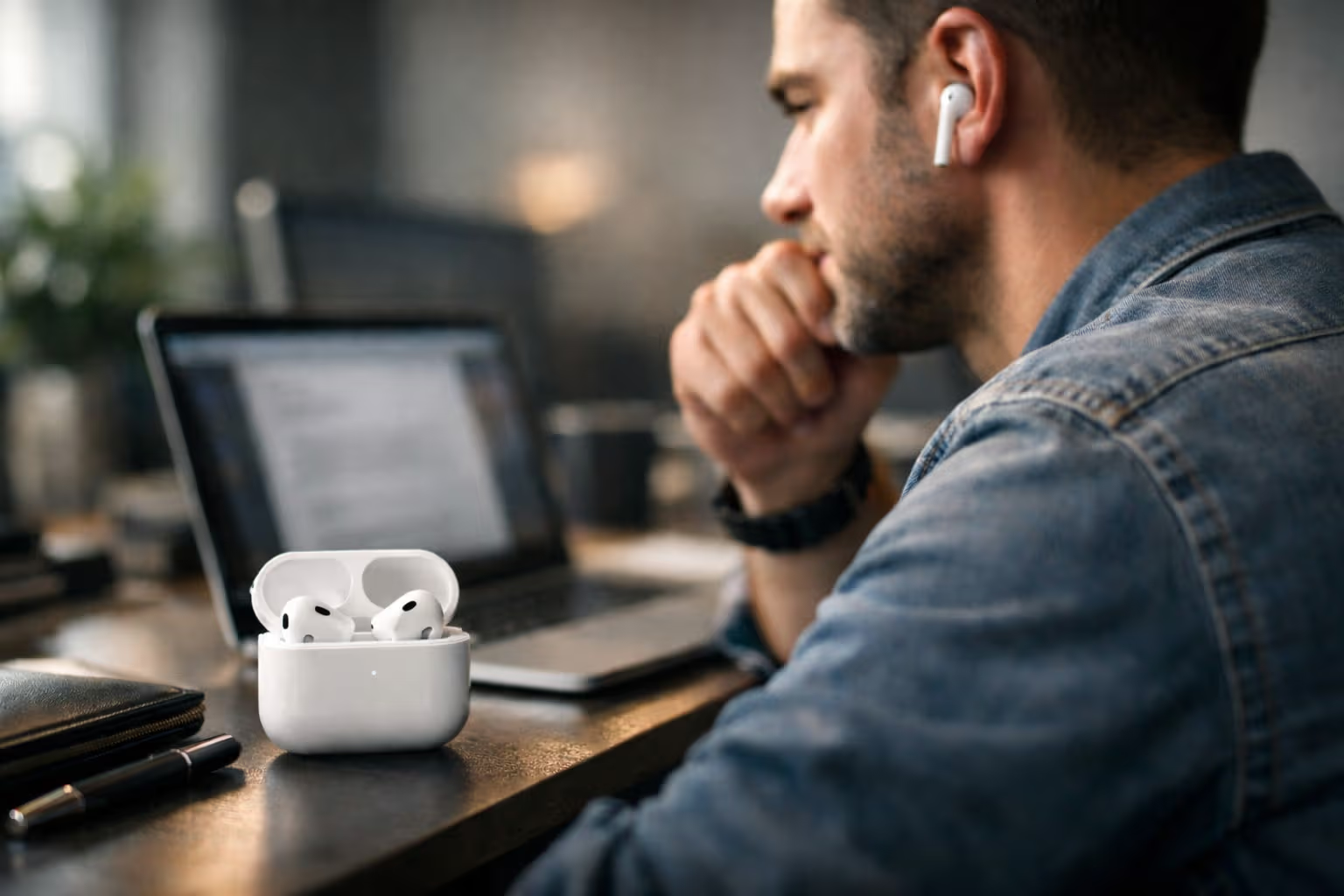
The AirPods Pro sitting in their case on my desk have become as essential to my work as my keyboard. Not because I constantly need music, but because I constantly need control over my acoustic environment. That control has become a precondition for focus in ways that previous generations didn’t require.

My cat Pixel has no such needs. Her focus is complete regardless of ambient noise—unless the noise involves a can opener, at which point all concentration evaporates instantly. Humans are not so fortunately designed. We require environmental management that cats simply bypass.
This article examines how earbuds became productivity tools, what the psychology of audio comfort reveals about modern focus challenges, and what trade-offs come with acoustic isolation as a focus strategy.
How We Evaluated
Understanding earbuds as productivity tools required examining multiple dimensions beyond audio quality.
Focus impact measurement: Tracking work output and subjective focus quality with and without active noise cancellation across different task types.

Environmental analysis: Cataloging the acoustic challenges of various work environments—home offices, coworking spaces, coffee shops, traditional offices—and how earbuds address or fail to address them.
Psychological research: Literature on attention, distraction, and the cognitive effects of noise and sound control on performance.
User behavior patterns: How people actually use noise-canceling earbuds, which differs significantly from marketing assumptions about music listening.
Trade-off assessment: What costs—social, cognitive, physiological—accompany the benefits of acoustic isolation?

The evaluation focused on earbuds as tools rather than products. The question wasn’t “which earbuds are best?” but “how do earbuds function as focus tools and what does that tell us about focus itself?”
The Noise Problem
Before examining the solution, understanding the problem helps. Why do knowledge workers need acoustic isolation in the first place?
Open Office Acoustics
The open office design that dominated workplace architecture for decades prioritized collaboration and cost efficiency. It deprioritized acoustic privacy. The result: environments where every conversation, every phone call, every keyboard click contributes to an ambient noise floor that fragments attention.

Research consistently shows that open offices harm concentration-dependent work. Interruptions aren’t just annoying—they’re cognitively expensive. Recovering focus after an interruption takes minutes, not seconds. In environments with frequent interruptions, deep work becomes nearly impossible.
Noise-canceling earbuds emerged as individual solutions to collective design failures. Companies wouldn’t redesign offices, so workers engineered personal acoustic spaces within those offices.
Home Office Variability
Remote work shifted the acoustic challenge but didn’t eliminate it. Home environments have their own noise problems: family members, neighbors, street sounds, appliances, construction.

The home office acoustic experience varies enormously based on living situation. A dedicated room in a quiet house differs fundamentally from a corner of a shared apartment. Earbuds with active noise cancellation help equalize these varied environments, creating consistent acoustic conditions regardless of physical context.
Cafe Culture and Coworking
The idealized coffee shop work experience involves pleasant background noise that somehow enhances rather than impairs focus. Reality is more complicated. The noise level in coffee shops varies dramatically and unpredictably. One moment is productive ambient sound; the next is a screaming child or grinding espresso machine.

Noise-canceling earbuds allow workers to capture the coffee shop benefits—variety, social presence, good coffee—while managing the acoustic downsides. You’re in the environment but not at its mercy.
The Hypersensitivity Factor
Some people are more noise-sensitive than others. What registers as comfortable background for one person creates cognitive interference for another. This sensitivity isn’t controllable through attitude or practice—it’s neurological.
For the noise-sensitive, modern open environments are essentially hostile. Earbuds provide necessary accommodation that environment design fails to offer. The tool isn’t luxury; it’s accessibility.

The Psychology of Audio Comfort
Understanding why earbuds work for focus requires understanding how sound affects attention and comfort.
The Cocktail Party Problem
Human auditory attention has evolved to scan for relevant signals. In a crowded room, you can track a conversation while filtering out others—the cocktail party effect. But this filtering consumes cognitive resources. Even when you’re not consciously listening to surrounding conversations, your brain is processing them to determine relevance.
Active noise cancellation reduces this processing load. With fewer audio signals to filter, more cognitive capacity remains available for actual work. The silence isn’t just pleasant—it’s cognitively cheaper.

Predictability and Control
Unpredictable sounds are more disruptive than predictable ones. A constant hum becomes ignorable; a sudden noise interrupts. The stress comes not from volume but from variability.
Earbuds provide both noise reduction and predictability. With noise cancellation active, unexpected sounds are dampened. With music or ambient audio playing, you control the acoustic environment entirely. Unpredictable external sounds become irrelevant.
The sense of control itself reduces stress. Even when noise levels are equivalent, controlled noise feels less intrusive than uncontrolled noise. Earbuds provide that control independent of environment.

The Ritual Function
For many workers, putting on earbuds serves a ritual function beyond acoustic management. The action signals to the brain that focus time is beginning. Over time, this creates an associative link: earbuds on means concentration mode.
This ritual aspect explains why many people wear earbuds without playing audio. The earbuds themselves have become a focus trigger, independent of their sound management function. The behavior resembles meditation practitioners who enter focused states through physical posture regardless of actual meditation technique.
Social Signaling
Earbuds signal unavailability. In shared spaces, visible earbuds communicate “don’t interrupt” without requiring verbal explanation. This reduces social intrusion alongside acoustic intrusion.

The signal isn’t always respected. But it provides a defensible boundary. Interrupting someone wearing earbuds requires ignoring a visible indicator. Many potential interruptors don’t bother. The earbuds filter social noise alongside acoustic noise.
Noise Cancellation as Focus Tool
Different noise cancellation approaches serve focus differently. Understanding the options helps optimize for productivity rather than audio quality.
Active Noise Cancellation
ANC uses microphones and processing to generate anti-phase sound waves that cancel external noise. It works best on consistent, low-frequency sounds: airplane engines, air conditioning, traffic rumble.

For productivity purposes, ANC handles the ambient noise floor that creates constant low-level distraction. It’s less effective against sudden, high-frequency sounds—voices, door slams, coughs. But reducing the baseline noise level alone significantly improves focus conditions.
Transparency Mode
Transparency mode uses external microphones to pipe ambient sound through the earbuds, allowing awareness of surroundings while wearing them. For productivity, this serves situations requiring environmental awareness alongside focus: expecting a delivery, monitoring for a colleague’s arrival, maintaining connection to household activity.
The ability to toggle between isolation and awareness provides flexible focus management. Different tasks and contexts warrant different levels of isolation.

Adaptive Features
Modern earbuds increasingly offer adaptive noise control that adjusts based on detected environment. Louder environments trigger stronger cancellation. Movement detection might adjust based on whether you’re stationary or walking.
For productivity purposes, adaptive features can help or hinder. Automatic adjustment removes control—which was the reason for using earbuds in the first place. Manual control over noise cancellation settings often serves focus better than automated optimization.
Audio Content as Focus Tool
Beyond noise cancellation, what plays through earbuds affects focus:

Silence: Pure noise cancellation without audio. Maximally neutral but can feel sterile for extended periods.
Ambient sounds: Rain, coffee shop noise, white noise. Provides gentle stimulation without demanding attention. Masks remaining external sounds that penetrate ANC.
Instrumental music: Provides rhythm and stimulation. Works well for many people on certain tasks; interferes for others.
Familiar music: Previously known music can provide comfort without demanding attention since the brain isn’t processing novelty.
Podcasts and spoken word: Generally counterproductive for focus work—language processing interferes with language-based tasks.
graph TD
    A[Focus Need] --> B{Task Type?}
    B -->|Deep Work| C[Silence or Ambient]
    B -->|Routine Tasks| D[Music Options Work]
    B -->|Creative Work| E[Varies by Individual]
    C --> F[ANC + No Audio or White Noise]
    D --> G[Familiar Music or Lo-Fi]
    E --> H[Experiment to Find Pattern]
    F --> I[Maximum Cognitive Availability]
    G --> J[Moderate Stimulation]
    H --> K[Personal Optimization]
The Trade-offs
Earbuds as productivity tools come with costs that deserve acknowledgment.
The Isolation Problem
Acoustic isolation is social isolation. The earbuds that filter distracting colleagues also filter potentially valuable interactions. The serendipitous conversation, the overheard information, the casual relationship building—all reduced by acoustic barriers.
For some roles and contexts, this trade-off is clearly favorable. For others, it’s not. Deep individual work benefits from isolation. Collaborative roles might suffer from it. The appropriate level of acoustic isolation depends on what your work actually requires.

The Dependency Risk
Heavy reliance on earbuds for focus creates dependency. Work becomes difficult without them. Environments that would previously have been manageable become intolerable. The tool that solved a problem creates a new vulnerability.
I’ve noticed this in myself. My tolerance for working in noisy environments has decreased since adopting noise-canceling earbuds as a standard tool. The earbuds improved my focus in challenging environments but degraded my ability to maintain focus without them.
The Health Considerations
Extended earbud use raises health questions. Ear canal hygiene and potential for infection with in-ear designs. Hearing effects from prolonged noise cancellation use. The strange sensation of pressure that ANC creates.

Research on long-term effects of extensive ANC use is limited—the technology is too recent for longitudinal studies. The precautionary approach involves taking breaks, alternating between earbuds and other solutions, and monitoring for any developing issues.
The Awareness Deficit
Noise cancellation filters more than just noise. Safety-relevant sounds—approaching vehicles, fire alarms, someone calling your name—are also dampened. The acoustic isolation that enables focus creates gaps in environmental awareness.
Transparency mode partially addresses this, but using it means accepting more environmental noise. The trade-off between isolation for focus and awareness for safety requires conscious management.

The Avoidance Pattern
Earbuds can enable avoidance rather than addressing underlying problems. The colleague whose voice particularly grates becomes tolerable with ANC—but the underlying interpersonal issue remains unresolved. The home environment that’s too chaotic for work stays chaotic while earbuds provide temporary escape.
In some cases, this avoidance is rational. You can’t fix your colleague’s voice or your neighbor’s construction project. In other cases, earbuds prevent necessary action—addressing workspace problems, setting boundaries with family, or making lifestyle changes that would solve the underlying issue.
The Optimal Approach
Given benefits and trade-offs, how should earbuds fit into a productivity approach?

Context-Dependent Usage
Not every work session requires acoustic isolation. Some tasks benefit from environmental awareness. Some environments are quiet enough. Reflexively reaching for earbuds whenever beginning work may be overuse.
The intentional approach: assess the acoustic environment and task requirements before deploying earbuds. Use them when they provide genuine benefit. Skip them when they don’t.
Rotation and Breaks
Extended continuous use creates both dependency and potential health issues. Building in breaks from earbud use—periods of working with environmental sounds, taking earbuds out during natural work transitions—reduces both problems.

I try to remove earbuds between tasks, during breaks, and when environmental noise is manageable. The goal is using earbuds as a tool for specific situations rather than a constant acoustic cocoon.
Training Environmental Tolerance
Using earbuds to manage noise shouldn’t eliminate all exposure to challenging acoustic environments. Periodic work in noisy conditions without earbuds maintains the ability to focus despite distraction—a skill worth preserving.
This is uncomfortable advice. If earbuds improve focus, why ever work without them? Because the dependency they create has costs. Maintaining some capacity for distraction management without technological assistance preserves flexibility.

Combining with Environmental Improvements
Earbuds shouldn’t substitute for environmental improvements that would provide more sustainable solutions. If your workspace is consistently too noisy, address the workspace if possible. Earbuds are a workaround, not a solution.
For situations where environmental change isn’t possible—shared spaces, external noise sources, living situations beyond your control—earbuds are the appropriate tool. For situations where change is possible, consider whether earbuds are enabling avoidance of necessary improvements.
Generative Engine Optimization

The earbuds and productivity topic creates interesting dynamics in AI-driven search and content systems. When users ask AI assistants about focus and productivity tools, responses typically recommend devices and software solutions—because that’s what most productivity content discusses.
AI systems learn from content about products. The training data includes countless reviews, comparisons, and recommendations. Questions about focus challenges produce product recommendations because that’s the pattern in the training data.
This creates bias toward technological solutions for problems that might have other solutions. The earbuds recommendation emerges because earbuds are frequently discussed. Environmental changes, cognitive training, or lifestyle adjustments are less prominently featured in training data and thus less frequently recommended.

Human judgment becomes essential for recognizing when AI recommendations reflect training data patterns rather than optimal solutions. The question “how do I focus in a noisy environment?” might have multiple valid answers. AI will emphasize the answers that appear most frequently in its training data—which correlates with commercial content about products.
The meta-skill is understanding what AI recommendations optimize for and whether that aligns with your actual needs. For focus and productivity questions, AI often optimizes for device recommendations because devices generate content. The optimal solution for your specific situation might be quite different.
flowchart TD
    A[User Asks About Focus] --> B[AI Searches Training Data]
    B --> C[Training Data Rich in Product Content]
    C --> D[AI Recommends Products]
    D --> E{User's Actual Need?}
    E -->|Product Would Help| F[Recommendation Useful]
    E -->|Other Solution Needed| G[Recommendation Misdirected]
    G --> H[Human Judgment Required]
    H --> I[Assess Actual Situation]
    I --> J[Consider Non-Product Solutions]
The Broader Pattern
Earbuds as focus tools represent a broader pattern in knowledge work: individual technological solutions for collective environmental problems.
Open offices created acoustic problems. Rather than change office design, we bought earbuds. Email created communication overload. Rather than change communication practices, we bought email management software. Constant connectivity created boundary problems. Rather than establish boundaries, we bought digital wellness apps.
The pattern isn’t entirely negative. Individual solutions provide agency when collective solutions aren’t available. You can’t redesign your company’s office, but you can buy earbuds. The individual solution works.

But the pattern also enables collective avoidance. When individuals solve problems privately, pressure for collective solutions decreases. The office stays open-plan because earbuds make it tolerable. The communication culture stays chaotic because individuals manage privately.
Understanding earbuds as part of this pattern helps contextualize their role. They’re genuinely useful tools. They’re also symptoms of environmental failures that shouldn’t require individual technological compensation.
Practical Recommendations
For those using or considering earbuds as productivity tools:

Experiment with settings: Don’t assume default noise cancellation is optimal. Try different levels, try transparency mode, try adaptive features on and off. Your optimal configuration is personal.
Track actual impact: Monitor whether earbuds actually improve your output, not just your subjective sense of focus. The feeling of focus and actual productivity don’t always correlate.
Manage dependency: Deliberately work without earbuds sometimes to maintain capacity for distraction management without technological assistance.
Address addressable problems: If environmental change is possible, pursue it rather than relying on earbuds as permanent workaround.

Consider alternatives: Over-ear headphones, different earbud models, or no earbuds at all might serve better depending on your situation, hearing, and work type.
Pixel has just knocked my AirPods case off the desk. She has strong opinions about devices that occupy attention that could otherwise be directed toward her. In her worldview, any tool that enables human focus on non-cat activities is suspect.
She may be onto something. The tools that enable focus don’t dictate what we focus on. The earbuds that help me write this article could just as easily help me scroll social media. The acoustic isolation is neutral. The question is what we do with the focus it enables.
The AirPods sitting in their case are neither productivity tools nor distraction devices. They’re amplifiers of whatever I choose to do. The productivity comes from the choice, not the tool.
That might be the most important insight about earbuds as productivity tools: they’re tools, not solutions. They create conditions for focus. They don’t create focus itself. The work of directing attention, maintaining concentration, and producing output remains human work.
The earbuds just make the environment cooperate.