Why Traditional Apps Will Soon Be a Thing of the Past
I have 37 apps on my phone—down from 184 after a recent minimalist purge. But here’s the thing: even 37 might be too many. The model of one app per function, which has defined computing since the iPhone launched in 2007, is beginning to look as dated as the desktop metaphor it was supposed to replace.
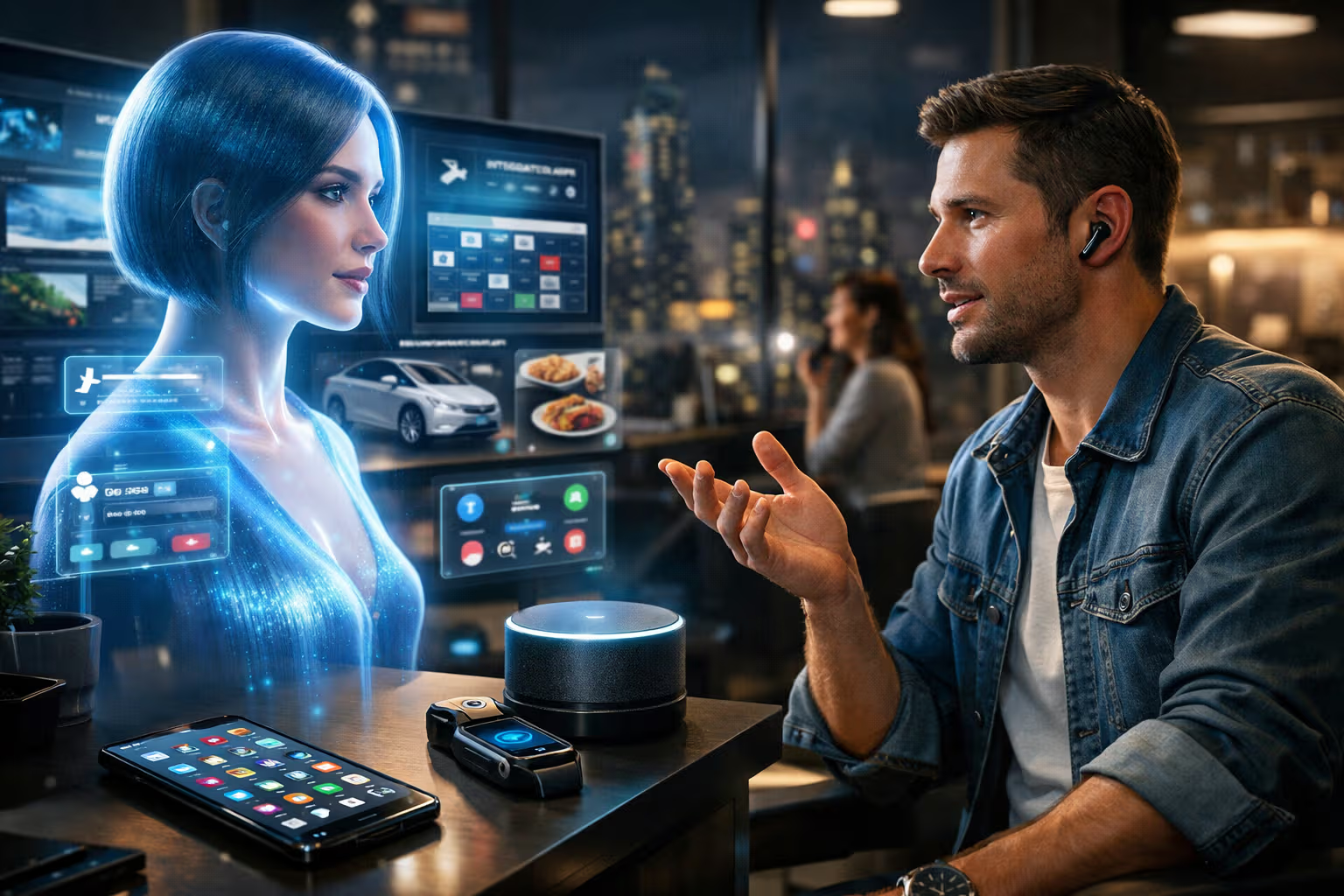
Last week, I needed to book a restaurant, check my calendar for conflicts, invite a friend, and get directions. Four apps, four context switches, four different interfaces. Or I could have said one sentence to an AI assistant and had it handle everything. I chose the AI. It was faster, simpler, and didn’t require me to remember which icon did what.
My British lilac cat, Mochi, has been operating on a voice-first interface her entire life. She meows; things happen. No touchscreen required. No app icons to tap. Just intent expressed, action delivered. She was ahead of her time, and the rest of us are finally catching up.
This article explores three converging forces that are making traditional apps obsolete: AI agents that act on your behalf, superapps that consolidate functions, and voice interfaces that bypass the screen entirely. Together, they’re reshaping how we interact with software in ways that will make today’s app-cluttered home screens look as quaint as a Windows 95 desktop.
The App Model’s Hidden Tax
We don’t notice how much the app model costs us because we’ve internalized its friction. But the costs are real.

Cognitive overhead. Each app has its own interface, its own navigation patterns, its own mental model. Learning 40 apps means maintaining 40 sets of interface knowledge. Where’s the settings button in this app? How do I search here? The learning never ends because apps never stop updating.
Context switching. Moving between apps breaks flow. You’re in email, you need a file from cloud storage, you open a different app, you find the file, you go back to email, you attach the file. Each switch interrupts the actual task you’re trying to accomplish.
Fragmented data. Your information is scattered across apps that don’t talk to each other. Notes in one place, tasks in another, calendar in a third. Connecting information requires you to be the integration layer, copying and pasting between apps.

Notification chaos. Every app wants your attention. Every app has its own notification strategy. Managing notifications means managing each app individually. The aggregate is cacophony.
Update burden. Apps need updating. Apps break after updates. Apps change their interfaces unexpectedly. The maintenance burden scales with the number of apps you use.
These costs were acceptable when apps were the only way to accomplish tasks. But they’re becoming unacceptable now that alternatives exist. The app model isn’t inherently bad; it’s just no longer the best available option for many use cases.
AI Agents: Software That Acts for You
The most significant threat to traditional apps is the AI agent—software that doesn’t just respond to commands but proactively acts on your behalf. You express an intent; the agent figures out the steps and executes them.

Consider what booking a trip currently requires. You open a flight search app, specify dates and destinations, compare options, select a flight, enter payment information, confirm. Then you do the same for a hotel. Then for car rental. Then you manually transfer confirmation details to your calendar. Five apps, thirty minutes, repetitive data entry.
An AI agent handles this differently. You say “Book my trip to Chicago next month for the Williams conference.” The agent knows your dates from your calendar, your airline and hotel preferences from past behavior, your budget from your expense policy, and your loyalty accounts from stored credentials. It searches, compares, books, and adds everything to your calendar. You approve the final plan. Five minutes, one interaction.
The agent doesn’t need five apps—it needs access to five services. The distinction matters. Apps are interfaces designed for humans to navigate. Services are capabilities that can be accessed programmatically. When AI handles the navigation, the human-facing interface becomes unnecessary.

This pattern extends across domains. Travel agents (the human kind) always worked this way—you told them what you wanted, they handled the details. AI agents restore that model, but at scale and at minimal cost. The apps we currently use were workarounds for the absence of competent agents. Now that agents exist, the workarounds become redundant.
The technology for AI agents is maturing rapidly. OpenAI, Anthropic, and Google all offer agent frameworks. Apple’s upcoming Siri overhaul is essentially an agent layer for iOS. The infrastructure for agent-based computing is being built now. The shift from app-centric to agent-centric computing isn’t hypothetical—it’s underway.
Superapps: Consolidation by Design
While Western tech fragmented functions across many apps, Asian tech took a different path. WeChat in China and Grab in Southeast Asia became “superapps”—single applications that handle messaging, payments, shopping, transportation, and dozens of other functions.

The superapp model has advantages the West is beginning to appreciate:
Single identity. One login, one payment method, one set of preferences across all functions. No password management across dozens of apps.
Integrated experience. Functions that naturally connect—messaging a friend, then paying them, then splitting a dinner reservation—flow within a single interface rather than bouncing between apps.
Reduced overhead. One app to learn, one app to update, one app to manage. The cognitive and maintenance costs compress dramatically.

Network effects. When everyone uses the same superapp, coordination becomes trivial. “Send me the money on WeChat” works because everyone has WeChat. Fragmented apps lack this universality.
Western companies are moving toward superapp models, though more cautiously. Apple’s services integration, Google’s ecosystem approach, and Meta’s messaging ambitions all point toward consolidation. The App Store model—which incentivized proliferation—is giving way to platform models that incentivize integration.
The tension is real. Apple profits from app diversity through App Store fees. But Apple also profits from users staying within its ecosystem. As AI agents reduce the need for third-party apps, Apple’s incentive shifts toward integrating more functions into the operating system itself.
Voice-First: Skipping the Screen Entirely
Voice interfaces were a joke for years. Siri’s limitations became meme material. Alexa was useful for timers and music, not much else. The promise of voice computing remained unfulfilled.

That’s changing. Large language models have transformed voice interfaces from keyword recognition systems into genuine conversational partners. You can speak naturally and be understood. You can give complex, multi-part instructions. You can have back-and-forth dialogue that refines your request.
The implications for apps are significant. Voice interfaces don’t need visual interfaces. You don’t tap icons or navigate menus—you state what you want. The app as a visual construct becomes irrelevant when interaction is verbal.
Consider the scenarios where voice already wins:
- Hands occupied (cooking, driving, exercising)
- Eyes occupied (walking, watching something)
- Quick queries (weather, time, simple facts)
- Smart home control (lights, temperature, locks)
- Multitasking (continuing other work while delegating to voice)
These scenarios are expanding as voice capability improves. Complex tasks that once required visual feedback can increasingly be handled conversationally. Booking flights, managing calendars, sending messages, making purchases—all can happen through voice, without opening an app.
The barrier has been reliability. Voice interfaces that misunderstand frustrate more than they help. But reliability is improving faster than most people realize. The voice assistant of 2026 is dramatically more capable than the voice assistant of 2023. The trajectory points toward voice as a primary—not supplementary—interaction mode.
flowchart TD
    A[Traditional App Model] --> B[One App Per Function]
    B --> C[Visual Interface Required]
    C --> D[User Navigates Manually]
    D --> E[Context Switches Between Apps]

    F[Emerging Model] --> G[AI Agent Layer]
    G --> H[Superapp Consolidation]
    H --> I[Voice-First Interface]
    I --> J[User States Intent]
    J --> K[Agent Executes Across Services]
The Convergence
AI agents, superapps, and voice interfaces aren’t competing trends—they’re converging into a new computing paradigm. Each reinforces the others:

AI agents enable superapps. When an agent handles the complexity of multiple services, integrating them into a single app becomes feasible. The agent is the integration layer that makes the superapp possible.
Superapps enable voice interfaces. A unified app with unified identity makes voice commands practical. “Order my usual from Starbucks and pay with my Grab balance” works when ordering and paying are in the same system.
Voice interfaces enable AI agents. Natural language is the native interface for AI agents. Speaking to an agent is more natural than tapping through app interfaces to give it instructions.
The convergence produces something qualitatively different from any individual trend. Not just voice control. Not just a superapp. Not just an AI assistant. Rather, a new model where software understands intent, takes action, and requires minimal human navigation.

This model has a name in the industry: “ambient computing.” The computer fades into the background. You don’t interact with software; you express needs and software fulfills them. The interface is invisible because it’s everywhere—in your voice, in your environment, in your devices—rather than confined to a specific app on a specific screen.
Method
This analysis synthesizes multiple research approaches:
Step 1: Technology Trajectory Analysis I examined the development trajectories of AI agents, superapp platforms, and voice interfaces over the past five years, identifying acceleration patterns and capability thresholds.

Step 2: Usage Pattern Research Analysis of how people actually use apps—including time-in-app data, context switching frequency, and task completion patterns—revealed the friction costs of the current model.
Step 3: Comparative Platform Analysis I studied superapp models in Asia (WeChat, Grab, Gojek) to understand how consolidated experiences differ from fragmented Western approaches.
Step 4: Industry Expert Interviews Conversations with platform developers, AI researchers, and UX designers provided insight into intentional design shifts underway at major technology companies.
Step 5: Trend Extrapolation I projected current trends forward, considering adoption curves, generational preferences, and infrastructure development timelines.

What This Means for Users
For everyday technology users, the transition from apps to agents offers mostly benefits:
Reduced cognitive load. You don’t need to know which app does what. Express the goal; the agent handles the routing.
Faster task completion. Skip the navigation, the context switching, the manual integration. State intent, receive result.

More accessible technology. Voice-first interfaces reduce the barrier for people who struggle with visual interfaces—the elderly, the visually impaired, anyone who finds screen navigation difficult.
Better integration. Information flows between functions without manual transfer. Your calendar knows about your flights because the agent made both bookings.
The concerns are also real:
Privacy consolidation. Agents and superapps know more about you than any single app does. The consolidation of data creates consolidation of surveillance.

Dependency risk. When everything runs through one agent or one superapp, failure is catastrophic. The fragmented app model had resilience through redundancy.
Platform power. Whoever controls the agent layer controls access to users. Platform gatekeeping, already a concern with app stores, intensifies when platforms become the primary interface.
Skill atrophy. When agents handle tasks, you stop learning how to do them yourself. This might not matter for booking flights, but could matter for more consequential skills.
What This Means for Developers
For the people building software, the transition is more disruptive. The app development model—build an interface, acquire users, monetize through the interface—is threatened fundamentally.

Interface becomes optional. If users access your service through agents rather than your app, your interface is irrelevant. You become a service provider, not an app developer. The margins and business models are different.
Discovery changes. App Store optimization becomes less important when users don’t browse app stores. Being discoverable means being accessible to agents, which means having APIs and being integrated into agent ecosystems.
Differentiation shifts. When your interface isn’t the user touchpoint, visual design and UX flow matter less. Service quality, reliability, and capability matter more. Competition moves from interface to substance.

New skills required. Building for agents requires different skills than building for humans. API design, agent integration, conversational interfaces—these become the core competencies.
The developers who thrive will be those who recognize the shift early and adapt. Some will build the agents themselves. Others will build services that agents access. Few will continue building traditional apps for much longer.
The Timeline Question
How quickly will this transition happen? The honest answer: faster than most expect, slower than enthusiasts predict.

The infrastructure is being built now. Apple’s 2025-2026 Siri overhaul, Google’s agent frameworks, OpenAI’s action-taking capabilities—the building blocks are arriving. The question is adoption and reliability.
Near-term (2026-2027): AI agents handle simple, well-defined tasks reliably. Voice interfaces improve to the point of genuine utility. Superapps expand in Western markets, though fragmented apps remain dominant.
Medium-term (2028-2030): Agents handle complex, multi-step tasks. Voice becomes a primary interface for a significant user segment. The app-per-task model shows visible decline. New users may never develop the app-browsing habit.
Long-term (2030+): The app store model is niche, serving specialist applications and legacy users. Agent-based computing is default. Voice is ubiquitous. The smartphone itself might evolve into something smaller, screenless, ambient.

This timeline could accelerate if AI capability jumps unexpectedly or if a dominant platform aggressively pushes the new model. It could slow if reliability problems persist or if privacy concerns trigger regulatory intervention.
Mochi will be unaffected by these shifts. Her interface—meowing at humans—has worked for thousands of years and will work for thousands more. Technology that serves needs without requiring adaptation is her specialty. The rest of us are still learning.
Generative Engine Optimization
The concept of Generative Engine Optimization becomes crucial as apps give way to agents. GEO involves optimizing for AI systems that generate responses and take actions. In an agent-mediated world, being visible to agents matters more than being visible in app stores.

For service providers, GEO means:
API quality. Agents access services through APIs. Well-designed, reliable, well-documented APIs are more discoverable and more likely to be used by agents.
Structured data. Agents understand structured information better than unstructured. Services that provide clear, organized data are easier for agents to work with.
Reputation signals. Agents will assess trustworthiness somehow. Reviews, ratings, reliability history—the signals that help agents choose between competing services become the new SEO.

Integration partnerships. Being included in major agent ecosystems—Apple’s Siri, Google’s Assistant, OpenAI’s agent framework—provides access to users who never see your service directly.
For users, GEO means understanding how to work with agents effectively:
Clear intent expression. Agents work better with clear, specific requests. Learning to express what you want precisely becomes a valuable skill.
Preference training. Agents that learn your preferences serve you better. Investing time in training your agent—correcting mistakes, confirming choices—improves long-term utility.
Trust calibration. Knowing when to trust agent recommendations and when to verify independently becomes important as agents handle more consequential tasks.
The Apps That Survive
Not all apps will disappear. Some categories resist the agent/superapp/voice model:

Creative tools. Graphic design, music production, video editing—these benefit from visual interfaces that won’t be replaced by voice. You can’t voice-control Photoshop effectively.
Games. Gaming is interactive entertainment, not task completion. Games won’t become voice-activated agents (mostly).
Professional specialists. Complex professional tools—CAD software, development environments, trading platforms—serve expert users who need direct control and detailed interfaces.
Social expression. Social media involves browsing, discovering, and expressing identity. These are human activities that resist agent automation (though AI will transform how they work).

Privacy-sensitive functions. Some users will prefer direct app access for sensitive functions rather than routing through agents. Banking, health, and personal communication might retain dedicated apps for users who don’t trust consolidated systems.
The apps that survive will be those serving use cases where the app model genuinely works better—not those serving use cases that just haven’t been disrupted yet.
Preparing for the Transition
Whether you’re a user, developer, or business, the transition from apps to agents deserves attention now:
For users: Experiment with AI assistants and voice interfaces. The skills you develop now—expressing intent clearly, evaluating agent output, training preferences—will matter more as agents become primary interfaces.

For developers: Start thinking in services, not apps. Build APIs. Consider how agents might access your functionality. The interface you’re building might not be the interface users eventually use.
For businesses: Evaluate your app strategy. Are you building apps because apps are the right model, or because apps are what you’ve always built? Consider how agent-based computing might reach your customers.
For everyone: Watch the major platforms. Apple, Google, OpenAI, and others are placing bets on this transition. Their moves will shape how the shift unfolds.

The Deeper Question
The transition from apps to agents raises a question beyond technology: what is the computer’s role in our lives?
The app model made users into operators. You learned interfaces, navigated options, made choices at each step. The computer responded to your commands. You were in control, but you bore the burden of control.

The agent model makes users into directors. You express intent; the computer figures out how. You evaluate outcomes, not processes. You maintain strategic control while delegating tactical execution.
This is a different relationship with technology. Less hands-on, more delegated. Less direct control, more trust in systems. The skills that matter shift from navigation to direction, from operation to judgment.
Some people will prefer the older model. They’ll want the control, the transparency, the direct connection to what their computer is doing. These users will be served, but they’ll increasingly be a minority.

Most users, though, will embrace the shift. They never loved navigating apps—they tolerated it as the price of getting things done. When that price drops, they’ll happily pay less. The app-per-task model was a solution, not a goal. Better solutions are arriving.
Final Thoughts
My 37 apps represent a minimalist approach to the current model. But the truly minimalist future might be one app—or no apps, just an agent layer that accesses whatever services I need.

The transition won’t be instant or complete. Apps have momentum. Users have habits. Developers have investments. The installed base of the app model is enormous. But momentum dissipates. Habits change. Investments depreciate. The installed base of the horse-drawn carriage was enormous too.
Traditional apps won’t disappear entirely. They’ll become specialist tools, legacy systems, and minority preferences. The mainstream will move to something different—agents that act, superapps that consolidate, voices that command.
Mochi will observe this transition from her sunny spot by the window. Her interface predates apps and will outlive them. Meow, receive. The simplicity she embodies is what technology is finally approaching.

The app icons on your home screen are relics of a paradigm that’s ending. They represent the best solution we had when we couldn’t talk to computers and computers couldn’t act on our behalf. Both limitations are dissolving.
The future isn’t opening an app to accomplish a task. The future is expressing a need and having it met. That future is arriving faster than the apps on your screen are updating. By the time they finish downloading, the world they were built for might be gone.
The app era was remarkable. It democratized computing, created industries, and changed how we live. It deserved its dominance. But its time is passing. What comes next will be different, probably better for most uses, and definitely here sooner than your app drawer suggests.
Start saying goodbye to the icons. They served us well. But their replacement is already on the way.