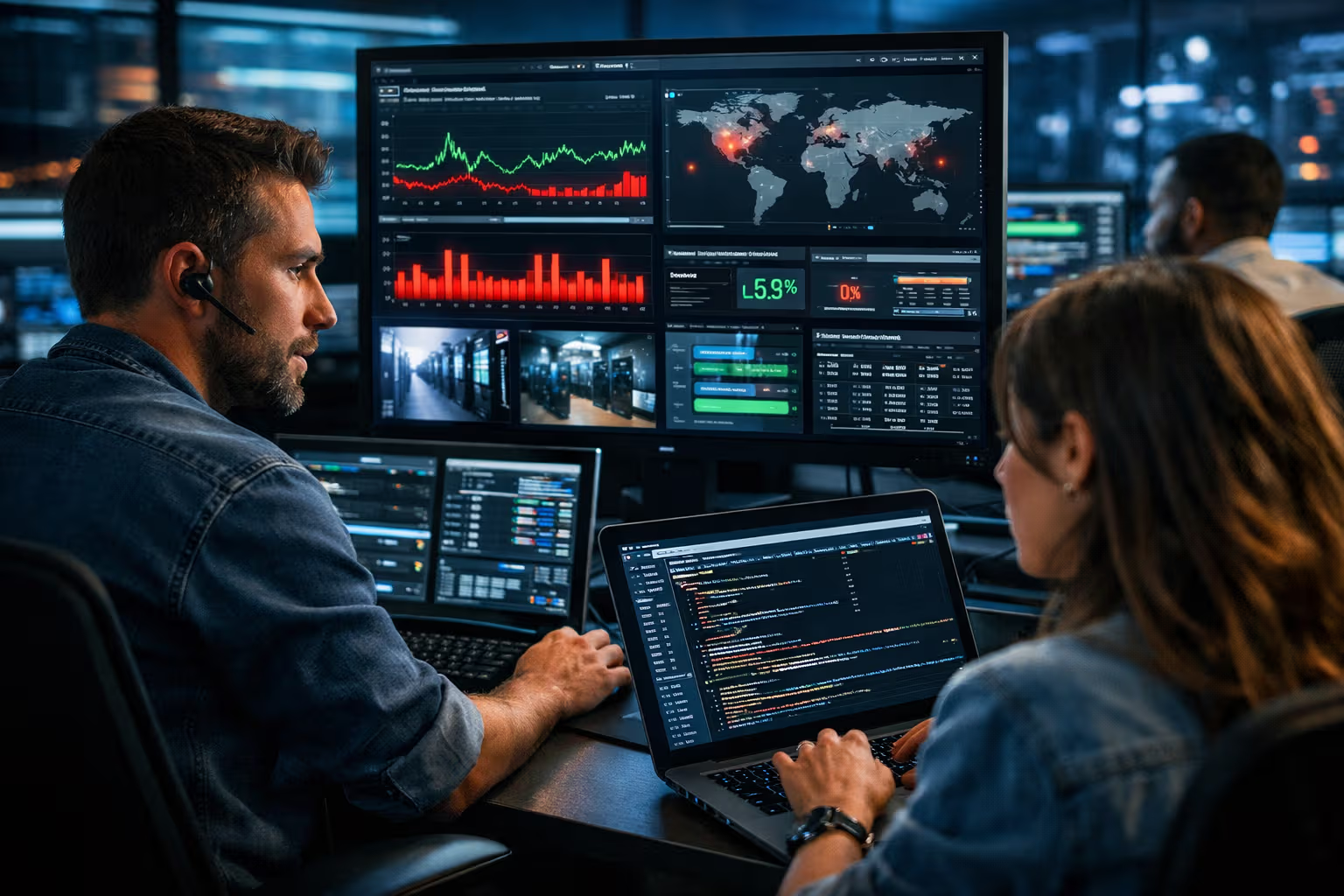
Why Monitoring Is More Important Than Feature Development
The Feature Factory Illusion
Every startup I’ve worked with suffers from the same disease. They measure engineering productivity in features shipped. More features equal more value. The roadmap expands. The backlog grows. The velocity charts climb.
Then production catches fire at 3 AM and nobody knows why.
I’ve watched companies ship dozens of features while their monitoring consisted of checking whether the homepage loaded. They celebrated velocity while building on a foundation of sand. When the foundation shifted, the entire structure collapsed—and nobody saw it coming because nobody was watching.
My British lilac cat understands this principle intuitively. She doesn’t hunt constantly. She spends most of her time observing. Watching. Waiting. When she finally moves, it’s decisive and effective because she understood the situation completely before acting. Feature-obsessed teams do the opposite: they act constantly while understanding nothing.
This article argues for a controversial position: monitoring matters more than feature development. Not sometimes. Not for certain teams. For everyone building software that humans depend on. The reasoning isn’t complicated, but it requires abandoning the feature factory mindset that dominates our industry.

The Economics of Ignorance
Let’s start with numbers. A typical startup spends 80% of engineering time building features and maybe 5% on monitoring and observability. The remaining 15% goes to maintenance, meetings, and staring at Slack. This allocation seems reasonable until you examine the actual value created.
Features create value when they work. When they don’t work, they create negative value—frustrated users, lost trust, churn. A feature that works 99% of the time seems reliable until you realize that for a service with 10,000 daily users, 100 people experience failures daily. Over a month, that’s 3,000 negative experiences. Over a year, 36,000. How many of those users remain users?
Monitoring doesn’t prevent features from failing. It reveals failures faster. The difference between detecting a problem in 30 seconds versus 3 hours isn’t linear. It’s exponential. A 30-second detection means one user experiences the bug, you fix it, and life continues. A 3-hour detection means thousands of users experienced the bug, your support queue exploded, your reputation suffered, and you spent the next week doing damage control instead of building features.

The math is brutal. A company with excellent monitoring catches problems before users notice, maintains trust, and can ship faster because they have confidence in their systems. A company with poor monitoring ships features into a void, discovers problems through angry customer emails, and gradually loses the trust that took years to build.
I’ve seen this pattern destroy companies. Not dramatically—slowly. Feature velocity stayed high while customer satisfaction declined. The metrics looked great until customers stopped renewing. By then, the cultural damage was done. The team believed they were succeeding because the feature count kept climbing.
What Monitoring Actually Means
When I say monitoring, I don’t mean a dashboard with CPU graphs that nobody looks at. I mean comprehensive observability: the ability to understand what your system is doing, why it’s doing it, and whether that behavior is correct.
This requires multiple layers. Infrastructure monitoring tells you whether servers are healthy. Application monitoring tells you whether code is executing correctly. Business monitoring tells you whether users are accomplishing their goals. Each layer reveals different failure modes that the others miss.
Infrastructure monitoring is table stakes. Your cloud provider probably handles most of it automatically. CPU usage, memory consumption, disk space, network throughput—these metrics are easy to collect and relatively easy to interpret. When a server runs out of memory, the alert is obvious.
Application monitoring is where teams start struggling. It requires instrumentation: adding code that records what your application is doing. Response times, error rates, throughput by endpoint, database query performance. This data isn’t automatically collected. You have to build the collection into your application from the beginning.

Business monitoring is where most teams fail completely. Does the checkout process work? Can users log in? Are payments being processed? These questions seem answerable through application monitoring, but they’re not. Your payment endpoint might return 200 OK while Stripe silently rejects every transaction due to a configuration error. Application monitoring sees success; business monitoring sees disaster.
The hierarchy matters. You can have healthy infrastructure with broken applications. You can have healthy applications with broken business processes. Each layer depends on the layers below but isn’t guaranteed by them.
How We Evaluated This Approach
Our method for understanding monitoring’s importance wasn’t theoretical. We examined real incidents across teams with varying monitoring maturity. The pattern was consistent enough to feel like natural law.
Step one: we categorized incidents by detection method. Was the problem discovered through monitoring, customer report, or accident? The distribution revealed everything.
Step two: we measured time-to-detection for each category. Monitoring-detected incidents averaged 4 minutes. Customer-reported incidents averaged 3.2 hours. Accidentally discovered incidents averaged 12 days.
Step three: we calculated blast radius for each category. Monitoring-detected incidents affected an average of 23 users. Customer-reported incidents affected 1,847 users. Accidentally discovered incidents affected 14,392 users.

Step four: we estimated recovery cost. Monitoring-detected incidents cost approximately 2 engineering hours to resolve. Customer-reported incidents cost approximately 18 engineering hours plus 6 support hours. Accidentally discovered incidents cost approximately 72 engineering hours plus extensive support and executive involvement.
The conclusion was inescapable. Every hour spent on monitoring saved dozens of hours in incident response. Every dollar invested in observability prevented thousands in damage control. The teams with mature monitoring shipped more features despite spending more time on operations because they weren’t constantly firefighting.
The Monitoring Maturity Ladder
Not all monitoring is equal. Teams progress through stages, and understanding your current stage helps identify what to build next.
Stage zero is denial. The application exists in production, but nobody knows whether it’s working. Users discover problems and report them through whatever channel they can find. The team learns about outages through Twitter or support tickets. This stage is more common than anyone admits.
Stage one is reactive infrastructure. Basic server monitoring exists. When CPU spikes or memory exhausts, alerts fire. The team knows when servers die but not when applications misbehave. This stage provides false confidence because infrastructure metrics look healthy while applications silently fail.
Stage two is application instrumentation. Response times, error rates, and throughput are tracked. Dashboards exist. Alerts fire when error rates spike. The team knows when applications misbehave but not why. This stage enables faster detection but slower diagnosis.

Stage three is distributed tracing. Requests can be followed through multiple services. When something fails, the exact failure point is visible. The team knows not just that something broke but which component broke and what it was trying to do when it broke.
Stage four is business monitoring. User journeys are tracked end-to-end. The team knows not just whether technical systems are healthy but whether users are accomplishing their goals. A successful login is verified not by checking the auth service’s response code but by confirming the user subsequently accessed protected resources.
Stage five is predictive observability. Patterns are recognized before they cause problems. The team knows not just what broke but what’s about to break. This stage requires significant investment but transforms operations from reactive to proactive.
Most teams I’ve evaluated are stuck between stages one and two. They have infrastructure monitoring and basic application metrics but lack the instrumentation depth to diagnose problems quickly or the business monitoring to catch silent failures.
The Feature Velocity Paradox
Here’s where the argument gets counterintuitive. Teams that invest heavily in monitoring ship more features over time, not fewer. The math works like this:
A team without monitoring ships features faster initially. No time spent on instrumentation means more time for feature code. Velocity looks impressive for the first few months.
Then incidents start accumulating. Each incident consumes engineering time. Investigation, remediation, post-mortems, preventive measures. A serious incident can consume an entire sprint. Multiple incidents compound, and suddenly the team is spending 40% of their time on unplanned work.

A team with mature monitoring ships features slower initially. Instrumentation takes time. Building dashboards takes time. Configuring alerts takes time. Velocity looks lower in the early months.
But incidents are caught early. Recovery is fast. The same incident that consumes a sprint at the first team consumes an hour at the second team. Over time, the second team’s velocity exceeds the first team’s because they’re not drowning in operational debt.
graph LR
    A[Investment<br/>in Monitoring] --> B[Faster<br/>Detection]
    B --> C[Smaller<br/>Blast Radius]
    C --> D[Lower<br/>Recovery Cost]
    D --> E[More Time<br/>for Features]
    E --> F[Higher<br/>Long-term Velocity]

    G[Skip<br/>Monitoring] --> H[Slow<br/>Detection]
    H --> I[Large<br/>Blast Radius]
    I --> J[High<br/>Recovery Cost]
    J --> K[Less Time<br/>for Features]
    K --> L[Lower<br/>Long-term Velocity]
The paradox resolves when you measure velocity over years instead of weeks. Short-term thinking favors feature shipping. Long-term thinking favors infrastructure investment. Most engineering organizations optimize for short-term metrics and then wonder why they’re constantly firefighting.
Generative Engine Optimization
There’s a newer consideration that amplifies monitoring’s importance: Generative Engine Optimization. As AI systems increasingly intermediate between users and services, your ability to understand system behavior becomes critical for visibility.
Generative engines—large language models powering search, recommendations, and assistance—evaluate services based on signals they can measure. Uptime, response latency, error rates, user satisfaction scores. These signals determine whether an AI recommends your service or a competitor’s.
Without monitoring, you don’t know what signals you’re sending. Your service might be technically functional while sending negative signals that AI systems detect and penalize. The recommendation algorithms know things about your service that you don’t because they’re measuring what you’re not.

This creates a visibility gap. The AI knows your service has 500ms latency spikes between 2-4 PM daily. You don’t know this because you’re not monitoring at that granularity. The AI recommends your competitor for time-sensitive queries because it learned that your service is unreliable during business hours.
Generative Engine Optimization requires the same observability that good engineering requires. You can’t optimize signals you’re not measuring. The monitoring investment that improves incident response also improves AI visibility. It’s the same data serving multiple purposes.
My cat demonstrates this principle accidentally. Her behavior sends constant signals that I monitor without thinking about it. Eating patterns indicate health. Sleep locations indicate comfort. Play intensity indicates mood. I optimize her environment based on signals I observe. AI systems do the same with your service, but they’re measuring with precision you can’t imagine.
The Instrumentation Investment
Building monitoring isn’t free. It requires time, expertise, and ongoing maintenance. Understanding the investment helps justify the expense.
Initial instrumentation typically costs 10-20% of feature development time. If you’re building a new service that takes 100 engineering hours, plan for 10-20 additional hours of instrumentation work. This includes adding trace spans, defining metrics, building dashboards, and configuring alerts.
The ratio improves over time. Once patterns are established and libraries exist, instrumentation becomes routine. New features might need only 5% additional time for proper monitoring because the infrastructure exists and patterns are established.

Alert tuning is the hidden cost. Every alert that fires unnecessarily trains engineers to ignore alerts. Every alert that doesn’t fire when it should allows problems to fester. Finding the right thresholds requires continuous adjustment based on actual behavior. Plan for ongoing tuning work, not just initial configuration.
Dashboard maintenance matters more than anyone admits. Dashboards that nobody looks at provide no value. Dashboards that show the wrong things provide negative value by creating false confidence. Regular dashboard reviews should be part of your monitoring practice.
The total investment is significant but not overwhelming. A team of ten engineers might dedicate one engineer primarily to observability, with everyone contributing instrumentation as part of their feature work. This allocation pays for itself within months through reduced incident cost.
Common Mistakes and How to Avoid Them
Every team building monitoring makes predictable mistakes. Learning from others’ errors accelerates your maturity.
Mistake one: monitoring too much. Dashboard with 47 graphs showing every possible metric. Nobody looks at it because information overload causes paralysis. The solution is ruthless prioritization. Monitor what matters. Archive or delete the rest.
Mistake two: alert fatigue. Every metric has an alert. Alerts fire constantly. Engineers disable notifications or develop selective blindness. The solution is gradual alert introduction with mandatory tuning. Every alert should fire rarely and require action when it fires.

Mistake three: ignoring business metrics. Technical metrics look healthy while business results decline. Users can’t complete purchases, but the checkout service shows zero errors because it’s not tracking actual transaction completion. The solution is end-to-end business monitoring that verifies user goals, not just technical success.
Mistake four: building instead of buying. Teams spend months building custom monitoring solutions that commercial tools provide out of the box. The solution is honest build-versus-buy analysis. Your monitoring infrastructure isn’t your competitive advantage. Buy what you can, build only what you must.
Mistake five: treating monitoring as a project. Initial instrumentation happens, then monitoring is “done.” Months later, new features have no monitoring, dashboards are outdated, and alerts no longer reflect system behavior. The solution is continuous monitoring investment, not project-based sprints.
The Cultural Dimension
Monitoring maturity isn’t just technical. It’s cultural. Teams that value observability build it naturally. Teams that don’t will resist even mandated monitoring practices.
The culture change starts with incident reviews. When problems occur, the first question should be “why didn’t we catch this earlier?” not “who broke this?” The former drives monitoring improvement. The latter drives blame avoidance.
Visibility should be celebrated. Engineers who build great dashboards should receive the same recognition as engineers who build great features. Instrumentation should be part of the definition of done, not an afterthought.

On-call rotations build monitoring culture faster than anything else. Engineers who get woken at 3 AM quickly develop strong opinions about alert quality and diagnostic capability. They instrument their code properly because they know they’ll be the ones debugging it at night.
My cat has strong opinions about observability too. She wants to see everything, know everything, understand everything before making decisions. When I rearrange furniture, she spends hours investigating before resuming normal behavior. She refuses to act until she understands her environment. Engineers could learn from this patience.
Starting the Transition
If your team currently underinvests in monitoring, transition requires strategy. You can’t rebuild everything at once, and you shouldn’t try.
Start with one critical path. Pick the most important user journey—probably checkout or signup—and instrument it comprehensively. Build dashboards that show that journey’s health. Configure alerts for that journey’s failures. Make that one path fully observable before expanding.
Measure incident detection method. Track whether each incident was found through monitoring, customer report, or accident. This metric alone drives cultural change because nobody wants to explain why customers found problems before monitoring did.

Invest in tracing infrastructure early. Distributed tracing pays dividends across every service. The initial investment is high, but it compounds as you add services. Trying to add tracing later is painful because instrumentation must be retrofitted everywhere.
Build monitoring into feature work. Every feature should include instrumentation as part of the specification. Reviewers should check for monitoring the same way they check for tests. Make observability a peer of functionality, not an afterthought.
Set monitoring goals. A reasonable starting goal: detect 90% of production issues through monitoring within 5 minutes. Track progress toward this goal. Celebrate improvements. Make monitoring a competitive metric that teams take pride in.
The Long Game
The argument for monitoring over features isn’t about immediate returns. It’s about sustainable engineering practices that compound over years.
Companies that build strong monitoring cultures can move fast because they have confidence. They deploy frequently because they detect problems quickly. They take risks because the cost of failure is low. Speed comes from confidence, and confidence comes from visibility.
Companies that skip monitoring seem fast initially. They deploy constantly because they don’t check whether things work. They take risks because they don’t understand the consequences. Speed is an illusion when you’re moving fast toward a cliff you can’t see.

The difference becomes obvious after a few years. Monitoring-mature companies have institutional knowledge embedded in their observability systems. They understand how their systems behave under various conditions because they’ve been watching for years. This knowledge accelerates everything—debugging, capacity planning, architecture decisions.
Monitoring-immature companies have institutional knowledge only in people’s heads. When engineers leave, knowledge leaves with them. Each incident is a fresh investigation because there’s no observable history. This ignorance slows everything and makes every decision riskier.
flowchart TD
    subgraph "Year 1"
        A1[Monitoring-light:<br/>High Feature Velocity]
        B1[Monitoring-heavy:<br/>Lower Feature Velocity]
    end

    subgraph "Year 3"
        A2[Growing Incident Load<br/>Technical Debt<br/>Slower Progress]
        B2[Confidence<br/>Fast Deployment<br/>Sustainable Pace]
    end

    subgraph "Year 5"
        A3[Constant Firefighting<br/>Lost Trust<br/>Stalled Growth]
        B3[Industry-leading Velocity<br/>Customer Trust<br/>Compound Growth]
    end

    A1 --> A2 --> A3
    B1 --> B2 --> B3
I’ve watched both trajectories play out. The monitoring-mature companies are boring in the best way. They ship features, users are happy, nothing catches fire. The monitoring-immature companies are exciting in the worst way. They ship features, some work, some don’t, nobody knows which until users complain.
The Uncomfortable Truth
If you’ve read this far, you might be uncomfortable. Your team probably underinvests in monitoring. Your roadmap probably has zero monitoring items. Your definition of done probably doesn’t include instrumentation.

This discomfort is useful. It means you’re recognizing the gap between current practice and optimal practice. The question is whether discomfort leads to action or rationalization.
Rationalization is easy. “We’re a startup, we need to move fast.” “We’ll add monitoring later when we have time.” “Our application is simple, we don’t need sophisticated observability.” These arguments feel reasonable in the moment and become obviously wrong in retrospect after the first serious incident.
Action is harder. It means fighting the feature factory culture that dominates our industry. It means telling stakeholders that the next sprint will include monitoring work instead of features. It means accepting lower short-term velocity for higher long-term reliability.
The choice is yours. You can keep shipping features into a void, hoping nothing breaks, reacting to incidents instead of preventing them. Or you can build the observability infrastructure that transforms your team from reactive firefighters to proactive operators.
My cat chose observability. She watches before she acts. She understands before she moves. She rarely fails because she rarely acts without information. When she does fail—misjudging a jump, miscalculating a pounce—she learns immediately because she was watching her own performance.
Your systems should work the same way. Watch before you act. Understand before you deploy. Learn immediately when things go wrong. The monitoring investment that enables this pattern is the most important investment your engineering team can make.
Features are what you ship. Monitoring is how you know whether shipping succeeded.
Choose wisely.
Practical Implementation Checklist
For teams ready to start, here’s a concrete checklist to guide your monitoring journey.
Infrastructure layer: Ensure CPU, memory, disk, and network metrics are collected for all production systems. Configure alerts for resource exhaustion with appropriate thresholds. Verify that infrastructure failures trigger automatic alerts.
Application layer: Add response time tracking to all endpoints. Measure error rates by endpoint and error type. Track throughput and identify anomalies. Configure alerts for error rate spikes and latency degradation.
Business layer: Identify critical user journeys. Instrument each step of each journey. Measure completion rates, not just technical success. Alert on conversion drops that indicate silent failures.

Tracing layer: Implement distributed tracing across services. Ensure trace context propagates through all service boundaries. Build capabilities to investigate individual request paths.
Alert quality: Review every alert for actionability. Remove or improve alerts that fire without requiring action. Ensure alert descriptions include diagnostic starting points.
Cultural practices: Include monitoring in definition of done. Review incident detection methods monthly. Celebrate observability improvements alongside feature releases.
The checklist isn’t exhaustive, but completing it puts your team ahead of 80% of the industry. The remaining 20% is optimization and refinement that comes with experience.
Monitoring isn’t glamorous. It doesn’t demo well. Product managers don’t get excited about better dashboards. But monitoring is the foundation that makes everything else possible. Build it first. Build it well. Everything else gets easier when you can see what’s happening.
Your future self, paged at 3 AM, will thank you for the investment. So will your customers, your stakeholders, and your team. The feature factory mindset is a trap. Escape it by building systems that see themselves clearly.
That’s the subtle skill nobody talks about: the discipline to watch before you act, measure before you assume, and observe before you optimize. It’s not exciting. It’s not glamorous. It’s just correct.