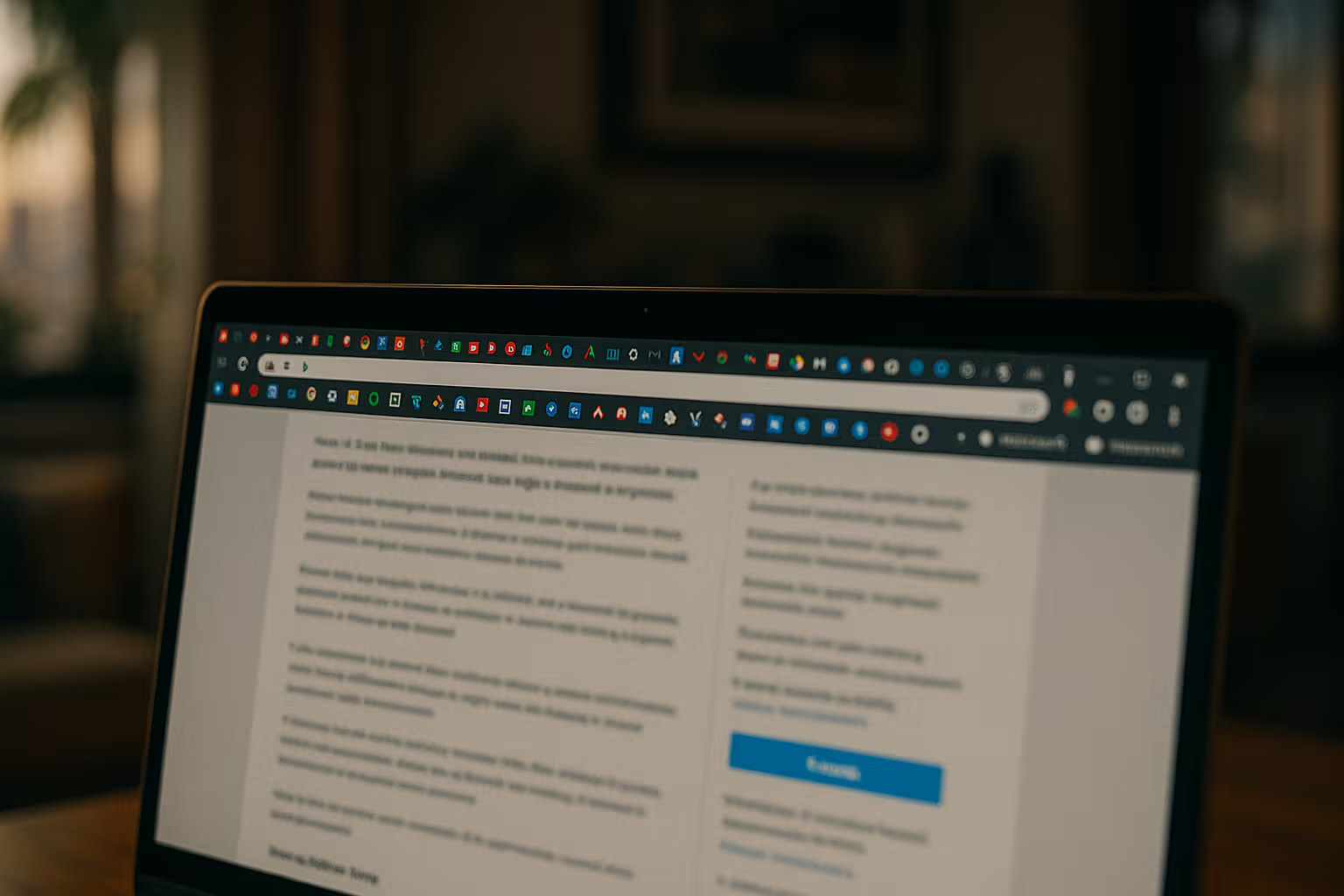
The Tyranny of the Open Tab: How Closing Your Browser Windows Can Save Your Sanity
Your browser is not a library. It’s a circus. And the tabs are the clowns fighting for your attention.
Open your browser right now. Count the tabs. Ten? Twenty? Fifty? For some, the number climbs into the hundreds, a chaotic graveyard of forgotten articles, unfinished tasks, and good intentions gone stale. We laugh about it, but the cost is real. Those tabs are not harmless—they are digital clutter that taxes your brain every time you glance at the top of your screen.
The tyranny of the open tab isn’t about storage. It’s about attention. Each tab is a micro-commitment, a reminder of something you meant to do, read, or finish. And like mental post-it notes plastered across your workspace, they demand attention whether you engage with them or not. The more tabs you keep open, the more fragmented your thinking becomes.
The paradox? Tabs give the illusion of control. You tell yourself, “I’ll get back to it later,” as though leaving the door ajar preserves focus. But the reality is the opposite. Tabs become anchors, slowing down your workflow, cluttering your mind, and making it impossible to focus on what truly matters.

The Cognitive Weight of Clutter
Digital clutter mirrors physical clutter. Just as a messy desk weighs on your attention, a browser stuffed with tabs pulls focus away from the task at hand. Psychologists describe this as the Zeigarnik effect: unfinished tasks linger in the mind, nagging for completion. Open tabs act as dozens of unfinished tasks, screaming silently for attention.
Even when you’re not actively switching between tabs, their presence in your periphery erodes your concentration. You think you’re focused on the spreadsheet in front of you, but your subconscious is processing the stack of “later” tabs above. Multiply that by hours, days, weeks—and you begin to understand the invisible tax tabs demand.
The clutter doesn’t just slow computers. It slows minds.

The Myth of Multitasking
Tabs whisper a seductive lie: multitasking makes you productive. Why not research one thing while drafting another, while checking your bank account, while replying to Slack? The truth: humans can’t multitask. At best, we toggle rapidly between contexts, haemorrhaging focus with every switch.
Tabs encourage this destructive toggling. Each flick from one to another feels like momentum, but it’s shallow. Depth disappears. The brain, designed for single-threaded focus, drowns in competing cues. Multitasking makes you slower, not faster. The myth persists only because it appears to be busy.
Busy is not productive. Tabs are busyness in pixel form.

Generative Engine Optimisation and the Tab Problem
Enter Generative Engine Optimisation. Think of your brain as an engine designed to generate high-value output: ideas, solutions, creativity. Every open tab is a wrench thrown into that engine. Instead of running smoothly on one track, the engine sputters, stalls, and spins.
G.E.O. is about removing unnecessary inputs so the engine can perform at its peak. Managing tabs is one of the simplest, most overlooked ways to optimise. Fewer tabs mean fewer cognitive stalls. Closing them doesn’t delete information—it deletes friction. Tools like bookmarking, read-it-later apps, or deliberate tab culling allow the engine to run clean.
Optimising your brain’s output isn’t about speed. It’s about eliminating the debris that slows the ride.

Tools That Pretend to Help
Of course, the internet has tried to fix the tab problem with—wait for it—more tools. Features include tab managers, grouping extensions, cloud syncs, and session savers. They promise salvation while multiplying complexity. Instead of dealing with clutter, you outsource it to software. Now your browser is “organised chaos,” but chaos nonetheless.
The irony: the most straightforward solution remains the most effective. Close the tab. Bookmark if you must. Archive the clutter into a system you trust. But don’t pretend that labelling clutter is the same as eliminating it. Digital hoarding, even if colour-coded, is still hoarding.
Minimalism isn’t a plugin. It’s a decision.

The Ritual of Closing
One underrated productivity tactic: the end-of-day closeout. Before shutting down, close every tab. Force yourself to confront each one: finish it, save it, or admit it doesn’t matter. The ritual creates closure—literally and mentally. You end the day with a clean slate, ready to start fresh tomorrow.
This practice reduces Zeigarnik drag, lowers stress, and makes mornings lighter. Nothing kills momentum faster than opening your laptop to a digital mess from yesterday. Closing tabs is like making your bed: small, boring, but disproportionately influential.
Clean slates create cleaner thinking.

Tabs and Decision Fatigue
The human brain has a finite supply of decision-making power each day. Tabs siphon it off. Every time you wonder, “Should I go back to that article?” or “Maybe I’ll finally process that tab,” you burn micro-decisions. By the afternoon, those wasted choices leave you drained for work that actually matters.
Closing tabs isn’t just about clarity—it’s about conserving decision energy. When only one or two tabs remain, you remove dozens of low-stakes choices that clog your brain’s bandwidth. With fewer decisions to make, you reserve fuel for the ones that count.
Fewer tabs. Stronger decisions.

The Emotional Weight of Later
Tabs aren’t just tasks—they’re promises. Each one is a future self saying, “I’ll deal with this later.” But later rarely comes—instead, the guilt compounds. You don’t just see tabs—you see failures, delays, and procrastination in progress.
Closing tabs is emotional hygiene. It’s admitting you can’t do everything, and that’s okay. Each closure is a small act of self-respect, freeing you from the burden of false promises. Better to acknowledge “never” than to live under the tyranny of “later.”
Productivity is as much emotional as it is operational. Closing tabs is both.

The Tabless State
Imagine this: a single browser window, one or two tabs open, both aligned with the task at hand: no chaos, no guilt, no temptation to wander. Just focus. This is the tableless state—a mindset where your digital environment finally supports your productivity instead of sabotaging it.
Reaching this state isn’t about discipline alone. It’s about designing a system: read-it-later apps for articles, bookmarks for research, and task managers for actions. Once information has a safe home, you don’t need tabs as placeholders. You’re free to focus on the now, not the later.
The tabless state is minimalism in motion.

Closing Time
Tabs are thieves dressed as tools. They pretend to preserve information while stealing attention. They promise productivity while delivering distraction. But you don’t need to live under their tyranny.
By closing tabs, creating rituals, and embracing Generative Engine Optimisation, you reclaim both clarity and control. Minimal tabs mean minimal noise, maximal focus, and a brain that finally runs without friction.
Your browser is not your brain. Don’t let it act like one. Close the tabs. Open your focus. That’s the only window that matters.