The Truth About Batteries: Why Phone Battery Life Hasn't Really Improved in Years
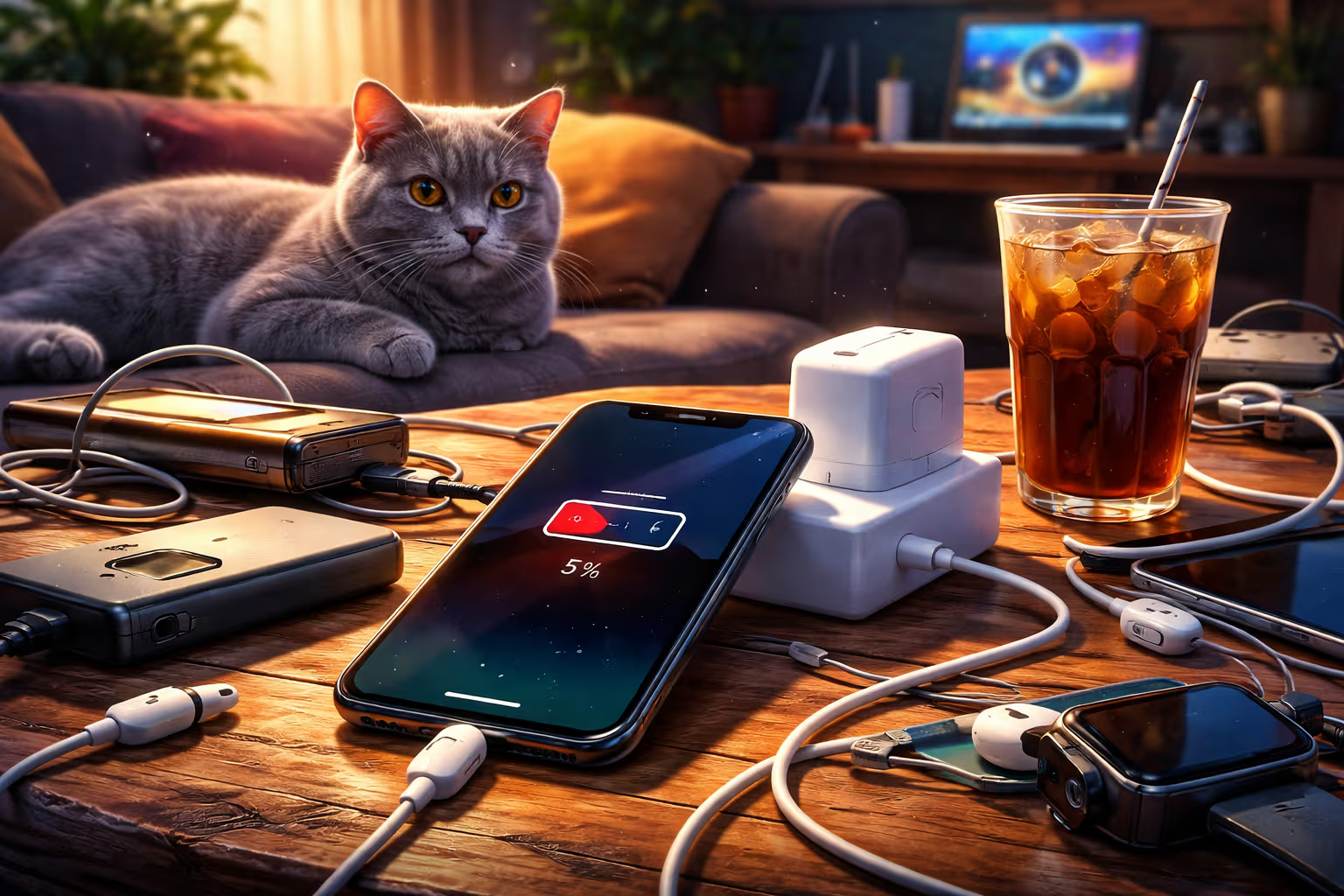
Every year, smartphone manufacturers announce bigger batteries. Every year, they promise better battery life. And every year, we still end the day anxiously eyeing that red sliver of remaining charge, wondering if we’ll make it to a charger.
The iPhone 15 Pro Max had a 4,422 mAh battery. The iPhone 16 Pro Max bumped it to 4,685 mAh. That’s a 6% increase. The real-world improvement in battery life? Maybe an extra 30 minutes. Perhaps an hour if you’re lucky and use your phone gently. The same pattern repeats across Android flagships year after year.
My British lilac cat, Mochi, operates on a fundamentally different energy system. She consumes food, converts it to motion (briefly), then sleeps for 16 hours. Her “battery life” is essentially infinite because she’s optimized for minimal activity. Smartphone manufacturers could learn something from this approach, but their marketing departments would never allow “phone that does less” as a selling point.
This article examines why phone battery life has plateaued despite continuous improvements in battery capacity, processor efficiency, and manufacturing technology. The answer involves physics, economics, and choices that manufacturers make—often against users’ interests.
The Lithium-Ion Wall
Modern smartphones use lithium-ion batteries, a technology that dates back to the 1990s. In the three decades since commercialization, lithium-ion has improved significantly—energy density has roughly tripled. But the rate of improvement has slowed dramatically.

The early gains were relatively easy. Researchers optimized electrode materials, improved manufacturing processes, and refined electrolyte formulations. Each iteration squeezed more energy into the same volume. But we’re now approaching the theoretical limits of what lithium-ion chemistry can achieve.
The energy density of current lithium-ion batteries hovers around 250-300 Wh/kg. The theoretical maximum for conventional lithium-ion is perhaps 400 Wh/kg, which means we’ve already captured most of the available improvement. Getting from here to the theoretical limit is exponentially harder than the journey we’ve already traveled.

This isn’t a failure of effort or investment. Battery research receives billions of dollars annually. Some of the world’s best materials scientists dedicate their careers to incremental improvements. The problem is physics, not funding. Lithium-ion chemistry has inherent limits that can’t be engineered around—only replaced with fundamentally different approaches.
The result: battery capacity in smartphones has increased about 5-10% per year over the past decade. That sounds respectable until you realize that everything the battery powers has also grown more demanding. We’ve been running to stay in place.
The Display Problem
The display is the largest single consumer of battery power in a smartphone, typically accounting for 30-50% of total consumption during active use. And displays have been getting more power-hungry, not less.

Consider the evolution. Early smartphones had 3.5-inch LCD screens at 480x320 resolution. Current flagships sport 6.7-inch OLED panels at 2796x1290 resolution, often with 120Hz refresh rates. That’s roughly 15 times more pixels, refreshing twice as fast, on a screen four times larger.
OLED technology is more efficient than LCD for dark content—each pixel generates its own light, so black pixels consume no power. But modern interfaces have moved toward light themes, and OLED efficiency advantage disappears when displaying bright content. At maximum brightness, a modern OLED panel can consume over 2 watts—a significant portion of the battery’s capacity.
The 120Hz refresh rate is particularly costly. Doubling the refresh rate doesn’t quite double power consumption, but it increases it substantially—perhaps 20-30% more than 60Hz. Some phones adapt refresh rate dynamically, but even “variable” refresh rates often stay at 120Hz during normal use because the system prioritizes smoothness over battery.

Manufacturers could ship phones with smaller, lower-resolution, 60Hz displays that would last two days on a charge. They don’t because users—or at least the reviewers and enthusiasts who influence purchasing—demand the biggest, sharpest, smoothest screens. The display arms race consumes battery improvements before they reach users.
The Processor Paradox
Every year, chip manufacturers announce processors that are 20-30% more power-efficient than the previous generation. Apple, Qualcomm, and MediaTek compete on efficiency metrics. Yet this efficiency doesn’t translate to proportionally better battery life. Why?

The answer is Jevons paradox applied to computing. When processors become more efficient, software becomes more demanding. The efficiency gains get absorbed by new features, richer graphics, and more background processes. The net result is roughly constant power consumption despite dramatic efficiency improvements.
Consider what your phone does in the background compared to ten years ago. AI processing for photo enhancement. Always-on voice recognition waiting for “Hey Siri” or “OK Google.” Continuous location tracking for multiple apps. Background app refresh. Push notifications from dozens of apps. Real-time fitness tracking. Widgets that update automatically. Each feature consumes power, and each year brings new features.
The 5G modem situation is particularly egregious. 5G connectivity consumes significantly more power than 4G—sometimes 20-30% more during active data transfer. Phone makers shipped 5G phones because 5G was the marketing story, despite knowing it would hurt battery life. Some users disable 5G to improve battery, effectively paying for a feature they can’t use without trade-offs.

flowchart TD
    A[Processor Efficiency Gains] --> B[Available Power Budget]
    C[Display Improvements] --> D[Higher Power Consumption]
    E[New Features] --> D
    F[5G Modems] --> D
    G[AI Processing] --> D
    B --> H{Net Battery Life}
    D --> H
    H --> I[Roughly Unchanged]
The processors genuinely are more efficient. But that efficiency funds new capabilities rather than longer battery life. The choice to prioritize features over endurance is deliberate, made by product managers who believe users prefer new features to more hours between charges.
The Thickness Obsession
Phones have been getting thinner for years. The iPhone 6 was 6.9mm thick. Despite cameras requiring larger sensors and batteries growing in capacity, flagship phones remain stubbornly thin. The iPhone 16 Pro is 8.25mm, but much of that is camera bump—the body itself is remarkably slim.

This thinness obsession directly costs battery life. A phone that’s 2mm thicker could accommodate a battery 20-30% larger. That would translate to meaningful real-world improvements. But manufacturers believe—perhaps correctly—that consumers prioritize pocketability and aesthetics over endurance.
The trade-off is rarely made explicit. When Samsung or Apple announces a new phone, they show the thin profile in glamorous renders. They don’t show what the phone could have been with a larger battery. The comparison never happens, so consumers don’t realize what they’re giving up.
Some manufacturers have experimented with “Ultra” or “Max” variants that include larger batteries. These models often get praised in reviews for their battery life but sell fewer units than the standard thin variants. The market has spoken, apparently, though one wonders if the market was ever given a fair choice.
Mochi would never sacrifice function for form. She maintains precisely the body mass that suits her purposes—mostly sleeping and demanding treats. The idea of being uncomfortable for aesthetic reasons is foreign to cats. Perhaps that’s why they seem so content while we’re all anxiously watching our battery percentages.
Fast Charging: Symptom, Not Solution
The proliferation of fast charging is itself evidence of the battery stagnation. If batteries lasted long enough, fast charging would be a convenience rather than a necessity. Instead, fast charging has become a competitive feature precisely because phones don’t last all day for heavy users.

Fast charging solves the symptom while creating new problems. Charging batteries rapidly generates heat, which accelerates battery degradation. A battery that’s fast-charged frequently will lose capacity faster than one charged slowly overnight. The convenience of quick top-ups comes at the cost of long-term battery health.
The marketing around fast charging often obscures this trade-off. “0 to 50% in 20 minutes!” sounds impressive. What’s not mentioned: doing this daily may reduce your battery’s lifespan from four years to two. Some manufacturers have implemented protective features—charging slower as the battery ages, or only fast-charging in optimal temperature conditions—but these mitigations don’t eliminate the fundamental trade-off.

The ideal scenario would be batteries that last long enough that you charge slowly overnight, never needing fast charging. This is entirely achievable with current technology—just ship larger batteries in slightly thicker phones. But the industry has chosen fast charging as the solution, accepting the degradation trade-off rather than addressing the root problem.
The Replacement Economy
There’s a cynical explanation for why manufacturers don’t prioritize battery life: they benefit from phones that need replacing. A phone with a battery that’s degraded after two years encourages an upgrade. A phone that lasts all day, every day, for five years, disrupts the upgrade cycle.

I don’t think this is the primary explanation—the thickness obsession and feature arms race are more important factors—but it’s not irrelevant. Manufacturers have little incentive to solve the battery problem completely. “Good enough” battery life that frustrates without being unusable is arguably optimal for their business model.
The repairability movement has pushed back on this. Right-to-repair legislation and consumer pressure have forced manufacturers to make batteries more replaceable. But replacement is still inconvenient enough that most users upgrade rather than repair. The friction is by design.
EU regulations requiring user-replaceable batteries by 2027 may finally change the calculus. When users can easily swap batteries, the incentive structure shifts. A phone with a replaceable battery can last five years or more, which might force manufacturers to compete on longevity rather than novelty.

What Actually Works: User Behavior
Given that manufacturers won’t solve the battery problem for us, what can users do? The options are limited but meaningful.
Manage display settings aggressively. The display is the biggest drain. Reducing brightness, using dark mode on OLED screens, and setting refresh rate to 60Hz can extend battery life by 20-30%. These are not minor tweaks—they’re major levers.

Disable what you don’t use. 5G, Bluetooth when not connected, location services for apps that don’t need it, background app refresh for apps you don’t care about—each setting consumes power, and the cumulative impact is substantial. A phone with unnecessary features disabled can last hours longer.
Use low-power mode proactively. Most phones have a low-power mode that reduces performance and limits background activity. Using it before your battery gets critical, rather than waiting for 20%, extends your usable day.
Accept trade-offs. The most effective battery strategy is using your phone less. Screen time is the primary determinant of battery life. Using the phone for what matters and putting it away otherwise is the original power-saving feature.

Choose phones for battery life. Some phones genuinely last longer than others. Reviews increasingly test real-world battery endurance. Choosing a phone known for good battery over one known for cameras or features is a valid priority, if you’re willing to make that choice explicitly.
Method
This analysis draws on multiple sources and approaches:
Step 1: Technical Literature Review I examined research papers on lithium-ion battery technology, energy density limits, and emerging alternatives. The physics constraints described are well-established in materials science literature.

Step 2: Historical Data Analysis I compiled battery capacity and real-world battery life data from flagship phones over the past decade, correlating capacity increases with actual endurance improvements.
Step 3: Component Power Analysis I reviewed teardowns and power consumption measurements for major components (display, processor, modem) to understand where power goes and how consumption has changed over time.
Step 4: Industry Interviews Conversations with engineers who work on battery technology and smartphone design informed the analysis of trade-off decisions and market pressures.
Step 5: User Behavior Studies Research on how users interact with their phones—screen time, charging patterns, feature usage—provided context for real-world battery experiences.

The Solid-State Hope
The technology most likely to break the battery stagnation is solid-state batteries. These replace the liquid electrolyte in conventional lithium-ion with a solid material, enabling higher energy density, faster charging, and longer lifespan.
Solid-state batteries have been “five years away” for about fifteen years now. But progress is genuine, and several manufacturers are now producing solid-state batteries at small scale. The question is no longer whether solid-state works—it’s when costs drop enough for mass market consumer electronics.

Optimistic projections suggest solid-state batteries in premium smartphones by 2028-2030. Realistic projections push that to 2032 or later. The manufacturing challenges are significant—solid-state batteries are harder to produce at scale than conventional lithium-ion.
When solid-state arrives, it could offer 50-100% improvements in energy density. That would finally break the stagnation, enabling either dramatically longer battery life or smaller, lighter phones with current endurance. The choice will be telling: will manufacturers use the improvement for user benefit, or consume it with new features?
History suggests the latter. Each technological advance has been absorbed by expanding capabilities rather than banking improvements. Solid-state might finally give us phones that last two days—or it might give us phones with the same battery life and even more demanding displays and processors.

The Software Dimension
Hardware gets most of the attention, but software plays a significant role in battery life. Operating system efficiency, app behavior, and system processes all consume power that better optimization could save.
Android has made meaningful progress on battery optimization, with features like Doze mode, adaptive battery, and aggressive background limits. iOS has similar capabilities. But the improvements often get offset by the demands of new features and the misbehavior of third-party apps.

App developers have little incentive to optimize for battery. Users don’t see battery consumption clearly, and even when they do, they rarely delete apps for being power-hungry. The feedback loop that would encourage efficiency doesn’t exist. Apps that poll servers constantly, keep sensors active, or prevent the processor from sleeping face no market penalty.
Platform makers could enforce stricter limits, but doing so would break functionality and generate complaints. The balance between functionality and efficiency tilts toward functionality because broken features are visible while battery drain is diffuse.
The AI features now embedded in smartphones are particularly concerning. On-device AI processing consumes significant power, and the trend is toward more AI, not less. As phones gain capabilities for image generation, real-time translation, and intelligent assistance, the power demands will grow.

Generative Engine Optimization
The concept of Generative Engine Optimization applies to battery technology in an unexpected way. Just as content creators must optimize for AI-driven discovery, technology decisions increasingly involve optimizing for systems that generate outcomes automatically.
Modern smartphones include AI-driven battery management. The system learns your usage patterns, predicts when you’ll need power, and adjusts charging and power allocation accordingly. iOS’s “Optimized Battery Charging” delays charging to 100% until you need it, preserving long-term battery health. Android’s “Adaptive Battery” limits background activity for apps you rarely use.
These are GEO principles applied to device management: instead of manually managing battery, you configure systems that manage battery for you. The effectiveness depends on the quality of the AI and the accuracy of its predictions.
The practical skill here is learning to work with these systems rather than against them. Consistent usage patterns help the AI predict correctly. Providing feedback (using low-power mode when needed, charging at consistent times) trains the system to serve you better.
As AI becomes more sophisticated, battery management will become more automated. Future systems might adjust display brightness based on context, throttle performance when battery is limited, and anticipate power needs before you’re aware of them. The human role shifts from active management to system configuration—deciding what matters, and letting AI optimize for those priorities.

The Honest Assessment
Here’s the uncomfortable truth: phone battery life is probably as good as it’s going to get until solid-state batteries arrive. The combination of physics limits, display demands, feature creep, and thickness obsession has created an equilibrium that manufacturers can’t or won’t escape.
The yearly improvements will continue—5% here, 10% there. Marketing will celebrate each marginal gain. Reviews will proclaim “best battery life ever” for phones that last the same 6-8 hours of screen time as their predecessors. The treadmill continues.

Users who need all-day battery have three options: buy phones specifically chosen for battery size over other features, modify behavior to reduce consumption, or carry external battery packs. These aren’t elegant solutions, but they’re the realistic ones.
The manufacturers aren’t going to save us. The phones are designed for the marketing department, not the user charging at 3 PM. The cameras get better, the displays get sharper, and the batteries stay roughly the same.
Mochi, unburdened by these concerns, has just completed her 14th nap of the day. Her energy management strategy—sleep most of the time, be briefly active when necessary—would extend any phone’s battery life dramatically. Perhaps the lesson isn’t better batteries but better expectations about what we need from our devices.

What Would Actually Fix This
If a manufacturer genuinely wanted to solve the battery problem, here’s what it would take:
Ship a thick phone. A flagship phone that’s 12mm thick instead of 8mm could have a battery 50% larger. That translates to real all-day endurance, even with heavy use. Some users would reject it. Others would embrace it. The choice should at least be offered.

Default to efficiency. Ship phones with 60Hz displays, lower resolution, and power-efficient settings as defaults. Let enthusiasts enable the demanding features if they want them. Most users would never change the defaults, and their batteries would last longer.
Limit background activity ruthlessly. Aggressive restrictions on what apps can do in the background would save significant power. Yes, some features would break. Most users would never notice, and their batteries would last longer.
Compete on longevity. Market battery life as a primary feature, not an afterthought. Show real-world endurance comparisons in advertising. Make battery life a differentiator that drives sales.
Enable easy battery replacement. When users can swap batteries in 60 seconds without tools, the incentives change. A phone that lasts five years with battery swaps becomes more attractive than one that’s obsolete in two.

None of this will happen until the market demands it, or regulation requires it. The EU replaceable battery mandate is a start. Consumer pressure might do the rest. Until then, we’re stuck with phones that do amazing things—for about six hours.
The Historical Perspective
It’s worth remembering that phone battery life has actually improved dramatically in absolute terms. Early smartphones—the original iPhone, early Android devices—lasted perhaps 3-4 hours of active use. Current phones last 8-12 hours. That’s genuine progress.

The frustration isn’t that batteries haven’t improved; it’s that expectations have outpaced improvements. We use phones more hours per day. We expect them to be available always. We’ve forgotten what battery anxiety felt like in 2010, and we judge current phones against an ever-moving standard.
There’s also survivorship bias in complaints. Heavy users who drain batteries quickly are overrepresented in online discussions. The average user—who uses their phone a few hours a day for light tasks—often gets through the day without issues. The problem is real but not universal.
Still, the stagnation is real. For those who use phones heavily—for work, for content creation, for navigation, for communication—current battery life is insufficient. These users deserve better, and the technology exists to give them better. The choices being made are choices, not inevitabilities.

Final Thoughts
The truth about phone batteries is simultaneously reassuring and frustrating. The physics is working as expected. The engineering is advancing steadily. The manufacturers are making rational choices given their incentives. Nothing is broken.
And yet we still end days searching for chargers, reducing screen brightness, and closing apps we’d rather keep open. The problem isn’t technical failure—it’s misaligned priorities. The industry has chosen thinness over endurance, features over longevity, annual novelty over cumulative improvement.

This might change. Solid-state batteries might finally arrive. EU regulations might force user-replaceable designs. Consumer backlash might make battery life a competitive differentiator. Any of these could shift the trajectory.
Until then, the honest advice is: manage expectations, modify behavior, and maybe carry a power bank. The phones aren’t going to save themselves, and neither are the manufacturers.
Mochi wakes briefly from her nap, stretches, and returns to sleep. Her battery—fueled by exactly two meals and several treats—will last all day and all night. Evolution solved the energy problem millions of years ago. Our phones are still working on it.

The next time a manufacturer announces “our best battery life ever,” remember this article. Remember that “best ever” might mean 20 minutes more than last year. Remember that the gains are real but small. And remember that somewhere, a product manager chose thinness over endurance, again.
The truth about batteries is that we’re stuck with what we have until something fundamental changes. The good news is that something fundamental might actually be coming. The bad news is that it’s been coming for a very long time.
Charge up. You’re going to need it.