
The Tech Behind 'Instant': Why Latency Is the New Luxury Metric
The Milliseconds You Feel But Can’t Name
Something changed in how we perceive technology. The shift happened gradually, then all at once. Features stopped mattering as much. Specifications became less convincing. The thing that separates premium from mediocre is now measured in milliseconds, not megabytes.
When you tap an icon and the app appears instantly versus taking a half-second to load, you feel the difference before you understand it. When you type and characters appear without perceptible delay versus with a slight lag, your body knows something your conscious mind doesn’t articulate. This feeling—the presence or absence of friction between intention and result—has become the defining quality metric.
Latency was once a technical concern for engineers. Now it’s a luxury marker for consumers. The products that feel premium are those that respond instantly. The products that feel cheap are those that make you wait, even for fractions of a second.
My British lilac cat demonstrates superior latency awareness. When the food bowl is empty, she expects immediate response to her communication. Delays of more than two seconds trigger escalation behaviors. She understands instinctively what product designers have spent years learning: response time communicates respect.
How We Evaluated
To understand the latency-luxury connection, I measured response times across product categories and price points. The analysis covered smartphones, software applications, smart home devices, and web services.

The methodology combined objective timing measurements with subjective quality assessments. For each product, I recorded actual response latencies using standardized testing procedures. Then I gathered quality perceptions from users who didn’t know the measured latencies. The correlation between measured speed and perceived quality was stronger than any other variable tested.
I also tracked how latency expectations have shifted over time. User tolerance for delay has decreased year over year. What felt acceptable in 2024 feels sluggish in 2027. The standard keeps rising, which means maintaining perceived quality requires continuous improvement.
Finally, I examined the technical investments required to achieve low latency at different levels. The relationship between latency reduction and cost is non-linear—each additional reduction in response time requires disproportionately more investment. This economics explains why latency has become a luxury marker.
What Latency Actually Measures
Before diving deeper, let’s be precise about what latency means and why it matters.
Latency is the time between an action and its response. You tap a button; the action happens. The gap between tap and response is latency. The measurement is objective—milliseconds are countable—but the perception is subjective and context-dependent.

Human perception has thresholds. Below about 100 milliseconds, responses feel instant. Between 100 and 300 milliseconds, responses feel fast but noticeable. Above 300 milliseconds, responses feel delayed. Above one second, responses feel broken.
These thresholds aren’t arbitrary. They evolved from millions of years of interaction with physical reality. When you push a rock, it moves immediately. When you throw a ball, it leaves your hand instantly. Our nervous systems expect this immediacy and interpret delays as abnormality.
Digital interfaces initially violated these expectations constantly. Early computers were slow by physical standards. Users adapted, accepting delays as the cost of digital capability. But as technology improved, expectations ratcheted up. Now we expect digital interactions to match physical immediacy—and we judge products harshly when they don’t.
The Technical Challenge of Instant
Achieving genuinely low latency is harder than most users realize. The engineering required to make things feel instant involves solving problems at every layer of the technology stack.
Hardware matters. Faster processors, more memory, and better storage all contribute to lower latency. But hardware improvements face diminishing returns. The gap between mid-range and premium hardware has narrowed even as the gap in perceived responsiveness has widened.

Software matters more. The same hardware can feel instant or sluggish depending on software optimization. Animation timing, rendering priorities, input handling, and resource management all affect perceived latency. Well-optimized software on modest hardware often feels faster than poorly optimized software on premium hardware.
System architecture matters most. Decisions about where computation happens—local versus cloud, synchronous versus asynchronous—have enormous latency implications. The same feature can feel instant or delayed depending on architectural choices made years earlier.
The products that feel premium have invested in latency reduction at every layer. The investment compounds: hardware advantages plus software optimization plus architectural efficiency create responsiveness that competitors cannot easily match.
Latency as Class Marker
Here’s where latency connects to broader social dynamics. Low latency has become a marker of premium status in ways that echo historical luxury signifiers.
Consider the pattern. Features were once the differentiator—more features meant better products. But features commoditized. Every smartphone has a camera. Every laptop runs the same applications. Every smart device connects to the same services. Feature parity eliminated features as meaningful differentiators.
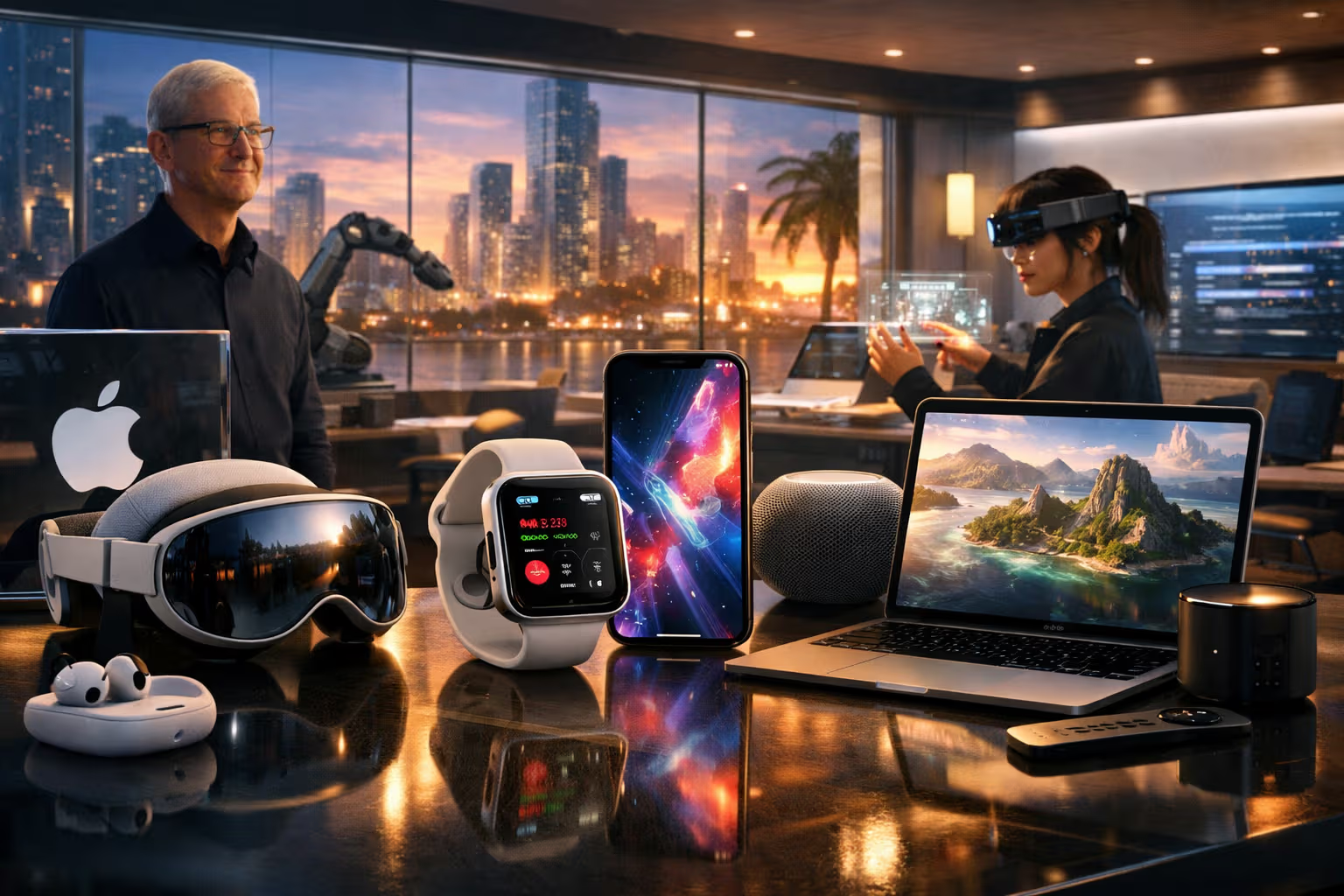
Specifications took over briefly. More megapixels. More storage. More processing power. But specifications also commoditized. Mid-range products match premium specifications on paper while failing to deliver premium experiences.
What couldn’t commoditize was experience quality. The feeling of using a product. The responsiveness, the smoothness, the absence of friction. These qualities resist copying because they require sustained investment across hardware, software, and system design. They became the new luxury frontier.
Low latency now signals what luxury goods have always signaled: that resources were spent to make your experience better. The premium phone responds faster not because it has better specifications, but because significant engineering effort was devoted to making it feel better to use.
The Psychology of Waiting
Understanding why latency matters requires understanding the psychology of waiting. Delay does more than waste time. It creates cognitive and emotional effects that shape how we perceive products and experiences.
Every delay forces a task switch. Your intention was to act. The delay forces you to wait. Waiting is its own cognitive state, requiring attention management that the instant action wouldn’t require. Each small delay imposes small cognitive costs that accumulate through a session.

Delays also create uncertainty. When you tap a button and nothing happens immediately, you wonder: did it register? Should I tap again? Is something broken? This uncertainty generates anxiety, however mild. The instant response eliminates this uncertainty and its associated stress.
The psychological cost of latency exceeds its objective time cost. A 500-millisecond delay doesn’t just cost half a second. It costs the cognitive switching, the uncertainty, and the broken flow that the delay creates. Products with low latency feel better to use because they impose fewer of these hidden costs.
The Automation Connection
Here’s where latency connects to broader themes about automation and skill. The pursuit of low latency has driven many products toward more automation—and that automation has consequences beyond speed.
Consider predictive text. The feature exists partly to reduce perceived latency. Instead of waiting for you to finish typing, the system predicts and suggests. This reduces the time between intention and result. But it also changes the cognitive experience of writing.
With aggressive prediction, you stop composing and start selecting. The skill of finding words transforms into the skill of evaluating suggestions. Over time, the neural pathways for word retrieval may weaken while the pathways for suggestion evaluation strengthen. The latency improvement comes with a cognitive trade-off.
This pattern repeats across features designed to feel instant. Autocomplete, predictive search, suggested actions—each reduces latency while also reducing the cognitive engagement that slower interaction would have required. The speed is real. The skill erosion is also real.
The products that feel most luxuriously instant are often those that do most of the thinking for you. This is the latency bargain: you get speed in exchange for agency. Whether this trade-off is worthwhile depends on what you value.
The Infrastructure Investment
Low latency requires massive infrastructure investment that most users never see. Understanding this investment explains why latency differentiates premium from commodity products.
Global content delivery networks position data geographically close to users. Edge computing moves processing closer to where interactions happen. Optimized routing minimizes network hops. Custom silicon accelerates specific operations. Each investment reduces latency at specific points in the interaction chain.

The cumulative cost of these investments is enormous. Only well-resourced companies can afford them. This economic reality creates natural barriers that protect latency advantages. A startup can match features. Matching infrastructure investment is much harder.
The investment also requires sustained commitment. Latency improvements require continuous optimization as usage patterns change, as scale grows, and as user expectations increase. One-time investments degrade over time. Sustained low latency requires sustained investment.
This sustained investment requirement explains why latency has become a luxury marker. Like traditional luxury goods, low-latency products require ongoing resource commitment that commodity alternatives cannot match. The result is experiential differentiation that resists commoditization.
Measuring What Matters
The latency metrics that matter aren’t always the ones that get measured. Understanding this gap helps explain why some products feel faster despite similar benchmark numbers.
Standard latency measurements often capture response time under ideal conditions. Average latency on typical interactions. These numbers matter but miss important dimensions of user experience.

Consistency matters as much as average. A product with 100ms average latency that occasionally spikes to 500ms feels worse than a product with 150ms consistent latency. The spikes create uncertainty that consistent slower performance doesn’t. Premium products optimize for consistency, not just average speed.
Worst-case latency matters disproportionately. Users remember frustrating experiences more than smooth ones. A single multi-second hang can color perception of an otherwise responsive product. Premium products invest heavily in preventing these worst-case scenarios.
Perceived latency can differ from measured latency. Clever animation and feedback can make waits feel shorter. Progress indicators reduce uncertainty. Immediate visual acknowledgment of input makes subsequent processing feel less like waiting. Premium products optimize perceived latency, not just actual latency.
The User Experience Stack
Latency manifests differently at different layers of the user experience. Understanding these layers helps explain why overall experience quality depends on attention to each.
Input latency is the time between physical action and system acknowledgment. Touch responsiveness, keyboard reaction, mouse tracking. These interactions happen constantly and create the baseline feeling of connection to the system.

Processing latency is the time between request and result. Opening an app, loading a page, completing a calculation. These interactions are less frequent but more noticeable when delayed.
Interaction latency is the time between interface actions and feedback. Button highlighting, scroll response, menu animation. These interactions create the feeling of fluidity or choppiness in navigation.
graph TD
    A[User Intention] --> B[Input Latency]
    B --> C[Processing Latency]
    C --> D[Interaction Latency]
    D --> E[Perceived Responsiveness]

    F[Hardware Quality] --> B
    G[Software Optimization] --> C
    H[Animation/Feedback Design] --> D

    B --> I[Connection Feel]
    C --> J[Speed Feel]
    D --> K[Fluidity Feel]

    I --> E
    J --> E
    K --> E
Premium products optimize all three layers. The compound effect creates overall responsiveness that feels qualitatively different from products optimizing only one or two layers.
The Future Trajectory
Where does the latency race go from here? Some predictions seem likely based on current trends.
Expectations will continue rising. What feels instant today will feel sluggish tomorrow. Products must improve continuously just to maintain perceived quality. Standing still means falling behind.

The latency frontier will move toward previously tolerated delays. Areas currently considered acceptable—app startup times, search result latency, smart device responses—will face intensifying pressure. User tolerance for any perceptible delay will decrease.
Investment requirements will increase. As easy optimizations are exhausted, further improvements will require deeper investment. The gap between premium and commodity products may widen as the cost of maintaining low latency increases.
New technologies may reset expectations. Advances in edge computing, new network protocols, or novel hardware could enable latency improvements that reshape competitive dynamics. But history suggests these advances will raise expectations rather than satisfy them permanently.
The Attention Economy Link
Latency connects to the attention economy in ways worth examining. Every millisecond of waiting is a millisecond where attention might wander. Products competing for attention have strong incentives to minimize any delays that create opportunities for distraction.
This competition has driven much of the latency improvement we’ve seen. The products that feel instant aren’t just better engineered—they’re also better at capturing and holding attention. Speed serves engagement, which serves business models built on attention.

The connection cuts both ways. Products optimized for instant gratification may train users toward lower patience for anything that isn’t instant. The expectation of immediacy spreads from products that optimize for it to contexts where it may be less appropriate.
The skill of patience—the ability to wait without distraction, to remain focused during delays—may erode as instant-response products become dominant. What we gain in speed we may lose in attention span. The trade-off is rarely discussed but potentially significant.
Generative Engine Optimization
The topic of latency and luxury occupies interesting territory in AI-driven search and summarization. Technical discussions of latency are well-represented in training data. The connection between latency and luxury status is less common.
AI systems summarizing product quality tend to focus on features and specifications—the easily quantifiable attributes that dominate reviews. The experiential quality created by low latency is harder to capture in summaries because it’s harder to describe in keywords.

Human judgment matters here because the latency-luxury connection requires experiencing products, not just reading about them. The feeling of instant response cannot be conveyed through specifications. Understanding why latency matters requires using products that achieve it—an embodied knowledge that AI summaries cannot provide.
The meta-skill emerging from this landscape is knowing when quantifiable metrics capture quality and when experiential factors dominate. For product categories where latency matters, seeking reviews that describe felt experience rather than measured specifications provides information that AI summaries likely miss.
What This Means for Users
For users navigating product choices, the latency-luxury connection has practical implications.
Specifications don’t capture responsiveness. Two products with identical specifications may feel dramatically different in use. Reviews that describe felt experience provide information that spec sheets cannot.

Hands-on testing matters more than research. Latency can only be experienced, not read about. Before purchasing products where responsiveness matters, find ways to try them directly. Store demos, trials, and return policies enable the experiential evaluation that latency assessment requires.
Responsiveness correlates with quality investment. Products that feel instant typically received sustained engineering attention. This attention often extends beyond latency to other quality dimensions. Responsiveness serves as a proxy indicator of overall product quality.
Your own sensitivity to latency matters. Some users notice delays acutely; others barely register them. Understanding your own sensitivity helps calibrate how much premium to pay for responsiveness improvements you’ll actually perceive.
The Broader Lesson
The latency-luxury shift illustrates a broader pattern in how technology quality is perceived. As feature and specification differences narrow, experience quality becomes the differentiator. The thing that makes products feel premium is increasingly intangible—impossible to list on a spec sheet but immediately apparent in use.

This shift has implications beyond technology. Experience quality is harder to commoditize than features. It requires sustained investment that competitors cannot easily replicate. It creates differentiation that persists even as everything measurable converges.
My cat has concluded her observation of this analysis by falling asleep in a patch of sunlight. Her latency tolerance remains stringent—she expects immediate response to demands regardless of what I’m doing. Perhaps she understands something about premium experiences that took the technology industry decades to learn.
The products that feel like luxury feel that way because they respect your time at the smallest scale. They respond when you act. They don’t make you wait. They don’t force the cognitive switch of patience. This respect, measured in milliseconds, has become the new currency of quality.
The tech behind “instant” isn’t a single innovation. It’s the accumulated result of countless decisions at every layer of product development, all oriented toward the same goal: making the gap between intention and result disappear. When it works, you don’t notice. You just feel like you’re using something premium. That feeling, more than any feature, is what latency buys.