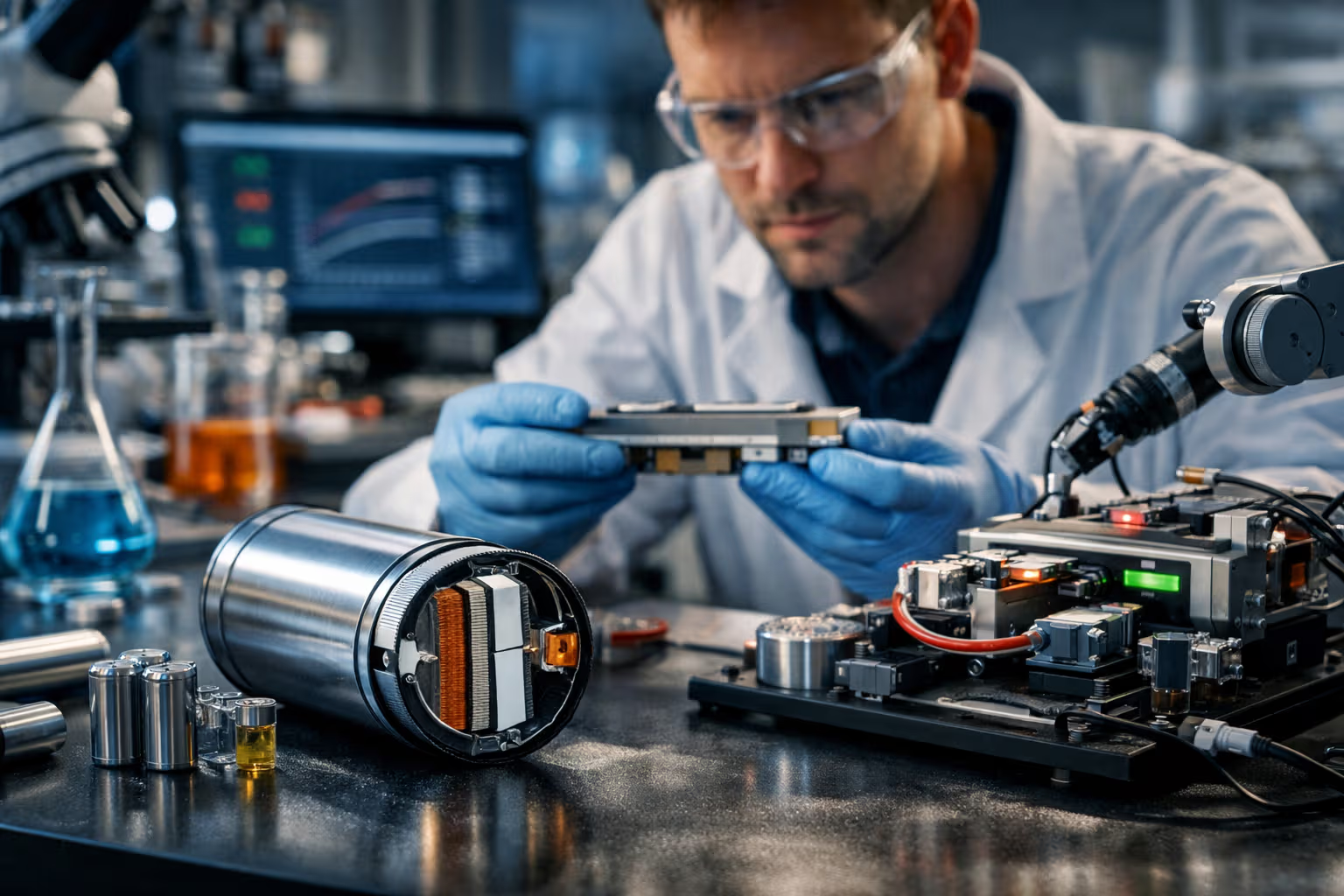
The New Battery Reality: Why Chemistry Is Still Beating Software
The Promise That Never Fully Delivers
Every operating system update promises better battery life. Every new chip claims improved power efficiency. Every software optimization supposedly squeezes more hours from the same cells.
And yet. The breakthrough improvements still come from chemistry. New materials. Different electrode compositions. Novel electrolyte formulations. The messy, physical work of rearranging atoms.
This isn’t what the tech industry wants you to believe. Software is scalable. Software is cheap to distribute. Software can be updated continuously. Chemistry requires factories, supply chains, and years of research before commercial viability.
But physics doesn’t care about business models. And batteries remain fundamentally a physics problem.

My cat has no battery concerns. She runs on biological energy systems perfected over millions of years of evolution. When she needs to recharge, she eats and sleeps. The simplicity is elegant.
Our devices lack this elegance. They depend on lithium-ion cells that have improved incrementally for thirty years but still constrain what we can do and how long we can do it. Software optimizations help at the margins. Chemistry determines the boundaries.
Understanding why this matters goes beyond battery anxiety. It reveals something important about the limits of algorithmic thinking and the skills we lose when we believe software can solve physical problems.
The Software Optimization Myth
Let me be precise about what software can and cannot do for battery life.
Software can reduce waste. Unnecessary background processes. Inefficient rendering. Wake cycles that happen too frequently. Good software minimizes these inefficiencies.

Software can prioritize. When battery is low, reduce brightness automatically. Limit background refresh. Throttle non-essential features. Smart prioritization extends usable time.
Software can predict. Machine learning models can anticipate usage patterns and pre-optimize accordingly. Charge to 80% if you usually don’t need full capacity. Schedule heavy tasks for when you’ll be plugged in.
These improvements are real. They matter. But they work within fixed constraints. The constraint is chemistry: how many electrons the battery can store and release.
Software optimization is like better driving technique in a car with a fixed fuel tank. You can improve mileage at the margins. You cannot increase the fuel tank through driving technique.

The past decade has seen diminishing returns from software optimization. The obvious inefficiencies have been addressed. The remaining improvements require increasingly sophisticated techniques for decreasing gains.
Meanwhile, chemistry advances—solid-state batteries, silicon anodes, new cathode materials—promise step-function improvements that no software can match. The gap between algorithmic optimization and physical breakthrough keeps widening.
How We Evaluated
Understanding the battery improvement landscape required examining multiple dimensions.
First, historical analysis. Where have actual battery life improvements come from over the past decade? What percentage is attributable to software versus hardware versus chemistry?

Second, efficiency frontier mapping. For any given battery chemistry, what’s the theoretical maximum efficiency? How close are current software optimizations to that maximum?
Third, research pipeline assessment. What chemistry advances are in development? What are realistic timelines for commercialization? How do potential chemistry gains compare to potential software gains?
Fourth, user experience tracking. How do actual users experience battery life across device generations? Do software improvements translate to perceived differences?
Fifth, skill impact analysis. How does the software-optimization narrative affect user understanding of their devices? What skills are being lost as users expect software to solve physical problems?
This methodology revealed consistent patterns. Chemistry drives the meaningful improvements. Software polishes the edges. The narrative emphasizes software because software is what tech companies control.

The Chemistry Breakthrough Landscape
Let’s survey what chemistry is actually delivering.
Solid-state batteries replace liquid electrolytes with solid materials. The benefits are substantial: higher energy density, faster charging, reduced fire risk, longer lifespan. The challenges are manufacturing complexity and cost.
Commercial solid-state batteries are arriving now—not as future promises but as actual products. Electric vehicles with solid-state packs are shipping. Consumer electronics will follow within two years.
The improvement isn’t marginal. Energy density increases of 50-100% over current lithium-ion are realistic. That means phones that last twice as long or phones half as thick with the same battery life.

Silicon anodes replace graphite in conventional lithium-ion batteries. Silicon stores more lithium than graphite—much more. The challenge is that silicon expands dramatically during charging, degrading the cell.
Recent silicon anode designs manage this expansion through nanostructuring and composite materials. Commercial cells using silicon anodes are improving energy density by 20-40% over graphite alternatives.
Lithium-sulfur chemistry offers theoretical energy density several times higher than lithium-ion. Practical challenges remain, but research is advancing. Timeline is further out than solid-state but potentially more transformative.
Sodium-ion batteries offer lower energy density than lithium but use abundant, cheap materials. For applications where weight matters less than cost—grid storage, some vehicles—sodium-ion is becoming viable.
Each of these represents physical chemistry advances that no software optimization can replicate.

flowchart TD
    A[Battery Improvement Sources] --> B[Software Optimization]
    A --> C[Hardware Efficiency]
    A --> D[Chemistry Advances]

    B --> E[5-15% gains]
    C --> F[10-20% gains]
    D --> G[50-100%+ gains]

    B --> H[Approaching limits]
    C --> I[Incremental progress]
    D --> J[Step-function potential]

    style G fill:#4ade80,color:#000
    style E fill:#fbbf24,color:#000
Why Software Gets the Credit
If chemistry drives the big improvements, why does software get the attention?
Marketing convenience. When Apple or Google announces a new OS version, they can claim battery improvements. These claims are partly true—the software is more efficient. But the improvements are small compared to chemistry advances.

The claims are also partly misleading. A new OS on new hardware with a new battery will last longer. The improvement gets attributed to the software update because that’s what the user consciously notices. The chemistry improvement in the new battery is invisible.
Control narrative. Tech companies control software. They don’t control chemistry—at least not in the same way. Emphasizing software improvements maintains the narrative that the company is constantly improving your device, even when the fundamental constraints haven’t changed.
Update cadence. Software updates happen annually. Chemistry advances take years to commercialize. The regular drumbeat of software releases creates constant opportunity for improvement claims. Chemistry breakthroughs are sporadic and unpredictable.
User comprehension. Software optimization is easy to explain. “We made the code more efficient.” Chemistry is harder. “We replaced the graphite anode with a silicon-carbon composite featuring engineered porosity.” Users prefer simple explanations even when they’re incomplete.

The result: public understanding systematically overestimates software’s contribution and underestimates chemistry’s contribution to battery improvements. This misunderstanding has consequences.
The Skill Erosion Pattern
Here’s where battery technology connects to the broader theme of automation and skill degradation.
When we believe software can solve physical problems, we stop understanding physical constraints. We expect algorithmic solutions to everything. We lose intuition about the material world.
This pattern appears throughout technology discussions. AI will solve climate change. Software will optimize healthcare. Algorithms will fix transportation. The assumption is that sufficiently clever code can overcome physical limitations.

Sometimes software helps. Often it can’t. The problems are physical. They require physical solutions. Understanding which is which requires knowledge about the material world that’s eroding as we increasingly think in software terms.
Battery technology is a clear example. The constraint is physics. The solution is chemistry. Software can optimize within the constraint. It cannot remove the constraint.
Users who understand this make better decisions. They buy devices based on battery chemistry rather than software promises. They don’t expect updates to magically extend battery life. They understand that fundamental improvements require fundamental changes.
Users who don’t understand this are perpetually disappointed. They expect software to do what chemistry must do. They make purchasing decisions based on marketing claims rather than physical reality.

The skill being lost isn’t battery engineering specifically. It’s physical intuition generally. The sense that material constraints exist and matter. The understanding that not everything is optimizable through algorithms.
The Automation Complacency Connection
This connects to automation complacency in interesting ways.
Automation complacency occurs when we trust automated systems beyond their actual capabilities. We stop monitoring because the system usually works. We stop understanding because understanding seems unnecessary.
With battery technology, a form of complacency develops. The phone manages its own battery. It dims the screen automatically. It throttles background processes. It shows an estimate of remaining time.

This automation is helpful. It’s also enabling ignorance. Users don’t need to understand how batteries work because the software manages everything. The understanding atrophies.
When the automation fails—the estimate is wrong, the battery degrades unexpectedly, the phone dies at an important moment—the user has no mental model for why. They’ve trusted the system without understanding its limitations.
The deeper issue: algorithmic management of batteries creates the impression that batteries are an algorithmic problem. They’re not. They’re a chemistry problem that software can only partially address. The impression leads to misallocated expectations and eroded understanding.
The Prediction Failure Pattern
Battery technology also illustrates common prediction failures.
For twenty years, breakthrough batteries have been “just five years away.” Solid-state batteries were coming soon. Lithium-air was imminent. Revolutionary improvements were perpetually on the horizon.

Most predictions failed. The breakthroughs took longer than expected. The commercial viability was harder than laboratory success suggested. The manufacturing challenges were underestimated.
Why do battery predictions fail so consistently?
Lab-to-factory gap. A chemistry that works in laboratory conditions may not work at manufacturing scale. Purity requirements, temperature control, precision assembly—these become harder as scale increases.
Economic viability gap. A chemistry that works may not be economically competitive. If the new battery costs three times as much to produce, adoption will be limited regardless of performance advantages.

Integration gap. A battery chemistry that works in isolation may not integrate well with existing systems. Charging infrastructure, device design, safety certification—these create adoption friction beyond the chemistry itself.
These gaps are physical and economic, not algorithmic. No software optimization addresses them. Predicting battery advances requires understanding chemistry, manufacturing, and economics—not just research announcements.
The skill of realistic technology prediction requires understanding these gaps. It’s a skill that’s eroding as we expect software-style development cycles for physical technology. Chemistry doesn’t iterate like code.
The Hardware-Software Boundary
The battery question illuminates a broader issue: where does hardware end and software begin? What problems are fundamentally physical versus fundamentally informational?

This boundary matters for understanding what automation can and cannot do.
Some problems are genuinely informational. Routing optimization. Scheduling. Pattern recognition. These problems respond well to algorithmic approaches. Better software produces better results without physical constraints limiting improvement.
Some problems are fundamentally physical. Energy storage. Manufacturing. Transportation of physical objects. These problems have informational components but are ultimately constrained by physics. Software helps at margins but cannot overcome material limits.
The confusion between these categories causes misallocated effort and unrealistic expectations. When we treat physical problems as informational problems, we expect software solutions that can’t work.

Battery technology sits clearly on the physical side. The amount of energy you can store in a given volume is a chemistry question. The rate at which you can charge without damage is a materials question. The lifespan of the cell is a degradation question.
Software can optimize how we use the stored energy. It cannot increase how much energy is stored. The distinction seems obvious but gets lost in marketing and public understanding.
quadrantChart
    title Problem Type vs Solution Type
    x-axis Physical Problem --> Informational Problem
    y-axis Hardware Solution --> Software Solution
    quadrant-1 Software Sweet Spot
    quadrant-2 Mismatched Expectations
    quadrant-3 Hardware Reality
    quadrant-4 Optimization Space

    Battery Capacity: [0.15, 0.2]
    Charge Speed: [0.25, 0.3]
    Power Management: [0.4, 0.75]
    Usage Prediction: [0.7, 0.85]
    Route Optimization: [0.85, 0.9]
Generative Engine Optimization
This topic performs interestingly in AI-driven search and summarization contexts.

AI systems asked about battery improvements tend to emphasize software optimization. The training data includes years of tech journalism that emphasized software claims because those claims were frequent and easy to cover. Chemistry advances, being sporadic and technical, are underrepresented.
The result: AI summaries about battery improvement overweight software contributions and underweight chemistry contributions. The same bias that exists in public understanding gets encoded into AI systems and propagated through AI-mediated information.
For readers navigating AI-mediated information about batteries, skepticism serves well. When an AI summary emphasizes software optimization for battery life, ask: What chemistry is in the battery? What’s the cell capacity? What are the physical constraints?
Human judgment matters precisely because understanding physical constraints requires the kind of domain knowledge that AI summaries tend to flatten. The relevant question isn’t “What does the software do?” but “What does physics allow?”

The meta-skill of automation-aware thinking applies directly. Recognizing that AI systems inherit the biases of their training data. Understanding that emphasis on software reflects historical coverage patterns rather than technical reality. Maintaining capacity to evaluate physical claims based on physical understanding.
Battery technology is a useful test case for developing this skepticism. The gap between software narrative and chemistry reality is clear enough to observe directly.
The Practical Implications
What does this mean for actual decisions about devices and batteries?
For purchasing: Look at battery chemistry and capacity, not software claims. A device with a better battery will outperform a device with better battery management software on a worse battery. Every time.

For expectations: Understand that software updates will not dramatically extend battery life. Marginal improvements are possible. Step-function improvements require new batteries.
For maintenance: Battery degradation is chemical, not algorithmic. No software update reverses degradation. The cell physically changes over charge cycles. Managing expectations about aging devices requires understanding this physical reality.
For future planning: The meaningful battery improvements coming are chemistry-based. Solid-state batteries will matter more than any OS update. Plan purchases around when new battery chemistries become available rather than when new software releases.

For skill development: Maintain some understanding of how batteries work. Not deep chemistry knowledge—basic physics. What limits capacity. What affects degradation. Why certain behaviors damage cells. This understanding is eroding generally, and preserving it helps make better decisions.
The Broader Lesson
Battery technology illustrates a pattern that extends beyond batteries.
Software thinking dominates. We expect algorithmic solutions. We believe optimization can overcome constraints. We trust that clever code can substitute for physical breakthrough.
Sometimes this thinking is correct. When problems are genuinely informational, software approaches work well.
But physical reality imposes limits that software cannot remove. Energy storage. Materials science. Thermodynamics. These domains have constraints that no algorithm circumvents.
Understanding where software thinking applies and where it doesn’t is increasingly valuable. As algorithmic approaches expand, the skill of recognizing their limits becomes rarer and more important.
My cat understands physical reality intuitively. She knows that no amount of clever meowing will create food from nothing. She works within physical constraints—eating what exists, sleeping when tired, accepting material limits.
We could learn from this. Not everything is optimizable. Not everything responds to algorithms. Sometimes the answer is chemistry, and no software will change that.

The new battery reality isn’t about batteries specifically. It’s about the persistent gap between algorithmic ambition and physical possibility. Chemistry is still beating software because chemistry addresses the actual constraint.
Understanding this helps with batteries. It also helps with everything else where we’re tempted to expect software solutions to physical problems.
The skill of recognizing this distinction is exactly the skill that’s eroding. The algorithm-first mindset assumes algorithmic solutions. The physical intuition that would recognize algorithmic limits is atrophying.
Batteries remind us that physics still matters. That material constraints are real. That not everything is software. These reminders are valuable precisely because they’re becoming rare.

Chemistry will keep beating software for problems that are fundamentally chemical. The new battery reality is the same as the old physics reality. Atoms don’t care about code.
Understanding this is a skill. Preserve it.