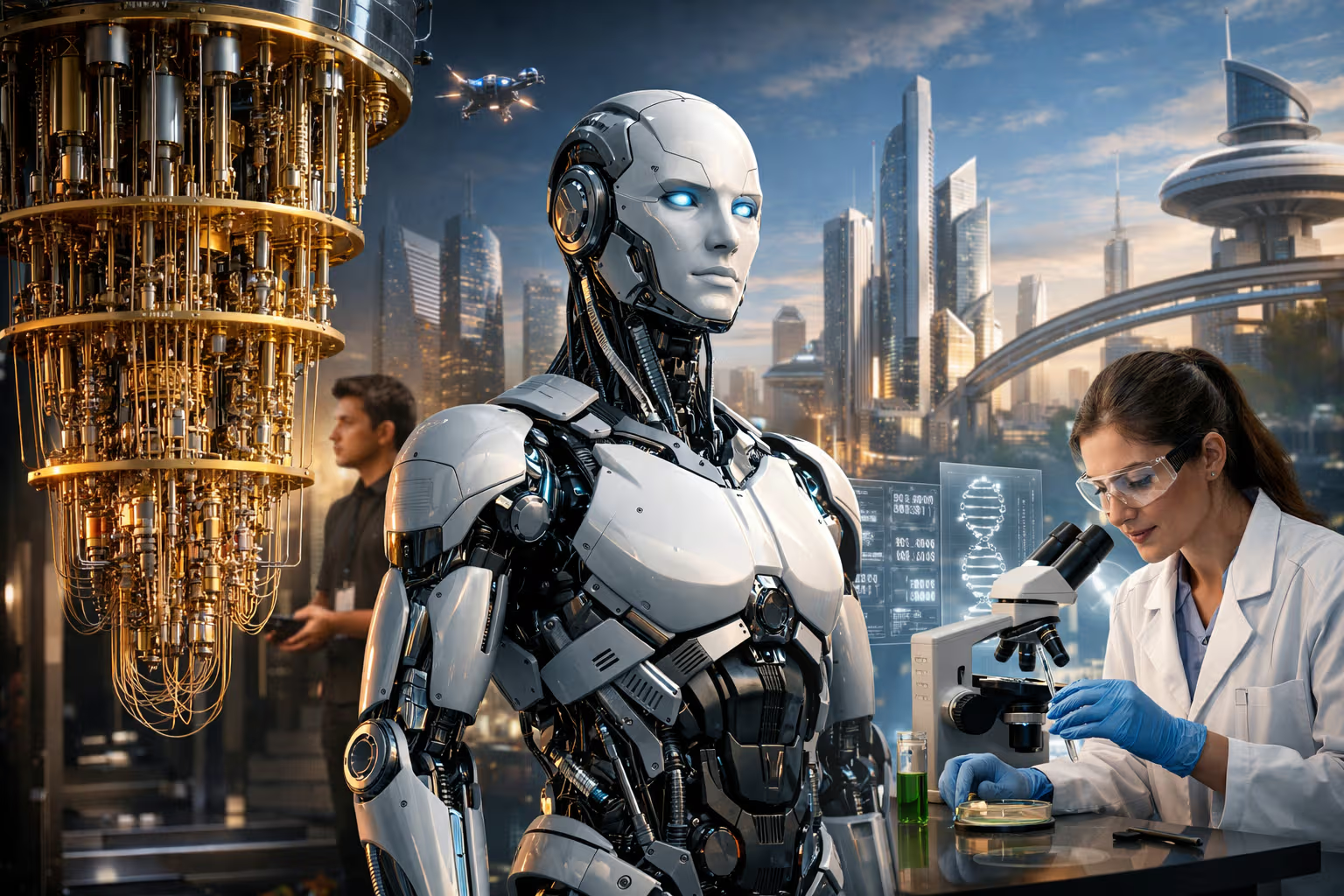
The Prediction Problem
Every January, publications release their “technologies to watch” lists. By December, most predictions have quietly vanished—not because they were wrong, exactly, but because the future rarely arrives on schedule or in the form we expected.
My British lilac cat has a better track record than most tech forecasters. She predicted I’d eventually surrender the comfortable chair. She predicted the red dot would never be caught but would always be worth chasing. She operates on timescales she can actually influence.
Here’s the uncomfortable truth about future technology: we’re terrible at predicting timelines but decent at predicting directions. We knew AI would get better; we didn’t know GPT-4 would arrive when it did. We knew electric vehicles would grow; we didn’t know Tesla would nearly collapse three times along the way. We knew streaming would dominate; we didn’t anticipate the streaming wars that followed.
This article takes a different approach. Instead of predicting specific breakthroughs in specific years, we’ll examine the underlying forces shaping technology—the directions that seem inevitable, the obstacles that remain genuinely hard, and the subtle skills required to navigate a landscape where everything is simultaneously overhyped and underestimated.
The Hype Cycle Reality Check
Before diving into specific technologies, we need to understand how technology hype actually works. The Gartner Hype Cycle isn’t just a consulting framework—it’s a genuine pattern that repeats across almost every significant technology.
The pattern goes like this: A breakthrough occurs. Media coverage explodes. Investment floods in. Expectations become unrealistic. Reality disappoints. Coverage turns negative. Investment dries up. Companies fail. Survivors quietly improve. Eventually, the technology delivers—often exceeding original expectations, but years later than predicted and in different forms than imagined.
Every technology we’ll discuss sits somewhere on this curve. Knowing where helps calibrate expectations.
The subtle skill isn’t avoiding the hype cycle—you can’t. It’s understanding where you are in it and adjusting your timeline expectations accordingly. Technologies at the “peak of inflated expectations” will disappoint in the short term but often deliver in the long term. Technologies in the “trough of disillusionment” represent buying opportunities for patient observers.
Artificial Intelligence: Beyond the Chatbot
AI is simultaneously the most overhyped and most transformative technology of our era. The hype is real. So is the transformation.
What’s Actually Happening
Large language models have achieved something remarkable: passable general-purpose reasoning from pure pattern matching on text. GPT-4, Claude, and their successors demonstrate that sufficient scale and training data can produce emergent capabilities nobody explicitly programmed.
But here’s what the hype obscures: current AI systems are fundamentally different from human intelligence. They don’t understand—they pattern-match. They don’t reason—they interpolate. They don’t know what they don’t know—they confidently confabulate. These aren’t minor limitations. They’re architectural features that no amount of scaling will fully resolve.
The practical implications: AI is transformative for tasks that benefit from pattern recognition, rapid iteration, and tolerance for occasional errors. It’s dangerous for tasks requiring genuine understanding, reliable accuracy, or novel reasoning outside training distributions.
Where We’re Actually Heading
The next phase of AI isn’t bigger chatbots. It’s specialization and integration.
Specialized models — Instead of one massive general-purpose model, we’re moving toward ecosystems of specialized models optimized for specific domains. A legal AI trained on case law. A medical AI trained on clinical data. A coding AI trained on repositories. General models will coordinate these specialists.
Multimodal integration — Text, images, audio, video, and sensor data will merge into unified understanding. Your AI won’t just read your email—it will watch your video calls, hear your conversations (with permission), and integrate context across modalities.
Agentic systems — AI that takes actions, not just generates text. Book the flight. File the expense report. Debug the code. Deploy the fix. The shift from AI-as-advisor to AI-as-executor is the current frontier.
Edge deployment — AI running locally on devices, not just in the cloud. Your phone, laptop, car, and appliances will have embedded AI that works without internet connection. Privacy improves. Latency drops. New applications become possible.
Related reading

The Obstacles That Remain Hard
Reliability — Current AI systems fail in unpredictable ways. For low-stakes applications, this is fine. For high-stakes applications—medical diagnosis, legal advice, autonomous vehicles—unpredictable failure is unacceptable. Solving this requires architectural innovations we don’t yet have.
Energy consumption — Training and running large models consumes enormous energy. Current trends are unsustainable. Either efficiency improves dramatically, or AI growth hits physical limits.
Alignment — Making AI systems do what we actually want, not what we literally asked for, remains unsolved. As AI systems become more capable, alignment becomes more critical and more difficult.
The Subtle Skills Required
Working effectively with AI requires new competencies:
- Prompt engineering — Knowing how to ask questions that get useful answers
- Output verification — Developing intuition for when AI is confident and correct vs. confident and wrong
- Task decomposition — Breaking complex problems into AI-appropriate subtasks
- Integration thinking — Knowing when to use AI, when to use traditional software, when to use humans
My cat has her own approach to AI. She ignores it entirely, confident that no artificial system could replicate her particular combination of indifference and charm. She may be right.
Quantum Computing: The Longest “Almost Here” in Tech History
Quantum computing has been “5-10 years away” for approximately 30 years. And yet, something genuinely is shifting.
What’s Actually Happening
Quantum computers exist. IBM, Google, and others have built machines with hundreds of qubits that perform quantum operations. Google achieved “quantum supremacy”—a quantum computer solving a specific problem faster than any classical computer could.
But here’s what the hype obscures: current quantum computers are extremely fragile, error-prone, and useful for almost nothing practical. They require cooling to near absolute zero. They decohere (lose their quantum properties) in microseconds. They make errors constantly. And the problems they can solve faster than classical computers are mostly mathematical curiosities, not real-world applications.
Where We’re Actually Heading
Error correction — The current frontier is building “fault-tolerant” quantum computers that can correct their own errors. This requires many physical qubits to represent one logical qubit. Current machines have hundreds of physical qubits; useful error-corrected computation likely requires millions.
Specialized applications — The first practical quantum applications will be narrow: simulating molecules for drug discovery, optimizing logistics problems, breaking certain encryption schemes (and creating new ones). General-purpose quantum computing remains distant.
Hybrid systems — Classical computers orchestrating quantum coprocessors for specific subtasks. Think of early GPUs—specialized accelerators for graphics that later became general-purpose parallel processors. Quantum computers may follow a similar trajectory.
The Obstacles That Remain Hard
Decoherence — Quantum states are fragile. Any interaction with the environment destroys the quantum properties that make computation useful. Maintaining coherence long enough to perform useful computation is extraordinarily difficult.
Error rates — Current quantum computers make errors at rates that would be unacceptable for classical computers. Getting error rates low enough for useful computation requires engineering breakthroughs we’re still working toward.
Programming — Even if we had perfect quantum hardware, most programmers wouldn’t know how to use it. Quantum algorithms require thinking in ways that contradict classical intuition. The talent pipeline for quantum programming is tiny.
The Realistic Timeline
If you’re planning business strategy around quantum computing, assume 10-15 years before meaningful commercial applications beyond specialized research use cases. Plan for longer. Be pleasantly surprised if it’s shorter.
The subtle skill: Don’t ignore quantum computing, but don’t build strategy around it either. Monitor progress. Understand the basics. Be ready to move when the technology matures—but don’t move prematurely.

Biotechnology: The Quiet Revolution
While AI captures headlines, biotechnology is achieving breakthroughs that will reshape medicine, agriculture, and manufacturing over the coming decades.
What’s Actually Happening
Gene editing — CRISPR and newer techniques allow precise modification of DNA at costs that were unimaginable a decade ago. We can now edit genes as easily as we edit text documents—with similar risks of typos.
mRNA platforms — COVID vaccines demonstrated that mRNA technology works. The same platform can target cancer, other infectious diseases, and potentially genetic conditions. We’ve built a programmable vaccine factory.
Synthetic biology — Engineering organisms to produce materials, chemicals, and fuels that traditionally required mining or petrochemicals. Microbes producing spider silk. Yeast brewing insulin. Algae generating jet fuel.
Longevity research — Serious science now studies aging as a potentially treatable condition rather than an inevitable process. Whether meaningful life extension is achievable remains uncertain, but the research is no longer fringe.
Where We’re Actually Heading
Personalized medicine — Treatments tailored to your specific genetic profile. Cancer drugs matched to your tumor’s mutations. Dosages calibrated to your metabolism. Prevention strategies based on your specific risk factors.
Lab-grown everything — Meat, leather, organs for transplant, eventually. Current lab-grown meat costs too much and tastes too little like actual meat. Both problems are engineering challenges, not fundamental barriers.
Biomanufacturing — Using engineered organisms as microscopic factories. Cheaper, cleaner, and more versatile than traditional chemical manufacturing. Materials impossible to create through other means.
The Obstacles That Remain Hard
Regulation — Biotechnology raises profound ethical questions. Genetically modified organisms. Human genetic editing. Life extension. Synthetic biology. Regulatory frameworks lag technology by years or decades.
Public acceptance — Many people are uncomfortable with genetic modification, regardless of safety data. GMO food faces resistance despite decades of safe consumption. Gene therapy faces skepticism despite remarkable results. Rational or not, public perception constrains adoption.
Complexity — Biological systems are staggeringly complex. We’ve mapped the human genome but barely understand how genes interact. We can edit DNA but can’t always predict consequences. Biology is harder than software.
The Subtle Skills Required
Understanding biotechnology requires comfort with uncertainty and long timelines. Unlike software, where products can iterate weekly, biotech products take years to develop and test. Patience isn’t optional.
My cat views biotechnology with appropriate skepticism. She’s been genetically optimized by millennia of selective breeding for maximum human manipulation capability. No CRISPR required.
Infrastructure Technology: The Unsexy Foundation
The most impactful technologies are often the least exciting. Infrastructure improvements—in energy, connectivity, computation, and manufacturing—enable everything else.
Energy Transformation
Solar and battery costs — Solar energy costs have dropped 90% in a decade. Battery costs are following similar curves. The crossover point where renewable energy is cheaper than fossil fuels has already passed for many applications.
Grid modernization — Electrical grids designed for centralized power plants must evolve for distributed generation, bidirectional flow, and variable renewable sources. This is a trillion-dollar infrastructure project happening quietly.
Nuclear renaissance — Small modular reactors promise safer, cheaper nuclear power. Fusion continues inching toward breakeven. Nuclear may play a larger role than current discourse suggests.
Related reading

Connectivity Evolution
Satellite internet — Starlink and competitors are bringing broadband to areas that will never have fiber. The digital divide is closing—not through terrestrial infrastructure, but from space.
5G and beyond — Not the revolutionary transformation promised by marketing, but meaningful improvements in capacity and latency. Enables applications (autonomous vehicles, remote surgery, industrial IoT) that couldn’t work on previous networks.
Edge computing — Moving computation closer to data sources. Reduces latency, improves privacy, enables new applications. The cloud isn’t going away, but it’s gaining a periphery.
Manufacturing Evolution
Additive manufacturing — 3D printing has moved from prototyping curiosity to production technology. Still limited in materials and scale, but expanding steadily.
Reshoring trends — Supply chain vulnerabilities revealed by pandemic and geopolitics are driving manufacturing closer to end markets. Automation makes domestic manufacturing more economically viable.
Sustainability requirements — Carbon accounting, circular economy principles, and regulatory pressure are reshaping manufacturing processes. Efficiency and sustainability are converging.
The Subtle Skill
Infrastructure changes slowly but matters enormously. The companies that win typically aren’t the ones with the flashiest products but the ones with the strongest infrastructure positions. AWS enables thousands of businesses. Starlink enables connectivity for billions. Tesla’s charging network matters more than any single car model.
Developing infrastructure intuition—understanding where bottlenecks exist and who’s positioned to relieve them—is undervalued.
The Interface Revolution
How we interact with technology is transforming as rapidly as the technology itself.
Voice and Natural Language
We’re moving from graphical user interfaces (clicking buttons) to natural language interfaces (asking questions). This shift is as significant as the move from command lines to GUIs in the 1980s.
The implication: every application will eventually need natural language capability. Not as a feature but as the primary interface. Software that can’t be spoken to will feel as dated as software without mouse support.
Spatial Computing
Virtual reality has disappointed repeatedly, but augmented reality is quietly improving. Apple’s Vision Pro, despite mixed reception, demonstrates that major players are serious about spatial interfaces.
The realistic timeline: Useful AR glasses that people actually want to wear are still 5-10 years away. When they arrive, they’ll transform how we interact with information, navigate spaces, and collaborate remotely.
Brain-Computer Interfaces
Neuralink and competitors are developing direct neural interfaces. Current applications focus on medical uses—restoring movement to paralyzed patients, treating neurological conditions. Consumer applications remain distant and ethically complex.
The subtle skill: Interface changes create opportunity. Each interface shift (command line to GUI, desktop to mobile, physical to voice) created new winners. Being early to the next interface shift—whatever it proves to be—matters.
How We Evaluated: The Method
Let me be transparent about how I approached this analysis of future technology.
Step 1: Historical Pattern Analysis — I examined past technology predictions, identifying what forecasters got right and wrong. The pattern: direction is usually correct; timing and form are usually wrong.
Step 2: Current State Assessment — For each technology, I assessed current capabilities, limitations, and rate of progress. Not marketing claims—actual demonstrated capabilities.
Step 3: Obstacle Identification — For each technology, I identified the genuinely hard problems that remain unsolved. These obstacles determine realistic timelines better than optimistic projections.
Step 4: Expert Synthesis — I drew on researchers, practitioners, and investors who work directly with these technologies. Their calibration is typically better than journalists or marketing departments.
Step 5: Contrarian Testing — For each prediction, I asked: What would have to be true for this to be wrong? What am I missing? What biases might be affecting my analysis?
The Meta-Skill: Technology Evaluation Framework
Rather than specific predictions, here’s a framework for evaluating any emerging technology:
Question 1: What problem does this actually solve?
Ignore marketing. Ignore hype. What specific problem gets solved, for whom, that isn’t already solved by existing technology?
Many hyped technologies solve problems that either don’t exist (“solutions looking for problems”) or are already adequately solved by simpler approaches.
Question 2: What are the genuine obstacles?
Not “challenges” in the marketing sense, but actual unsolved problems. Physics constraints. Engineering limits. Economic barriers. Regulatory hurdles.
Technologies with clear paths around obstacles will mature faster than technologies facing fundamental barriers.
Question 3: Who benefits from the hype?
Follow the incentives. Venture capitalists benefit from hype that attracts co-investors. Founders benefit from hype that attracts talent and customers. Journalists benefit from hype that generates clicks.
Understanding who benefits from exaggeration helps calibrate expectations.
Question 4: What’s the comparison class?
How did similar technologies mature? What timelines did they follow? What obstacles did they face? History doesn’t repeat exactly, but patterns recur.
Question 5: What would change my mind?
Define in advance what evidence would update your assessment. If you can’t specify what would change your mind, you’re not thinking clearly about the technology.

The Human Factor: What Doesn’t Change
Amid all this technological change, certain human constants remain:
Status seeking — New technologies become status markers. Early adopters signal sophistication. Eventually, ubiquity eliminates status value, and a new technology takes its place.
Connection desire — Every communication technology, from the telegraph to TikTok, succeeds by enabling human connection. Technologies that isolate fail; technologies that connect succeed.
Related reading

Story preference — Humans process information through narrative. Technologies that tell stories (video, games, social media) capture attention more effectively than technologies that present data.
Convenience bias — Given a choice between better and easier, people usually choose easier. Technologies that reduce friction win; technologies that add friction lose, regardless of other merits.
The subtle skill: Technology changes constantly; human nature changes slowly. Building for permanent human desires on evolving technological foundations is the lasting strategy.
What to Do With All This
If you’ve read this far, you’re probably wondering: Okay, but what should I actually do?
Stay informed, not obsessed — Follow technology news enough to understand major developments. Don’t follow it so closely that hype cycles capture your attention.
Build adjacent skills — Develop competencies that complement emerging technologies. AI is coming; prompt engineering and output verification skills are valuable. Biotech is advancing; understanding enough biology to collaborate with experts matters.
Maintain optionality — Don’t bet everything on specific technologies or timelines. Position yourself to benefit from multiple scenarios.
Invest in fundamentals — Clear thinking, effective communication, reliable execution, and strong relationships matter regardless of which technologies dominate. These skills compound.
Experiment cheaply — Try emerging technologies before committing. Most experiments will fail to produce value. The occasional success justifies the exploration.
Question narratives — When someone tells you a technology will change everything, ask: Who benefits from me believing this? What are they selling? What are they not mentioning?
The Realistic Optimism Position
Here’s my actual view on the technological future:
The next decade will see genuine progress in AI capability, energy technology, and biotechnology. Some predictions will dramatically exceed expectations; others will dramatically disappoint. The overall direction—more automation, cleaner energy, more personalized medicine—is likely correct even if specific timelines are wrong.
The biggest changes often come from unexpected directions. The iPhone transformed more than most technologies that were explicitly predicted to transform. The combination of technologies often matters more than any single technology in isolation.
My cat remains unimpressed by technological progress. She had everything she needed thousands of years ago: warmth, food, and humans who respond to emotional manipulation. Future technology won’t improve on this fundamental arrangement.
And perhaps that’s the final lesson: Technology changes what’s possible, but humans still decide what matters. The future tech landscape will be shaped as much by our choices about what to build and use as by what becomes technically feasible.
Choose wisely. The technologies that win are the ones humans decide to adopt. Your decisions—what to learn, what to buy, what to build, what to ignore—contribute to which possible futures become actual.
Now if you’ll excuse me, there’s a British lilac cat who has concluded that my assessment of future technology failed to adequately address the critical development area of automated treat dispensing. Some stakeholders are harder to satisfy than others.
One email a month: new articles, reviews and the upcoming live webinar + free recording. No spam, unsubscribe anytime.