The Future of Search: Why Google Is Slowly Losing Control of the Internet
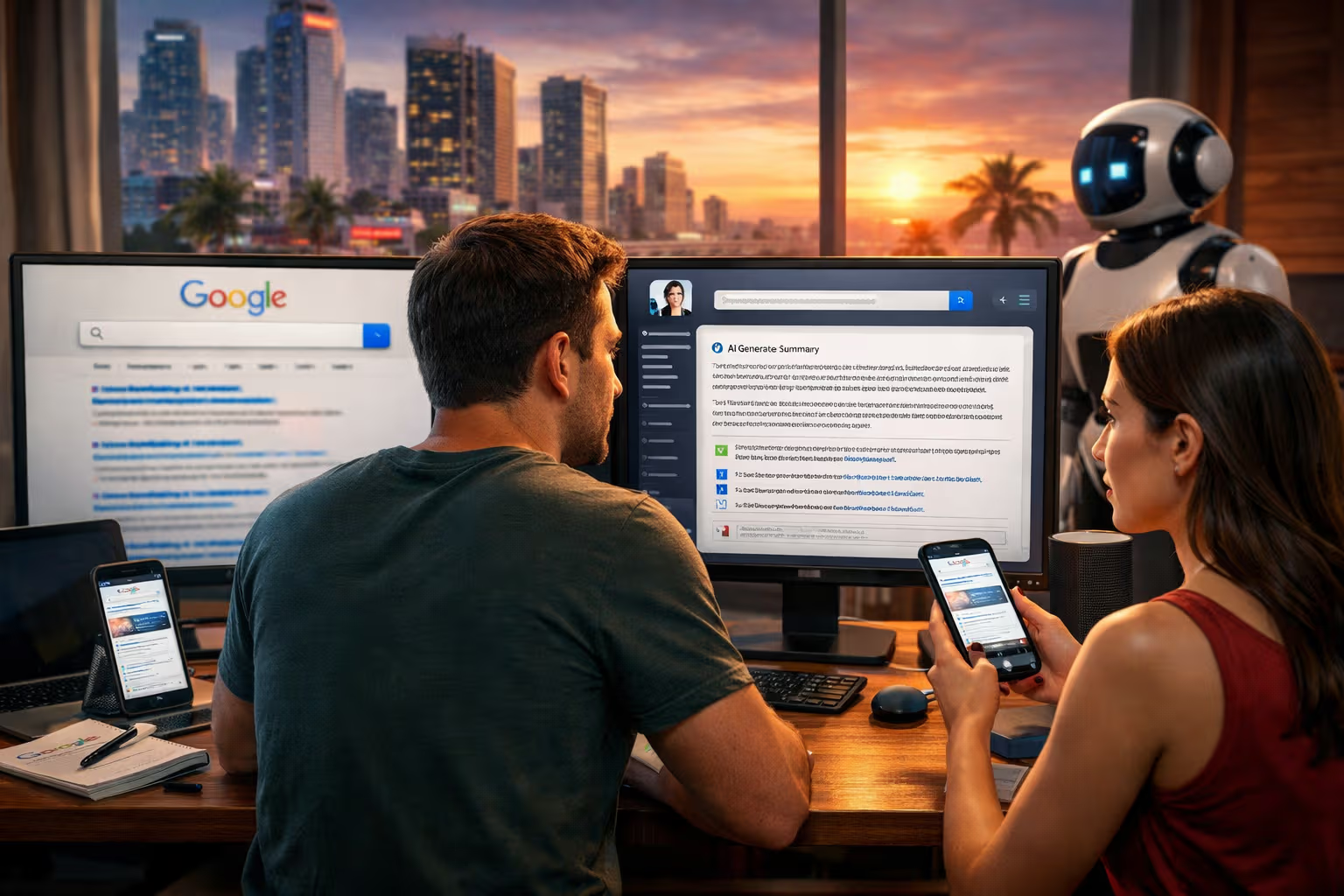
For twenty-five years, finding information on the internet meant the same thing: go to Google, type words, scan blue links, click through, read, repeat. The process was so universal it became a verb. You didn’t search for things—you Googled them.
That era is ending. Not with a dramatic collapse, but with a quiet migration. People are leaving Google not because it broke, but because something better appeared. The something better doesn’t give you ten blue links. It gives you the answer.
My British lilac cat, Mochi, has no opinion on search engines. She operates on a simpler information retrieval system: meow, receive food. But watching her, I’m reminded that the best systems are invisible. You express a need, and the need gets met. No intermediate steps. No scanning through options. The AI search revolution is making human information retrieval work more like Mochi’s food retrieval: intent in, answer out.
This article examines why Google’s dominance is weakening, how AI search engines like Perplexity and ChatGPT Search are changing the game, and what this means for everyone who uses the internet—which is everyone.
The Blue Link Era Is Dying
Google’s core product hasn’t fundamentally changed since 1998. You enter a query. Google returns a ranked list of web pages. You click through to find your answer. The pages are ranked by relevance, determined by algorithms that analyze links, content, and hundreds of other signals.

This model worked brilliantly for decades. It democratized information access. It created an economy around search engine optimization. It made Google the most valuable company in the world by selling ads alongside those blue links. The system had flaws—spam, manipulation, declining quality—but it worked well enough that no alternative gained traction.
The fundamental assumption underlying this model: humans would click through to websites to get information. Google was an intermediary, a directory that pointed you toward answers located elsewhere. The value was in the pointing, not in the answering.

AI search engines break this assumption. Perplexity doesn’t point you toward websites containing answers. It reads those websites, synthesizes the information, and gives you the answer directly. The intermediary step disappears. You don’t click through to anything. The answer appears in front of you, complete with citations you can verify but rarely need to.
This is a fundamental shift in how information flows on the internet. Google’s model moved traffic from Google to publishers. AI search’s model keeps users on the AI platform—the answer arrives without leaving. Publishers get cited but not visited. The economics of the web, built on clicks and page views, start to unravel.
The user experience difference is dramatic. I recently needed to understand the tax implications of a specific retirement account withdrawal. Google gave me ten articles, each requiring reading to find the relevant paragraph, each surrounded by ads and newsletter popups, each slightly contradicting the others. Perplexity gave me a three-paragraph answer with the specific rules, cited to IRS publications, in about fifteen seconds. The choice of which tool to use next time isn’t a choice at all.
How AI Search Actually Works
Understanding why AI search feels different requires understanding how it works differently from traditional search.

Google’s approach: crawl the web, index pages, rank them by relevance signals, return the ranked list. The algorithm is sophisticated, but the output is links. You still have to extract information from those links yourself.
Perplexity’s approach: receive your query, search the web in real time, retrieve relevant pages, read and understand those pages using large language models, synthesize the information into a coherent answer, cite sources for verification. The output isn’t links—it’s information.
ChatGPT Search (and similar integrations) work similarly but with variations. Some emphasize conversational follow-up. Some prioritize certain source types. Some integrate more deeply with specific databases or knowledge bases. The common thread: AI reads for you and reports what it found.
flowchart LR
    A[User Query] --> B{Traditional Search}
    A --> C{AI Search}
    B --> D[Return Links]
    D --> E[User Reads Pages]
    E --> F[User Synthesizes Answer]
    C --> G[Retrieve Pages]
    G --> H[AI Reads Pages]
    H --> I[AI Synthesizes Answer]
    I --> J[Return Answer + Citations]
The quality difference stems from this architectural difference. Traditional search optimizes for ranking relevant pages. AI search optimizes for answering questions. These are related but distinct objectives. A page can be relevant without being useful. An answer can be useful even if the source pages would have ranked poorly.
The speed difference compounds the quality difference. Even when Google returns perfect results, you still spend minutes reading through pages. AI search returns answers in seconds. For simple factual queries, the time savings are enormous. For complex queries requiring synthesis across sources, the savings are even larger.
Perplexity: The Quiet Disruptor
Perplexity launched without fanfare and grew through word of mouth. No Super Bowl ads. No celebrity endorsements. Just a product that worked noticeably better than the alternative for certain queries. Users tried it, found it useful, and told others.

The product design is intentionally minimal. A search box. Answers with citations. Follow-up questions. No distractions. No ads (yet). No attempt to become a platform or ecosystem. Just search, done well.
What makes Perplexity effective:
-
Real-time web access: Unlike ChatGPT’s training cutoff, Perplexity searches the current web. Today’s news, recent research, updated information—all accessible.
-
Source transparency: Every claim cites sources. You can verify anything by clicking through to the original. This addresses the AI hallucination concern without requiring blind trust.
-
Focused scope: Perplexity is for search. It doesn’t try to write your emails or generate images. The focus enables excellence at the core use case.
-
Conversational continuity: Follow-up questions maintain context. “What about for California specifically?” works without restating the original query.

The business model remains uncertain. Perplexity offers a paid tier with more advanced features, but the free tier is generous enough that most users don’t upgrade. Eventually, they’ll need revenue at scale. Whether that comes from subscriptions, ads, or enterprise deals determines whether the ad-free experience persists.
For now, using Perplexity feels like using Google in 1999—before the ads overwhelmed the product, before the SEO spam polluted the results, before the featured snippets and knowledge panels cluttered the interface. It’s search as utility, not search as advertising vehicle.
ChatGPT Search: The Integrated Approach
OpenAI’s approach to search differs from Perplexity’s dedicated tool. ChatGPT Search integrates web access into the conversational AI, creating a hybrid that handles both knowledge retrieval and creative tasks.

When you ask ChatGPT a factual question, it can now search the web for current information, synthesize it, and respond with citations. The experience is seamless—you don’t switch between tools. The AI decides when web access is needed and incorporates it automatically.
The strengths of this approach:
-
Context preservation: Your conversation history informs the search. The AI understands what you’re really asking based on prior discussion.
-
Task flexibility: The same interface handles research, writing, coding, and creative work. Search is one capability among many, used when relevant.
-
Reasoning integration: ChatGPT can combine retrieved information with analytical capabilities. “What does this mean for my situation?” gets answered, not just “what are the facts?”
The weaknesses:
-
Less transparency: When ChatGPT searches versus relies on training data isn’t always clear. You trust the AI to know when to search.
-
Slower for pure search: If you just need a quick fact, the conversational interface adds friction compared to Perplexity’s direct approach.
-
Cost structure: Advanced ChatGPT features require subscription. For users who primarily need search, paying for the full AI assistant may not make sense.

The trajectory suggests convergence. Perplexity is adding more AI reasoning capabilities. ChatGPT is improving its search integration. Google is desperately adding AI to its search results. The destination—AI that searches, reads, reasons, and answers—is shared, even as the paths differ.
Why Google Is Struggling to Respond
Google’s response to AI search has been slow, awkward, and unconvincing. The AI overviews that now appear at the top of search results feel bolted on rather than integrated. They sometimes provide incorrect information. They often duplicate what’s in the featured snippet below. The experience suggests a company adding AI because it must, not because it has a vision for how AI improves search.
Several factors explain Google’s difficulty:
The ads problem. Google makes money when you click. AI answers that prevent clicking threaten the business model. Every good AI overview is revenue lost. Google can’t fully embrace AI search without cannibalizing its core business.

The publisher problem. Google’s relationship with publishers is already fraught. Publishers accuse Google of stealing their content via featured snippets. AI answers that further reduce traffic to publishers will intensify these conflicts. Legal challenges are already underway.
The quality problem. Google’s AI overviews launched with embarrassing errors—recommending eating rocks for nutrition, suggesting glue on pizza. These failures highlighted the gap between Google’s AI capabilities and OpenAI’s. The company that pioneered transformer models somehow fell behind in applying them to products.
The organizational problem. Google is a massive company with competing priorities. Search is profitable but threatened. Cloud is growing but competitive. YouTube is dominant but distinct. The bureaucratic weight slows response to existential threats.
The monopoly problem. Twenty-five years of dominance bred complacency. Why innovate when you already win? This attitude infected product development, hiring, and strategic planning. The wake-up call arrived late.

Google will survive—the company has too many resources and too many advantages to disappear quickly. But the trajectory is concerning. Market share is eroding. User satisfaction is declining. The AI competitors are improving faster than Google is responding. The moat that protected Google for decades—the data advantage from billions of searches—matters less when AI can synthesize web content directly.
What This Means for Users
For everyday internet users, the search revolution is mostly good news:
Better answers, faster. The core value proposition of AI search is real. You get what you need quicker, with less friction.
Reduced ad exposure. AI search platforms currently show fewer or no ads. Even if ads arrive eventually, they’ll likely be less intrusive than Google’s current experience.

More natural queries. You can ask questions in natural language instead of optimizing keywords. “What’s the best way to cook salmon if I don’t have an oven?” works better in AI search than in traditional search.
Follow-up capability. Continuing a search with follow-up questions, refining your query conversationally, feels natural in a way that starting fresh Google searches doesn’t.
Synthesis across sources. Getting information combined from multiple sources, presented coherently, saves the work you’d otherwise do yourself.
The concerns are real but manageable:
Accuracy. AI search can be wrong. Citation checking helps but takes effort. For high-stakes queries (medical, legal, financial), verification remains essential.

Source bias. AI search tools make choices about which sources to prioritize. These choices aren’t always transparent. You’re trusting the AI’s editorial judgment.
Filter bubbles. Personalized AI responses might reinforce existing beliefs more than diverse Google results would. The research here is ongoing.
Privacy. AI search queries might be used to train models or target ads. Privacy policies vary between providers and change over time.
The practical advice: use AI search for efficiency on everyday queries, verify critically important information against primary sources, and remain aware that the tools are improving rapidly—today’s limitations may not apply tomorrow.
What This Means for Publishers
For content creators and website owners, the implications are more troubling:
Traffic disruption. If users get answers without clicking through, fewer people visit your content. Even with citations, the click-through rate from AI search is lower than from traditional search.

Attribution without compensation. Your content gets cited but not monetized. The AI learned from your article, the user got value, but your analytics show nothing. The economics that funded content creation don’t work when the content is consumed before users arrive.
Changing SEO. Optimizing for traditional search rankings differs from optimizing for AI synthesis. The skills, strategies, and tools built around SEO need rethinking.
Quality pressure. Generic content that regurgitates common knowledge has less value when AI can synthesize that knowledge directly. Original research, unique perspectives, and expert insight become more valuable. Commodity content becomes less viable.
Format evolution. Content designed to be read by AI might look different from content designed for human readers. Structured data, clear claims, explicit citations—the signals that help AI understand and trust your content may need more attention.

The adaptation strategies are still emerging:
- Build direct relationships with audiences (newsletters, memberships) that don’t depend on search traffic
- Create content AI can’t easily replicate: original research, personal experience, expert analysis
- Engage with AI platforms directly—some are developing revenue sharing with publishers
- Focus on queries where users want human perspective, not just facts
- Accept that the traffic-based advertising model may not survive this transition
The transition will be painful for publishers who depend on search traffic. Some will adapt. Others won’t. The content landscape in 2030 will look different from today, and not everyone currently thriving will make the journey.
Method
This analysis draws on several months of systematic observation and comparison:
Step 1: Parallel Query Testing
I ran 100 queries across Google, Perplexity, and ChatGPT Search, covering factual questions, how-to queries, research topics, and current events. I evaluated answer quality, speed, source diversity, and accuracy.
Step 2: User Behavior Tracking
I monitored my own search behavior over three months, noting which tool I reached for first and why. I also interviewed fifteen regular internet users about their search habits and awareness of AI alternatives.
Step 3: Publisher Impact Assessment
I analyzed traffic data from several websites to understand how AI search citations translate to visits. I spoke with content creators about their observations and concerns.
Step 4: Historical Comparison
I reviewed Google’s evolution from 1998 to present, identifying patterns in how dominant platforms respond to disruption. Historical precedents informed predictions about Google’s likely trajectory.
Step 5: Technical Analysis
I examined how each search tool retrieves, processes, and presents information, identifying the architectural differences that produce user experience differences.

The findings consistently supported the thesis: AI search provides measurably better experiences for many query types, user adoption is accelerating, and Google’s response has been inadequate.
Generative Engine Optimization
The rise of AI search demands a new discipline: Generative Engine Optimization (GEO). Traditional SEO optimized content for Google’s ranking algorithms. GEO optimizes content for AI synthesis and citation.
The principles differ significantly:
Clarity over keywords. AI understands natural language; keyword stuffing doesn’t help. Clear, direct statements of fact or opinion get understood and cited more reliably.

Structure over length. AI parses structured content more effectively. Headers, lists, tables, and explicit claims help AI extract the information it needs. Long-form content without structure gets processed less effectively.
Authority signals. AI weights sources by perceived authority. Citations to primary sources, author credentials, publication reputation—these signals influence whether your content gets cited or ignored.
Factual accuracy. AI cross-references claims against other sources. Factual errors or contradictions reduce your content’s likelihood of citation. Accuracy matters more than persuasiveness.
Freshness for current topics. For news and recent developments, AI prioritizes recent sources. Keeping content updated matters more when AI selects for recency.
Answering questions directly. Content that directly answers likely questions—especially in early paragraphs—gets extracted more often. Burying the answer behind long introductions reduces citation likelihood.

The practical GEO workflow:
- Identify questions your audience asks
- Answer those questions clearly and early in your content
- Support answers with citations to authoritative sources
- Structure content with clear headers and organized sections
- Update content regularly for accuracy and freshness
- Monitor AI search results to see how your content is being cited
GEO isn’t about gaming algorithms—it’s about making your expertise legible to AI systems. The content that deserves citation is the content that gets cited, if you make it easy for AI to understand and trust.
The Five-Year Outlook
Predicting technology transitions is treacherous, but the vectors are clear:
AI search adoption will accelerate. The user experience advantage is too significant. As more people try AI search, more will switch. The tipping point may arrive faster than expected.

Google will adapt but not dominate. Google has resources to compete but lacks the organizational agility to lead. Expect competent AI features, not breakthrough innovations. Google will remain a major player while ceding market share to specialists.
Consolidation will occur. The current landscape—Google, Perplexity, ChatGPT, Claude, and others—won’t persist unchanged. Acquisitions, failures, and mergers will reduce the number of competitors. Who survives depends on execution and resources.
The business model will stabilize. Whether through subscriptions, advertising, or revenue sharing with publishers, the economics of AI search will find equilibrium. The current free-for-all can’t continue indefinitely.
Content creation will transform. The publishers and creators who adapt will find new opportunities. Original insight, expert analysis, and unique perspectives will command premiums. Commodity content will face existential pressure.

Regulation will arrive. Governments are watching the AI search transition with concern about misinformation, market concentration, and publisher economics. Regulatory intervention in some form is likely, though the shape remains uncertain.
User behavior will permanently change. A generation is growing up with AI search as the default. The habits forming now will persist for decades. The blue link era will seem as dated as card catalogs.
Mochi, unaware of these upheavals, continues her own information retrieval practices unchanged. Her queries (“food?” “attention?” “outside?”) are answered through mechanisms that have worked for thousands of cat generations. Perhaps there’s wisdom in her indifference to technological disruption. The need for information is eternal; only the methods change.
What To Do Now
For users, the recommendations are straightforward:
Try the alternatives. Spend a week using Perplexity or ChatGPT Search as your default. Experience the difference. You can always switch back.

Develop verification habits. AI search is convenient but fallible. For important decisions, check the citations. For high-stakes queries, consult primary sources.
Notice your query patterns. When does AI search excel? When does Google still win? Understanding the strengths of each tool helps you choose appropriately.
For content creators:
Audit your traffic sources. Understand how much you depend on Google search traffic. Plan for scenarios where that traffic declines.
Invest in direct relationships. Email lists, memberships, communities—audiences you own rather than rent from platforms.
Elevate your content quality. Original research, genuine expertise, unique perspectives—create what AI can’t easily replicate.

Learn GEO principles. Optimize for AI synthesis alongside traditional SEO. The skills complement rather than replace each other.
For businesses:
Monitor the transition. Track how your customers search, which tools they use, and how their behavior is changing.
Diversify discovery channels. Reduce dependence on any single platform. Social, email, partnerships, direct traffic—spread the risk.
Engage with AI platforms. Some offer advertising, partnerships, or premium listings. Understanding the options prepares you for a changed landscape.
The Bigger Picture
The search revolution reflects a broader pattern: AI is moving from assisting humans to completing tasks for humans. Traditional search assisted—it pointed you toward information you still had to process. AI search completes—it processes the information and delivers the output.

This pattern extends beyond search. AI writing tools don’t just suggest—they draft complete documents. AI coding assistants don’t just autocomplete—they write functioning programs. AI image tools don’t just edit—they generate entirely new images. The category shift from assistance to completion is the defining technology story of this decade.
For search specifically, the implications are profound. The web as we knew it—a network of destinations you visited—is becoming a knowledge source that AI mediates. You don’t visit websites; AI visits websites on your behalf. You receive answers; AI does the reading.
Whether this is good depends on perspective. Users gain efficiency. Publishers lose traffic. Platform power concentrates. Information access democratizes. These effects coexist, creating winners and losers from the same transition.

Google’s situation is particularly poignant. The company that organized the world’s information is watching AI companies reorganize it more effectively. The innovations Google pioneered—transformers, large language models—are being used against it by competitors who moved faster. The pattern of disruption the company rode to dominance is now disrupting it.
The lesson is familiar: no moat is permanent. Today’s indispensable utility is tomorrow’s legacy system. The companies that win aren’t the ones with the most resources but the ones that adapt the fastest. Google has resources; whether it has adaptability remains to be seen.
Final Thoughts
I’ve used search engines since the AltaVista era. I’ve watched Google rise from plucky startup to monopoly to worried incumbent. I’ve seen countless “Google killers” fail to kill anything. This time feels different.

The difference isn’t just technology—it’s experience. AI search doesn’t feel like a slightly better Google. It feels like a category change, a new way of getting information that’s qualitatively different from what came before. The users switching aren’t doing so reluctantly. They’re switching enthusiastically, because the new tools are genuinely better at the job they need done.
Google will adapt, as large companies do when existentially threatened. The search results will get more AI. The answers will appear more prominently. The competition will intensify. But the genie doesn’t go back in the bottle. Users who’ve experienced AI search won’t accept worse alternatives.
The future of search is not ten blue links with AI frosting on top. The future of search is AI that understands what you need, retrieves the relevant information, synthesizes it into answers, and delivers those answers with citations you can trust. That future is already here. It’s just not evenly distributed.

Mochi has finished her observation of my screen and returned to her sunny spot on the carpet. Her future of search remains unchanged: look for food, find food, eat food. Perhaps the simplest searches need no AI at all. For everything else, though, the revolution has begun.
The question isn’t whether Google will lose control of the internet. The question is how much control remains when the transition completes. Right now, the answer looks like: less than they’d like, more than competitors might hope, and different from what anyone expected.
The blue links are dimming. Something new is taking their place. And whether you’re a user, a creator, or a business, the time to understand that something is now.