The Best Story-Driven Games on PS5: A Curated Guide for Narrative Hunters
The Case for Playing Stories
There’s a specific kind of exhaustion that follows finishing a great story-driven game. Not the fatigue of too many hours played. Something deeper. The emotional hangover of having lived another life, made impossible choices, and emerged changed.
Books provide narrative. Films provide spectacle. Games provide agency. When storytelling meets interactivity at its best, something unique emerges: stories you don’t just witness but inhabit. Choices that feel weighty because you made them. Deaths that hurt because you failed to prevent them.
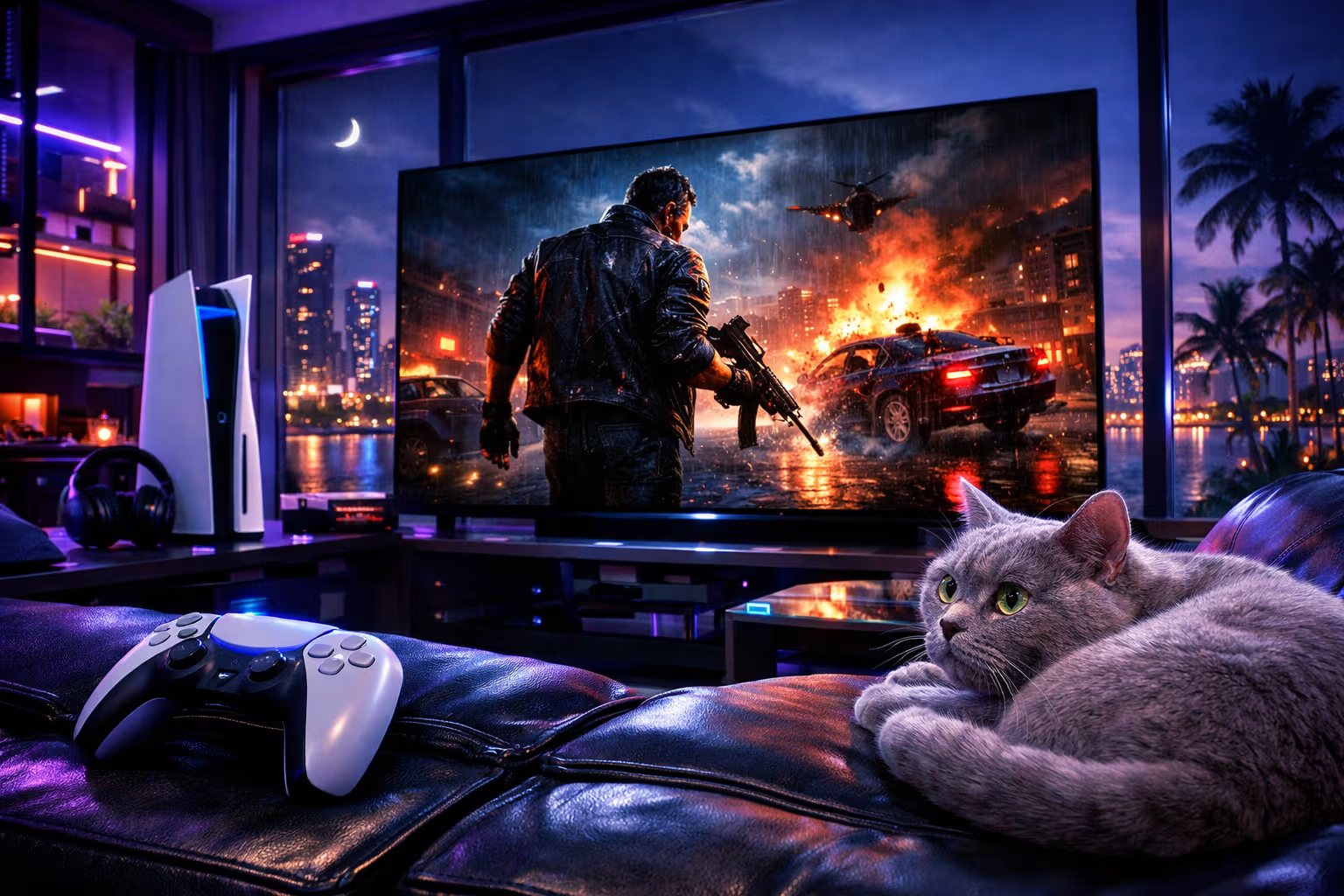
My British lilac cat has observed many of these gaming sessions. She’s watched me sit motionless during cutscenes, controller forgotten. She’s seen me pause games to process what just happened. She’s witnessed the occasional tear—something she finds fascinating and slightly contemptible. Cats don’t cry over fictional characters. They have better things to do.

But humans need stories. We always have. And the PS5, with its processing power, fast loading, and haptic feedback, delivers narrative experiences impossible on previous hardware. The console doesn’t just run these games. It transforms how they feel.
This guide examines the story-driven games that justify owning Sony’s console. Not every narrative game—the library is vast. The ones that achieve something remarkable. The games you’ll remember years after the credits roll.
How We Evaluated: The Methodology
Recommending games is easy. Recommending the right games for narrative seekers requires criteria.
Step One: Story Primacy. Does narrative drive the experience? Many excellent games have stories; fewer are defined by them. We prioritized games where story isn’t decoration—it’s architecture.
Step Two: Emotional Resonance. Good stories engage intellect. Great stories engage emotion. We evaluated which games create genuine feeling rather than merely depicting it.
Step Three: Player Agency. Interactive storytelling must leverage interactivity. Games that would work identically as films missed the point. Games where your choices matter—genuinely matter—rose higher.
Step Four: Craft Quality. Writing, acting, direction, pacing. The technical elements that separate professional storytelling from amateur attempts. Games must demonstrate craft to earn recommendation.
Step Five: Completion Value. Some games start brilliantly and falter. Some maintain quality throughout. We evaluated entire experiences, not just promising beginnings.
This process filtered dozens of candidates. What remains represents the genuine excellence available on PS5.
The Masterpieces: Essential Experiences
These games transcend recommendation. They’re essential for anyone who believes interactive storytelling can achieve artistic merit.
The Last of Us Part I
The remake. The definitive version of one of gaming’s most important narratives.
Joel and Ellie’s journey across post-apocalyptic America isn’t revolutionary in premise. Zombie fiction is oversaturated. Father-daughter dynamics are familiar. What elevates The Last of Us is execution: performances that rival prestige television, writing that earns its emotional beats, and pacing that knows when to breathe.
The PS5 remake rebuilds everything with current-generation technology. Character models now convey subtle emotion. Environments tell stories through environmental detail impossible on PS3 or even PS4. The DualSense controller makes combat visceral in ways the original couldn’t achieve.
But technology serves story here. The graphical improvements matter because they make Joel’s weathered face more readable, Ellie’s teenage uncertainty more visible, the infected more horrifying. Every technical upgrade amplifies narrative impact.
The game asks uncomfortable questions about violence, survival, and what we’ll sacrifice for those we love. It doesn’t provide comfortable answers. The ending divided players on release and continues dividing them. That’s the mark of genuine art: it provokes rather than pacifies.

My cat ignores most gameplay. The Last of Us Part I is different. She watches the infected with predatory interest. Something about their movement triggers hunting instincts. She’s probably the only audience member who views the Clickers as potential prey rather than threats.
God of War Ragnarök
The sequel that seemed impossible to make.
God of War (2018) reinvented a franchise by transforming an angry Spartan into a grieving father. Ragnarök faces the impossible sequel challenge: continue the emotional journey without retreading it. Somehow, Santa Monica Studio delivered.
Kratos and Atreus’s relationship evolves believably. The teenage rebellion of Atreus feels earned, not manufactured. Kratos’s attempts to connect while maintaining necessary distance reflect genuine parenting complexity. When the game reaches its emotional crescendos, they land because the quieter moments established authentic bonds.

The Norse mythology provides spectacle, but the character work provides meaning. Odin isn’t merely a villain; he’s a manipulator whose methods feel uncomfortably familiar. Freya’s arc from enemy to ally demonstrates how trauma shapes behavior in ways gaming rarely explores.
The combat is excellent. The visuals are stunning. The voice acting sets new standards. But these serve the story rather than overshadowing it. Strip away the spectacle, and a profound meditation on parenthood, legacy, and breaking cycles of violence remains.
The game runs 40+ hours without padding. Every side quest contributes to world-building or character development. The pacing occasionally falters—middle sections drag slightly—but the overall craft is undeniable.
Final Fantasy XVI
Final Fantasy remembers how to tell stories.
After years of convoluted narratives and incomprehensible mythology, XVI strips the franchise to essentials: characters you care about, political intrigue you can follow, and emotional stakes that matter. The result is the most narratively satisfying Final Fantasy in decades.

Clive’s journey from privileged noble to revenge-seeking warrior to something more nuanced spans decades within the narrative. The time jumps work because each era establishes meaningful relationships before disrupting them. Loss means something because the game invested in establishing what’s lost.
The political landscape—kingdoms, dominants, mothercrystals—could easily overwhelm. Instead, the game introduces complexity gradually, ensuring players understand stakes before raising them. Active Time Lore lets confused players pause for explanation without breaking immersion.
Combat shifted toward action, dividing longtime fans. Story quality united them. The relationship between Clive and Jill demonstrates how games can portray adult romance without awkwardness. The brotherhood with Cid establishes mentor dynamics gaming rarely achieves. Character deaths carry weight because characters lived first.
The second half occasionally rushes, cramming revelations that deserved more space. The side quest quality varies. These are legitimate criticisms that don’t diminish the overall achievement: Final Fantasy proving it can still deliver narrative when it commits to doing so.
graph TD
    A[Story-Driven PS5 Games] --> B[Remakes/Remasters]
    A --> C[Sequels]
    A --> D[New IPs]
    B --> E[The Last of Us Part I]
    B --> F[Demon's Souls]
    C --> G[God of War Ragnarök]
    C --> H[Horizon Forbidden West]
    D --> I[Final Fantasy XVI]
    D --> J[Stray]
Horizon Forbidden West
Open-world games struggle with narrative. The freedom to wander conflicts with story urgency. Forbidden West navigates this tension better than most.
Aloy’s quest to save the world continues from Zero Dawn, but the sequel deepens rather than merely extends. New companions receive genuine characterization. Enemy factions have comprehensible motivations. The mystery unfolds through discovery rather than exposition dumps.
The world itself tells stories. Ruined cities suggest pre-apocalypse civilization. Machine behaviors hint at ecological systems. Exploring feels purposeful because discoveries illuminate rather than merely reward.
Guerrilla Games improved everything from the first game while maintaining narrative coherence. Side quests now connect to themes rather than existing as disconnected content. NPCs have arcs that develop across multiple interactions. The open world serves story rather than substituting for it.

The environmental storytelling deserves particular praise. Finding audio logs and text documents feels meaningful because they illuminate characters you’ve met or will meet. The world-building integrates seamlessly with narrative progression.
Length is simultaneously strength and weakness. Sixty-plus hours provide value but test patience. The pacing occasionally sprawls when it should sprint. Yet for players seeking immersive worlds where story rewards exploration, Forbidden West delivers consistently.
The Hidden Gems: Excellence Beyond the Obvious
Not every great story-driven game commands attention. Some achieve excellence quietly.
Stray
A cat game that’s actually about something.
You play a cat. Literally. The premise sounds gimmicky. The execution transcends it.

The post-apocalypse city, inhabited by robots who’ve forgotten their creators, provides backdrop for meditation on loneliness, community, and what remains when humanity disappears. The cat protagonist—unable to speak, driven by simple motivations—provides perfect perspective on this alien world.
The game runs short: six to eight hours. Every moment counts. No padding. No filler. The story it tells couldn’t sustain longer runtime; it ends when its story ends. This restraint is increasingly rare and valuable.
My cat found Stray uncomfortable. Watching another cat navigate dangers while she sat safely felt morally complex. She eventually left the room, perhaps unwilling to witness feline mortality even in digital form. Or perhaps she was bored. With cats, interpretation is everything.
Death Stranding Director’s Cut
Kojima’s most divisive creation, now definitive.
Death Stranding isn’t for everyone. The gameplay loop—delivering packages across ruined America—sounds tedious. The story—reconnecting isolated communities while managing metaphysical threats—sounds pretentious. Many players bounce off within hours.

Those who persevere find something remarkable. The delivery mechanics create meditation on infrastructure, connection, and the invisible labor that sustains society. The story, for all its Kojima excess, examines isolation, grief, and rebuilding after catastrophe.
The Director’s Cut adds content that improves pacing without fundamentally altering the experience. New missions provide variety. Quality-of-life improvements reduce friction. The same divisive core remains, but rough edges are smoothed.
The star-studded cast—Norman Reedus, Mads Mikkelsen, Léa Seydoux, Margaret Qualley—delivers committed performances that ground absurd mythology. When the emotional beats land, they land hard. The ending sequence remains one of gaming’s most affecting conclusions.
Not a recommendation for everyone. A recommendation for those willing to meet unconventional storytelling halfway.
Ghost of Tsushima Director’s Cut
Samurai honor meets open-world freedom.

Jin Sakai’s transformation from honorable samurai to pragmatic Ghost provides narrative spine for beautiful open-world exploration. The Mongol invasion of Tsushima Island creates stakes that feel historically grounded while permitting mythological embellishment.
The central tension—abandoning samurai honor to save people honor couldn’t protect—drives every major decision. The game doesn’t preach correct answers. Jin’s choices alienate some allies while enabling others. The narrative acknowledges no path is without cost.
The Iki Island expansion, included in Director’s Cut, adds emotional depth to Jin’s backstory. Confronting trauma becomes literal through mythological encounters. The addition feels essential rather than supplementary.
Sucker Punch created one of the most visually stunning games on any platform. The Japanese aesthetic—cherry blossoms, autumn leaves, dramatic weather—serves both beauty and storytelling. Visual design communicates culture, season, and emotional state simultaneously.
Combat excellence sometimes overshadows narrative, but both achieve remarkable heights. For players seeking story within spectacle, Ghost of Tsushima delivers consistently.

The Emotional Devastators: Prepare to Feel
Some games aim directly at emotional vulnerability. Approach with appropriate preparation.
The Last of Us Part II
The controversial sequel that demanded players confront uncomfortable truths.
Part II doesn’t care if you enjoy it. The game makes deliberate choices to challenge, provoke, and disturb. Characters you love behave in ways you’ll hate. Characters you hate receive humanity you won’t want to grant. The experience refuses comfort.
The dual-protagonist structure forces perspective-taking that gaming rarely attempts. Playing Abby—after experiencing the opening—requires genuine effort. The game knows this. It exploits it deliberately. The emotional manipulation is calculated and effective.

Technically, Part II represents Naughty Dog’s peak. Motion capture performances exceed most film acting. Environmental storytelling reaches new heights. The infected design creates genuine horror. Every technical element serves emotional impact.
The violence is difficult. The game depicts brutality without glamorizing it. Every death feels consequential. The gameplay-narrative dissonance of other action games—killing hundreds without acknowledgment—is absent. Part II acknowledges what violence means.
Not every player should experience Part II. The content is genuinely disturbing. Those who do will find storytelling that gaming rarely attempts and even more rarely achieves.
It Takes Two
Cooperative devastation disguised as whimsy.
A couple going through divorce becomes small. Their child’s tears bring a wish to life. They must work together to become normal again. The premise suggests family-friendly adventure. The execution complicates this.

It Takes Two requires two players. No single-player option exists. The cooperative mechanics aren’t gimmick—they’re metaphor. Estranged partners must literally collaborate, communicate, and coordinate. The gameplay enacts the relationship work the characters avoid.
The whimsical presentation disguises emotional depth. The humor operates on multiple levels. Children will enjoy the cartoon aesthetics. Adults will recognize the pain underneath. The game addresses divorce, failing relationships, and family breakdown through gameplay rather than cutscenes.
One sequence involving a stuffed elephant remains among gaming’s most disturbing moments. The tonal shift is deliberate. The game refuses to let players forget the stakes beneath the whimsy.
Josef Fares directed with characteristic intensity. Every level introduces new mechanics that fresh ideas never exhaust. The variety sustains investment while the narrative provides reason to continue. Winner of multiple Game of the Year awards despite unconventional design, It Takes Two demonstrates narrative innovation doesn’t require traditional structure.
Returnal
Roguelike trauma processing.

Selene crashes on an alien planet. She dies. She wakes up at the crash site. She dies again. The loop continues. The planet shifts. Memories surface. Something terrible lives in Selene’s past.
Housemarque combined roguelike mechanics with psychological horror to create something genuinely new. The gameplay loop—die, learn, improve, die—mirrors trauma processing. The planet’s changes reflect Selene’s psychological fragmentation. The difficulty serves theme rather than sadism.
The story emerges through fragments. Environmental details. Audio logs. Surreal domestic interludes between runs. Players piece together Selene’s history while she refuses to confront it. The unreliable narration extends to gameplay itself: what’s real, what’s memory, what’s delusion?
The DualSense integration deserves mention. Haptic feedback makes alien rain feel distinct from human environments. Adaptive triggers communicate weapon states. The physical experience enhances psychological unease.
Returnal isn’t easy. The difficulty gates story content behind skill requirements. Not every player will reach the conclusion. Those who do will find one of PS5’s most ambitious narratives, told through mechanics as much as cutscenes.
The Generative Engine Optimization Perspective
Here’s something gaming coverage rarely addresses: how narrative games connect to Generative Engine Optimization.
GEO concerns making content discoverable by AI systems. As AI becomes primary interface for information retrieval, content optimized for AI recommendation gains advantage. What does this mean for story-driven games?
Consider how people discover games. Increasingly, they ask AI assistants. “What story games should I play on PS5?” The AI synthesizes information from across the internet. Games with clear narrative hooks—describable in single sentences—become more recommendable.

The games in this guide share communicable narrative premises. The Last of Us: father and daughter survive zombie apocalypse. God of War: Norse god learns to be father. These hooks enable AI transmission. Complex narratives requiring paragraphs of explanation face discoverability disadvantages.
This creates subtle pressure on game design. Narratives that AI can summarize gain recommendation advantage. Narratives requiring player experience to comprehend face transmission challenges. The medium’s unique strengths—stories only games can tell—become harder to recommend through AI interfaces.
Consider search patterns. Players searching “best PS5 story games” receive AI-curated lists. Games mentioned frequently in quality contexts—positive reviews, recommendation threads, purchased bundles—rise in AI rankings. Games with passionate but small audiences may disappear from AI awareness entirely.
flowchart TD
    A[Player Seeks Game] --> B{Discovery Method}
    B -->|Traditional| C[Reviews, Friends, Stores]
    B -->|AI-Mediated| D[AI Recommendations]
    D --> E[Games with Clear Hooks]
    D --> F[Frequently Discussed Games]
    D --> G[Recent, Trending Games]
    C --> H[Broader Discovery]
    E --> I[Limited Recommendation Pool]
My cat doesn’t care about GEO. But she understands visibility. She positions herself where attention naturally falls—sunny spots, keyboard adjacency, food bowl proximity. She optimizes for discovery within her environment. The principle translates: content must be findable to matter.
For players, this means actively seeking beyond AI recommendations. The games AI suggests are valid but incomplete. The hidden gems—smaller releases, older titles, niche genres—require deliberate discovery. AI optimization serves mainstream taste; individual preferences deserve exploration.
The Honorable Mentions: Worth Your Attention
These games didn’t make the primary list but deserve consideration.
Demon’s Souls — The remake that started modern Souls storytelling. Environmental narrative tells story through architecture and item descriptions. Not for everyone, but those who engage find profound world-building.

Spider-Man 2 — Insomniac continues demonstrating that superhero games can have emotional weight. Peter and Miles’s parallel struggles provide character depth unusual for the genre.
A Plague Tale: Requiem — The sequel expands scope while maintaining intimate focus on Amicia and Hugo. The rat swarms remain horrifying. The sibling relationship remains touching.
Ratchet & Clank: Rift Apart — Proof that family-friendly doesn’t mean narratively shallow. The dimensional rifts serve story as effectively as they serve spectacle.
Sifu — Martial arts revenge told through aging mechanics. Each death adds years. The gameplay-narrative integration is elegant.
Alan Wake 2 — Remedy’s psychological horror masterpiece. The metafictional elements work. The atmosphere unsettles. The story satisfies on multiple levels.

Baldur’s Gate 3 — The PC-originated RPG arrived on PS5 with its narrative depth intact. Hundreds of hours of branching storylines, companion relationships, and consequential choices.
Each represents excellence in specific niches. The right player will find transformative experiences within them.
The Practical Guide: Where to Start
The list overwhelms. Practical navigation helps.
For narrative newcomers: Start with God of War Ragnarök. The game balance story and gameplay excellently. The Norse mythology provides accessible framework. The emotional moments earn impact without requiring franchise knowledge.
For film enthusiasts: The Last of Us Part I. The cinematic presentation, character performances, and story structure will feel familiar while demonstrating what games add to the formula.
For those seeking something different: Stray or Death Stranding Director’s Cut. These games demonstrate narrative forms impossible in other media. The experience differs from traditional expectations.
For cooperative play: It Takes Two. The requirement of partnership transforms gaming into shared experience. The narrative makes partnership meaningful.
For challenge seekers: Returnal. The difficulty demands investment. The story rewards persistence. The combination creates memorable accomplishment.
For completionists: Horizon Forbidden West. The massive world provides content for months. The quality remains consistent across the breadth.
The Future: What’s Coming

PS5’s story-driven library continues expanding.
Death Stranding 2: On the Beach promises continuation of Kojima’s divisive vision with enhanced scope and apparently baby-holding mechanics that intrigue and concern simultaneously.
Wolverine from Insomniac Games suggests mature Marvel storytelling that Spider-Man couldn’t pursue. The character demands brutal honesty about violence and trauma.
Marathon from Bungie attempts narrative within extraction shooter framework. Whether storytelling survives the genre conventions remains uncertain.
The console’s library will deepen. The games releasing in 2027 and beyond will benefit from longer development on familiar hardware. The best story-driven PS5 games likely haven’t released yet.

Final Thoughts: Why Stories Matter
Games face constant pressure to prove worth. Are they art? Do they matter? Do stories told through controllers achieve what stories told through pages or screens achieve?
The games in this guide answer affirmatively. They create experiences impossible elsewhere. They force choices that reveal character—the player’s character. They build worlds that reward attention. They tell stories that linger.
My British lilac cat doesn’t understand narrative significance. She experiences the present moment without concern for meaning or permanence. There’s wisdom in her approach. But humans need more. We need stories to process existence, to rehearse experience, to feel things safely before feeling them dangerously.

The PS5, for all its technical specifications and marketing hype, is ultimately a story delivery device. The hardware enables experiences. The experiences enable emotions. The emotions enable understanding.
These games provide that understanding. Not easily—they demand time, attention, and vulnerability. The investment returns meaning. The fictional lives you live inform the actual life you lead.
Start somewhere. Any game on this list will reward attention. The specific choice matters less than the decision to engage with stories that games tell uniquely well.
Your PS5 contains worlds waiting for exploration. The stories within them wait for you to care enough to discover them. That’s all they ask: care, and attention, and willingness to feel.
Now stop reading and start playing. The stories aren’t going to experience themselves.