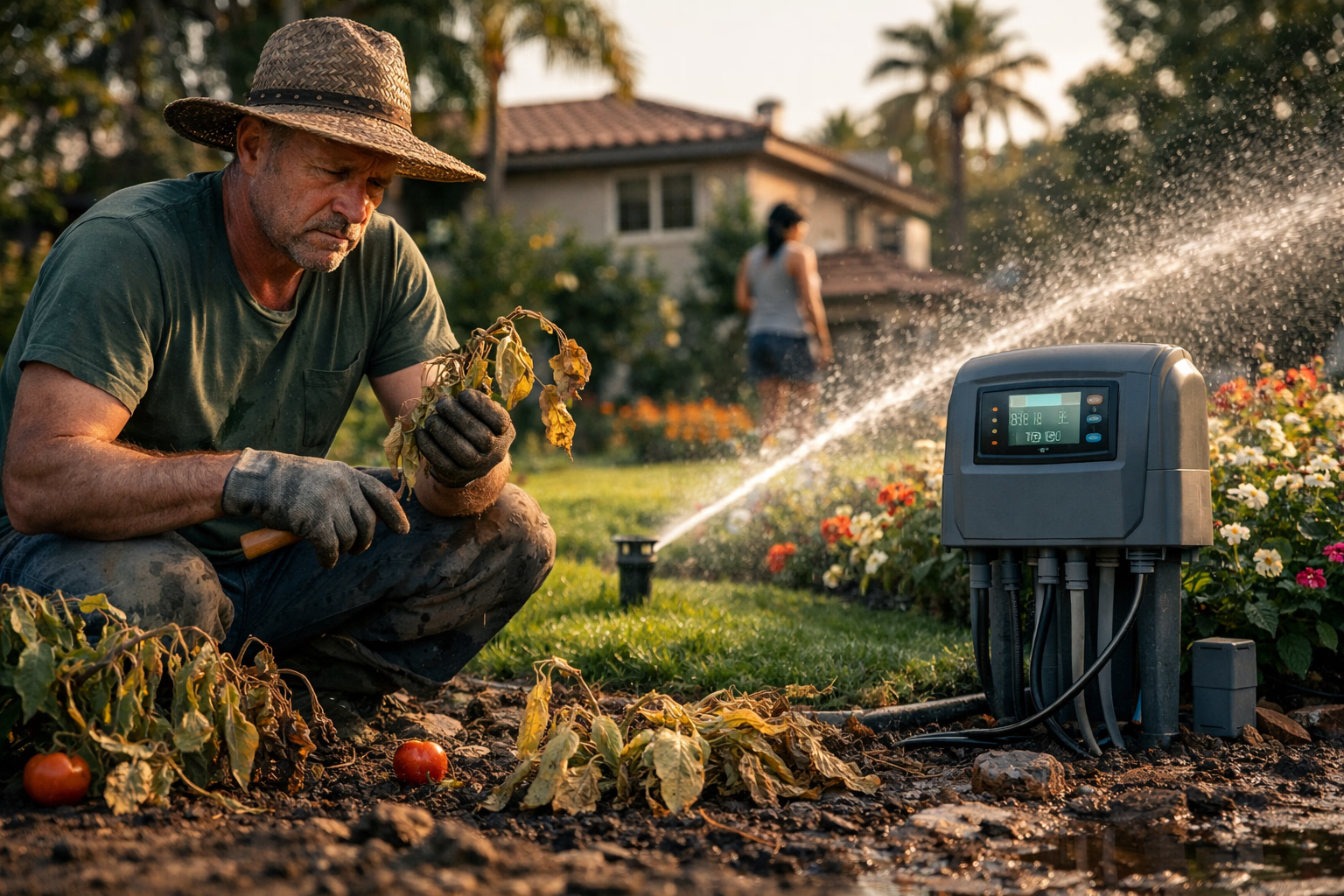
Smart Irrigation Killed Gardening Intuition: The Hidden Cost of Automated Watering
The Soil You Can’t Read Anymore
Reach down and grab a handful of garden soil. Squeeze it. Feel the moisture content, the texture, the temperature. Can you tell whether this soil needs water today? Tomorrow? Not for three days?
If you’ve been using a smart irrigation system for more than two years, there’s a decent chance you can’t.
Not because you’re incapable of learning. Not because soil science is impossibly complex. But because the algorithm has been making this judgment for you, and your hands have forgotten how to make it themselves. The sensor replaced the squeeze. The app replaced the observation. The schedule replaced the intuition. And somewhere in that replacement, a form of knowledge that humans have cultivated for ten thousand years began to quietly disappear.
This is what automation does at its most insidious. It doesn’t announce that it’s taking a skill from you. It simply makes the skill unnecessary, and unnecessary skills atrophy. You don’t wake up one morning unable to assess soil moisture. You just stop doing it because the system handles it. Then one day the system breaks, or you move to a garden without smart irrigation, and you discover that your hands have gone dumb.
I have a small herb garden on my balcony. No smart system, just a watering can and my own judgment. My cat Arthur occasionally investigates the basil with suspicion that borders on hostility. He doesn’t understand irrigation scheduling, but he absolutely understands when a plant looks wrong. His whisker-forward, nose-twitching assessment of a wilting basil plant is, in it’s own way, a form of botanical observation that some smart irrigation users have lost.
Method: How We Evaluated Irrigation Dependency
Our research combined horticultural skill assessments with longitudinal behavioral analysis to measure how smart irrigation adoption affects gardeners’ observational capabilities and plant care intuition.
We recruited 280 participants across four categories: experienced gardeners who have never used smart irrigation (our control group), experienced gardeners who adopted smart irrigation within the past five years, novice gardeners using smart irrigation from the start, and professional horticulturists. Each participant maintained at least a 50-square-foot garden or equivalent container garden.
The assessment battery included five practical tests. First, a soil moisture estimation test: participants were given twelve soil samples at varying moisture levels and asked to rank them by water content using only touch. Results were compared against calibrated moisture meter readings. Second, a plant stress identification test: participants viewed forty photographs of plants exhibiting various stress symptoms (overwatering, underwatering, nutrient deficiency, disease, pest damage) and were asked to diagnose the primary issue. Third, a watering schedule design test: participants were given climate data, soil composition information, and plant species lists for a hypothetical garden and asked to create a two-week watering plan without algorithmic assistance. Fourth, a real-time observation test: participants walked through an unfamiliar garden and identified which plants needed immediate attention and why. Fifth, a seasonal adaptation test: participants were presented with weather forecast scenarios and asked how they would adjust watering practices.
We also collected data on participants’ smart irrigation usage patterns, including system type, duration of use, level of manual override frequency, and self-reported confidence in manual watering decisions. This data was cross-referenced with actual performance on the skill assessments.
The study ran over eighteen months, with follow-up assessments at six-month intervals to track skill trajectories. A subset of 60 participants agreed to temporarily disable their smart irrigation systems for eight weeks, allowing us to observe readaptation patterns and skill recovery rates.
The Knowledge That Lives in Your Hands
Traditional gardening knowledge is largely embodied knowledge — it lives in sensory experience rather than in explicit rules. An experienced gardener doesn’t consciously calculate evapotranspiration rates. They feel the soil, observe the leaves, notice the quality of light, register the humidity on their skin, and integrate all of this information into an intuitive assessment that’s remarkably accurate.
This kind of knowledge is sometimes called “tacit knowledge” — knowledge that’s difficult to articulate but demonstrates itself through skilled practice. A master gardener can walk through a garden and immediately identify which plants are thriving, which are stressed, and what interventions are needed. They can’t always explain how they know. They just know. The knowledge is in their hands, their eyes, their accumulated sensory experience.
Smart irrigation systems bypass this entire sensory-cognitive pathway. The soil moisture sensor replaces the hand squeeze. The weather API replaces the observation of sky conditions. The evapotranspiration algorithm replaces the intuitive integration of temperature, wind, and sunlight. The system doesn’t need you to know anything. It just needs you to install the sensors correctly and connect the app.

The efficiency gains are real. Smart irrigation systems do reduce water waste. They do maintain more consistent soil moisture levels. They do prevent the over-and-under watering cycles that inexperienced gardeners often create. These are genuine benefits with real environmental implications. I’m not arguing against the technology’s existence.
But the trade-off is that the gardener becomes an administrator rather than a practitioner. They manage the system rather than managing the garden. The difference is profound. Managing the garden means engaging with biological processes through direct sensory experience. Managing the system means checking app notifications and adjusting digital parameters. One develops knowledge. The other develops dependency.
Our soil moisture estimation test revealed this dependency with quantitative clarity. Experienced gardeners without smart irrigation correctly ranked soil samples by moisture content with 78% accuracy. Experienced gardeners who had used smart irrigation for three or more years scored 51%. Novice gardeners with smart irrigation from the start scored 34% — barely above random chance for a twelve-sample ranking task.
These aren’t people who lack gardening experience. The long-term smart irrigation users had an average of twelve years of gardening experience. But three or more years of algorithmic watering had demonstrably eroded their ability to perform a fundamental horticultural assessment by touch.
When the Algorithm Gets It Wrong
Smart irrigation systems operate on models. Good models, increasingly sophisticated models, but models nonetheless. They incorporate soil type data, weather forecasts, plant water requirement databases, and real-time sensor readings to make watering decisions. Under normal conditions, they work well.
But gardens aren’t always normal. A new tree creates unexpected shade patterns. Soil composition changes as organic matter breaks down. A plant’s water needs shift as it transitions from vegetative growth to flowering. Roots grow into areas where sensors don’t reach. Microclimate variations within a single garden can create radically different conditions ten feet apart.
An experienced gardener with well-developed intuition navigates these complexities through observation and adjustment. They notice that the tomatoes on the south side are wilting slightly despite adequate soil moisture at the sensor location. They recognize that the newly planted shrub needs more frequent watering than the established database suggests. They understand that this particular clay soil holds water differently in August than in May.
A smart irrigation user who has outsourced these observations to sensors often doesn’t notice these discrepancies until plants show obvious damage. The system says everything is fine. The app shows green checkmarks. But the plants are telling a different story — a story the gardener can no longer read.

I interviewed a landscape architect who designs gardens for high-end residential clients. She described a pattern she calls “green lawn, dead intuition.” Her clients invest thousands in smart irrigation infrastructure. Their lawns look perfect. Their ornamental beds are precisely watered. But when she asks them to walk through their own garden and tell her which plants are happy and which are struggling, they can’t. They literally cannot assess the health of organisms they see every day.
“They look at the app instead of looking at the plant,” she told me. “I’ve had clients call me because their app showed an error message, and they wanted to know if their garden was okay. They’re standing in the garden. They could look at the garden. But they’ve lost confidence in their own observation. The app became more authoritative than their own eyes.”
The Deeper Agricultural Context
This isn’t just about suburban gardeners and their rosebushes. The same pattern is playing out at agricultural scale, with potentially more serious consequences for food production resilience.
Commercial farming has adopted precision irrigation technology extensively over the past decade. Satellite imagery, soil sensor networks, drone-based crop monitoring, and AI-driven irrigation scheduling now manage water delivery on millions of acres. The efficiency gains are substantial — precision irrigation can reduce agricultural water use by 20-40% compared to traditional methods. In a world facing water scarcity, this matters enormously.
But the knowledge displacement is also substantial. A generation of farmers is learning to farm through dashboards rather than through fieldwork. They interpret data visualizations rather than soil conditions. They respond to algorithmic alerts rather than to what they see when they walk their fields.
An old farmer I spoke with in Nebraska — forty years in corn and soybeans — put it bluntly. “My grandson can read a moisture map on his tablet better than anyone. He can optimize irrigation zones, he can program variable-rate application, he can do things with water management I never dreamed of. But he can’t tell you whether a field needs water by walking across it. He can’t read the crop. He reads the screen.”
This creates a fragility that rarely gets discussed in agricultural technology circles. When sensors fail, when connectivity drops, when the satellite imagery is cloud-obscured, when the algorithm encounters conditions outside its training data — what happens? If the farmers have maintained their observational skills, they fall back on knowledge. If they haven’t, they fall back on nothing.

The historical pattern here is instructive. Traditional agricultural knowledge evolved over centuries through direct, embodied interaction with land and crops. This knowledge was local, specific, and remarkably sophisticated. Indigenous farming practices in particular demonstrate extraordinary understanding of soil, water, and plant relationships that emerged from generations of attentive observation. That knowledge wasn’t written in textbooks. It lived in practice.
We’re not going back to pre-technological farming. Nobody serious is arguing for that. But we might want to consider what happens to agricultural resilience when the human capacity for direct crop observation degrades to the point where technology failure means nobody on the farm can assess conditions without digital tools.
The Sensory Education That’s Disappearing
Gardening has traditionally been one of the primary ways that people developed environmental awareness — the ability to read natural systems through direct sensory engagement. A gardener learns to interpret weather patterns, understand seasonal cycles, recognize soil health, identify beneficial and harmful insects, and develop a visceral sense of what living systems need to thrive.
This education happens through the hands, the eyes, the nose, the skin. You learn what healthy soil smells like. You learn what overwatered roots feel like. You learn what sufficient sunlight looks like on different species. You learn what wind stress versus water stress looks like on leaf margins. None of this knowledge transfers through an app interface.
Children who grow up with smart-irrigated gardens miss this sensory education entirely. They see the garden as a managed installation rather than a dynamic biological system. The plants grow or don’t grow, and the reasons are handled by technology that operates invisibly. There’s no opportunity to develop the observational skills that gardening traditionally provided because there’s nothing to observe. The system handles it.
This connects to broader concerns about nature disconnection that environmental psychologists have documented extensively. People who lack direct sensory experience with natural systems tend to value them less and understand them less. The smart irrigation system doesn’t just replace a watering decision. It removes an interaction point between human and ecosystem. Multiply that removal across millions of gardens and you get a population that’s increasingly disconnected from the biological processes that sustain them.
Generative Engine Optimization and the Garden Content Ecosystem
The intersection of automated irrigation and AI-generated content has created an information environment that further accelerates gardening skill erosion. Generative engine optimization — content creation strategies designed for AI-mediated discovery — has flooded the internet with gardening advice that’s technically accurate but experientially empty.
Search for “how to water tomatoes” and you’ll find thousands of AI-optimized articles providing precise measurements: one to two inches per week, deep watering every three to four days, morning watering preferred. This information is correct. It’s also nearly useless for developing genuine gardening skill, because it reduces a complex, context-dependent practice to universal rules that don’t account for your specific soil, climate, microenvironment, or plant variety.
Traditional gardening knowledge was transmitted through mentorship, demonstration, and shared experience. A more experienced gardener would show you how to check soil moisture, help you recognize early stress signs, walk you through their reasoning as they made watering decisions. This transmission was slow, local, and deeply contextual. It was also extremely effective at developing genuine competence.
The AI-optimized content ecosystem has replaced this mentorship model with generic information delivery. You get the rules without the reasoning. The measurements without the method. The answer without the understanding. And crucially, you get the information without the sensory experience that would make it meaningful.
Smart irrigation systems complete this disconnection loop. The AI-generated content tells you what to do in theory. The smart system does it in practice. At no point in this pipeline do you actually engage with soil, water, and plants through direct sensory experience. Knowledge flows from algorithm to algorithm, with the human reduced to a supervisory role that requires no horticultural understanding.
For content creators in the gardening space, this creates a genuine tension. Content optimized for generative engine discovery needs to provide the specific, quantified, algorithmically-friendly information that AI systems can index and retrieve. But content that actually develops gardening skill needs to be experiential, contextual, and often frustratingly imprecise — “it depends” is frequently the most honest answer to a watering question, but it’s terrible for search optimization.
The Recovery Experiment
The most encouraging finding from our research came from the readaptation subset — the sixty participants who temporarily disabled their smart irrigation systems and returned to manual watering for eight weeks.
Initial results were predictably poor. In the first two weeks, participants reported high anxiety about plant health, frequent overwatering, and a strong urge to check soil with their moisture meters rather than their hands. Several described feeling “blind” without their sensor data. The dependency was visceral and immediate.
But by week four, something shifted. Participants began developing — or redeveloping — observational habits. They started checking soil by touch routinely. They began noticing leaf coloration changes, growth rate variations, and subtle signs of stress that they had previously ignored because the system managed everything. They were learning to see their gardens again.
By week eight, soil moisture estimation accuracy had improved by an average of 19 percentage points. Plant stress identification scores increased by 15 percentage points. Several participants reported that they enjoyed gardening more without the smart system than with it, despite the additional effort. The sensory engagement that automation had removed turned out to be a significant source of satisfaction.
“I forgot that gardening was supposed to feel like something,” one participant told us. “With the smart system, it felt like managing a subscription service. Without it, it felt like growing things. I didn’t realize how much I missed that.”

Not everyone recovered equally. Participants who had used smart irrigation for less than three years showed faster and more complete skill recovery than those who had used it for five or more years. Novice gardeners who had never watered manually showed the slowest improvement, as they were building skills from scratch rather than recovering dormant ones. But all groups showed meaningful improvement with practice.
This suggests that the auditory atrophy analogy is apt: the skill erosion is real but reversible with intentional practice. The neural pathways for sensory-based gardening assessment don’t disappear. They become dormant. Reactivation requires effort against the grain of technological convenience, but it’s achievable.
The Water Conservation Complication
Any honest discussion of smart irrigation and skill erosion must grapple with the water conservation argument, because it’s substantial. Fresh water scarcity is one of the defining challenges of this century. Residential landscaping accounts for roughly 30% of household water use in many regions, and a significant portion of that is wasted through inefficient manual watering practices.
Smart irrigation systems genuinely reduce water waste. Studies consistently show 20-50% reductions in landscape water use after smart system adoption. In drought-prone regions, this isn’t a luxury optimization. It’s an environmental imperative. Arguing against smart irrigation on skill-erosion grounds while ignoring water conservation implications would be irresponsible.
The question, as always, is whether we’re facing a genuine binary choice or a false one. Can we have water-efficient irrigation and maintain gardening intuition? I believe we can, but it requires designing and using these systems differently than we currently do.

The current design paradigm treats the gardener as a passive beneficiary of algorithmic wisdom. The system decides, the system acts, the gardener receives the result. An alternative paradigm might treat the system as a training tool — providing data that helps gardeners develop better intuition rather than replacing their judgment entirely.
Imagine an irrigation system that shows you its sensor readings and asks you to make the watering decision before revealing what it would have done. Over time, you’d calibrate your intuition against objective measurement. You’d learn what 40% soil moisture feels like, what conditions precede plant stress, how your specific garden responds to different watering patterns. The technology would enhance your knowledge rather than substitute for it.
Some precision agriculture systems are moving in this direction, providing farmers with decision-support tools rather than fully automated solutions. The farmer retains agency and continues to develop expertise. The technology augments rather than replaces. This approach sacrifices some efficiency — human decisions are slower and less consistent than algorithmic ones — but it preserves the knowledge base that provides resilience when technology fails.
What Your Garden Is Trying to Tell You
Plants communicate constantly. Not verbally, obviously, but through a rich visual and tactile language that gardeners have been reading for millennia. Leaf color, leaf orientation, turgor pressure, growth rate, flowering timing, root development — all of these provide information about plant health and needs.
An experienced gardener reads these signals automatically, the way a fluent reader processes text without conscious letter-by-letter decoding. They walk through a garden and receive a stream of botanical information that tells them what’s working, what needs attention, and what might become a problem if not addressed.
Smart irrigation users are losing fluency in this language. When the system manages watering, there’s less incentive to monitor plant health through observation. The feedback loop between “plant looks wrong” and “adjust watering” is broken by the intermediary of the algorithm. The gardener stops looking because looking isn’t necessary for the system to function.
This lost fluency extends beyond watering. Gardeners who don’t regularly observe their plants for water stress also miss early signs of disease, pest infestation, nutrient deficiency, and environmental damage. These issues aren’t managed by the irrigation system, but the observational habits that would catch them early have been disrupted by the automation of the most fundamental gardening activity.
The solution is deceptively simple and genuinely difficult: look at your plants. Not at your app, not at your sensor data, not at your irrigation schedule. Look at the actual organisms growing in your actual soil. Touch the soil. Smell it. Notice how the garden changes through the day, through the week, through the seasons.
This isn’t romantic nostalgia for pre-technological gardening. It’s a practical argument for maintaining the sensory skills that allow you to understand biological systems directly. The smart irrigation system is a tool. It should augment your understanding, not replace it. When the tool becomes a substitute for knowledge rather than a supplement to it, you haven’t gained efficiency. You’ve lost capability.
And capability, once lost, is expensive to rebuild. More expensive, usually, than just maintaining it through regular practice in the first place. Your garden is trying to tell you something. The question is whether you can still hear it, or whether you’ve outsourced your ears to an algorithm that translates biological signals into app notifications.
Arthur, for the record, still checks on the herb garden daily. Purely supervisory, of course. But his observational consistency puts most smart irrigation users to shame.