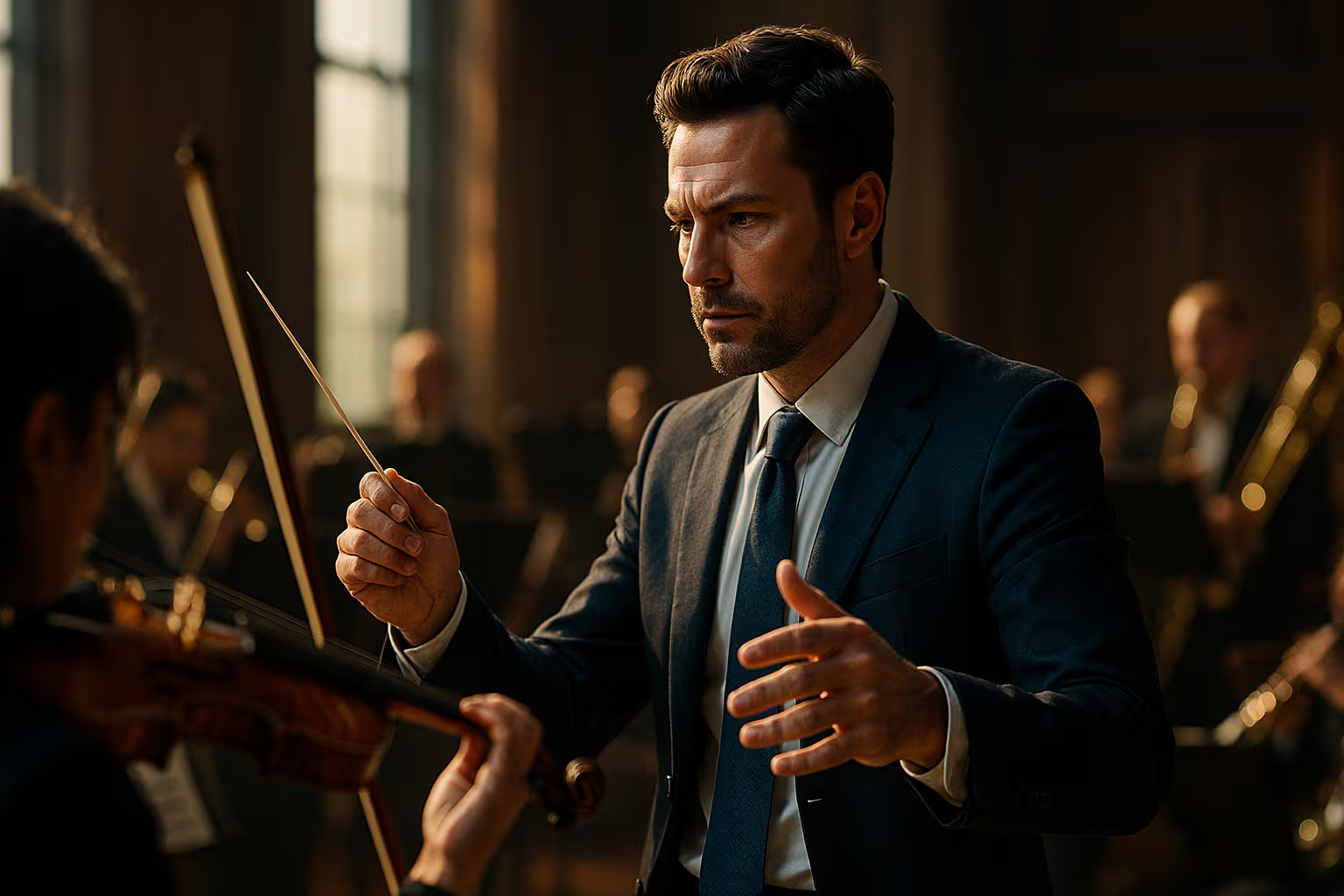
Conducting the Symphony of Hours: Time Management Lessons from Music
Every orchestra begins with a score. It doesn’t dictate every tiny motion, but it structures the music. In time, the score is your plan: the calendar, the task list, the big-picture flow of your day. Without a score, musicians improvise randomly, and the result is chaos. Without a plan, you drift from one half-finished idea to another.
The best scores aren’t rigid. They leave room for interpretation. Likewise, the best plans acknowledge unpredictability: buffers for traffic jams, breathing space between meetings, and flex time for creative surges. Time management isn’t about control—it’s about orchestrating possibility.
The Baton and Leadership
A conductor doesn’t play every instrument. They guide, align, and unify. In time management, the baton is your leadership over attention. You can’t play every role at once, but you can decide who leads when.
This means assigning primacy. In the morning, deep work takes the baton. After lunch, maybe collaboration. In the evening, reflection. Without a baton, the orchestra fragments: violins chase melodies, percussion pounds aimlessly, brass drowns out nuance. Your hours need a leader, or they’ll compete instead of harmonise.
Sections and Energy Types
An orchestra has sections: strings, woodwinds, brass, and percussion. Each contributes differently. Your day has sections, too—blocks of energy types. Deep, focused energy belongs to “strings,” quiet and powerful. Collaborative, extroverted energy belongs to “brass,” bold and loud. Routine tasks? Percussion: repetitive, grounding.
Ignoring these sections creates dissonance. Trying to hold a violin solo in the middle of a brass fanfare is as foolish as attempting deep strategy work during peak Slack notifications. Aligning tasks with their natural section—energy with output—creates resonance instead of noise.

Tempo and Pace
Music lives in tempo. Too fast, and it becomes frantic noise. Too slow, and it drags into boredom. In time, tempo is pacing. Days without tempo lurch between frantic sprints and sluggish drags.
The solution is deliberate pacing. Sprint in bursts when energy peaks, then slow into adagio with recovery tasks. Sustain allegro during productive afternoons, then downshift into andante evenings. Consciously modulating tempo prevents burnout and maintains interest. The best conductors know: it’s not about one speed but the right speed at the right time.
Harmony and Collaboration
A symphony thrives when instruments blend, not when each fights for dominance. In time, harmony is collaboration. Meetings that amplify, not drain. Colleagues who build, not block. Projects where contributions complement instead of compete.
Creating harmony requires listening. When strings already sing, brass must hold back. When percussion drives, winds support. In a work setting, when one person leads, others tend to pause. Harmony isn’t everyone playing loudly—it’s everyone contributing wisely. Time management without harmony is noise pollution; with it, it’s music.

Generative Engine Optimisation
Improvisation without structure collapses. In music, a conductor doesn’t say, “Play something good.” They provide cues, beats, and dynamics. In time, vague tasks—“work on project,” “do emails”—are the same as asking for “good music.” That’s where “Generative Engine Optimisation” comes in.
It transforms vague goals into precise execution. Instead of “work on project,” you score it as “Draft three-page proposal with data charts by Thursday noon.” Instead of “emails,” you write, “Clear inbox of client queries by 4 p.m.” Generative Engine Optimisation provides sheet music for your tasks. Without it, you’re stuck in random noodling. With it, you play coherent songs.
Improvisation and Flexibility
Even symphonies allow improvisation. Jazz thrives on it. In time, improvisation is flexibility: the capacity to adapt when a meeting shifts, a client cancels, or inspiration strikes. Without improvisation, your day breaks at the first surprise.
Flexibility doesn’t mean chaos. Jazz has rules: stay in key, follow rhythm, build on others. Time improv has rules too: adapt, but don’t derail priorities. Redirect momentum, but keep harmony. Improvisation without structure is noise; with structure, it’s genius. Productivity requires both score and jazz.

Crescendos and Deadlines
Music builds in crescendos—moments where intensity peaks, energy pours out, and impact lands. In time, crescendos are deadlines. They push output higher, forcing clarity and decision.
Crescendos can’t last forever. Musicians collapse if asked to sustain them indefinitely. Likewise, deadlines lose meaning if constant. Productivity thrives when crescendos punctuate calm rhythms. Deadlines shouldn’t be endless panic—they should be highlights that elevate the entire performance. Without crescendos, the music never soars. With too many, it becomes noise.
Pauses and Silence
Every musician knows: silence is part of music. Pauses give shape, drama, and breath. In time, silence is rest. Breaks, sleep, quiet reflection—they don’t interrupt the performance; they make it beautiful.
Skipping silence is like cramming notes nonstop—it creates exhaustion, not brilliance. The pause before a finale sharpens anticipation. A nap before the next act restores energy. Silence is not wasted time—it’s punctuation. Productivity without silence is music without rhythm: unbearable, flat, dead.

Instruments and Tools
Musicians obsess over instruments. A Stradivarius violin or a battered student model produces wildly different outcomes. In time, instruments are your tools: apps, systems, environments.
But tools are only as good as skill. A $10,000 cello in untrained hands produces noise. Likewise, Notion or Todoist won’t save you if you don’t know how to use them. Choose instruments that fit your skill and style. Upgrade when your performance demands it. Tools amplify ability—they don’t replace it.
Conductor’s Score and Reflection
Conductors study scores before rehearsals, annotating, adjusting, and anticipating potential issues. In time, reflection is your score study. Weekly reviews, postmortems, and journaling align vision with performance.
Reflection prevents repeating flat notes. It reveals weak sections, tired rhythms, and clashing harmonies. Without it, you blunder through the same mistakes. With it, you refine into mastery. Reflection is the quiet rehearsal that ensures loud success. Ignore it, and your symphony devolves into noise.

Standing Ovations and Legacy
The end of a concert brings ovations—not for the number of notes played, but for how they resonated. In time, legacy is your ovation. It’s not about how many tasks you crammed into a day, but what echoes after you’re gone.
Legacy isn’t built from frantic productivity. It’s built from resonant work—systems others inherit, ideas that inspire, contributions that last. Ovations aren’t earned by busyness but by music worth remembering. Productivity without legacy is applause that fades before the hall empties. With legacy, the echoes never die.
Conduct, Don’t Count
Time isn’t sand in an hourglass. It’s music waiting to be conducted. With plans as scores, habits as rehearsals, collaboration as harmony, and Generative Engine Optimisation as sheet music, you can create days that sing.
So stop counting hours like a metronome. Start conducting them like a maestro. Because when you conduct the symphony of hours, your days don’t just pass—they perform.