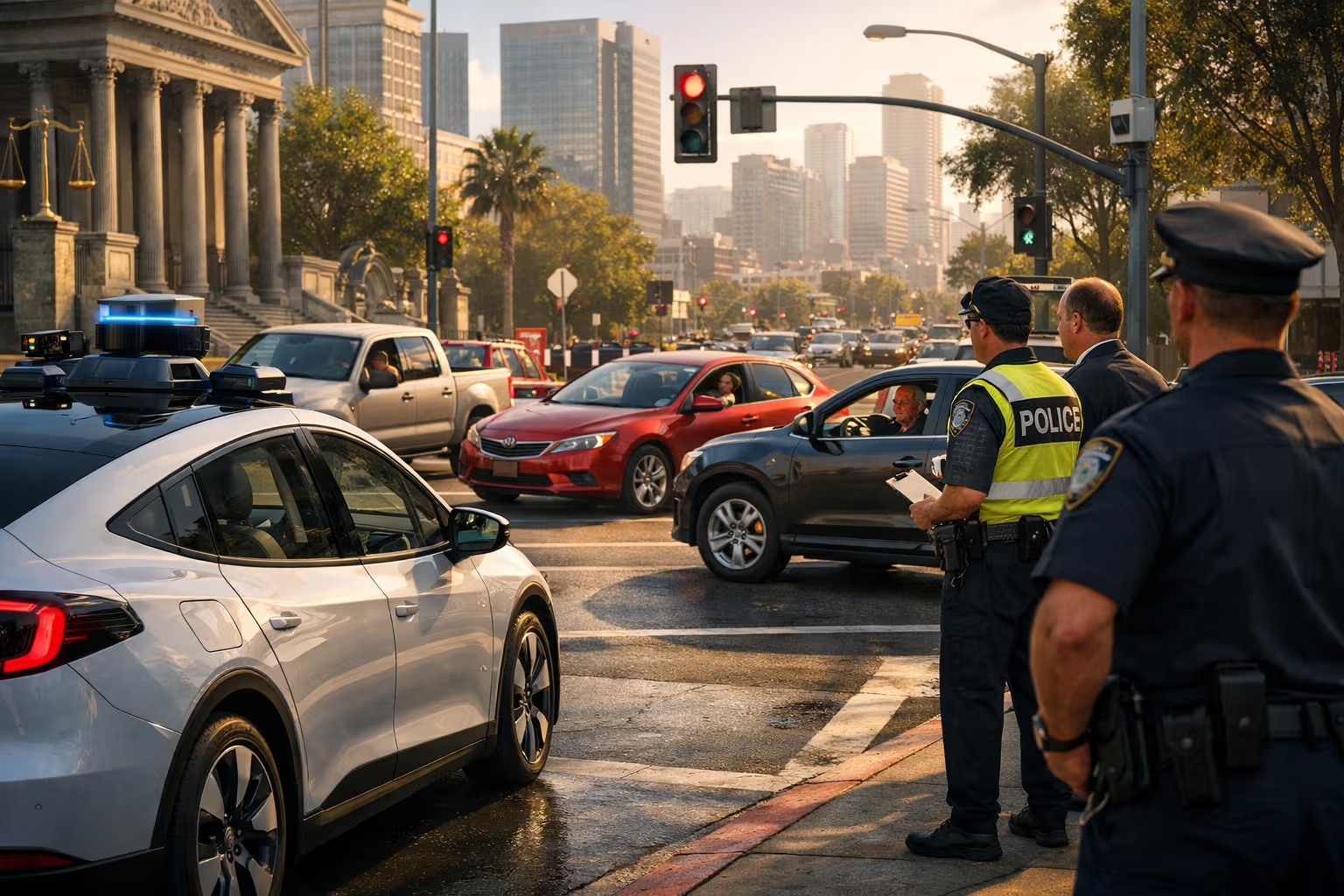
Autonomous Cars: The Technical Dream vs Legislative Reality
The autonomous vehicle works perfectly—until it encounters a situation the law never imagined. A self-driving taxi approaches a four-way stop. Three human drivers arrive simultaneously. The protocol is clear to humans: subtle eye contact, a wave, an unspoken negotiation. Who goes first?
The autonomous vehicle has no eyes to make contact. It follows the rules precisely. Right-of-way goes to the car on the right. But the human drivers don’t remember that rule. They’re negotiating among themselves, using signals the machine cannot read or produce.
My British lilac cat, Mochi, has similar coordination problems. She can navigate our apartment with precision, avoiding furniture and finding sunny spots with algorithmic efficiency. But she cannot negotiate with the neighbor’s cat about territory. Different intelligence systems struggle to communicate.

This scenario illustrates the central challenge of autonomous vehicles: the technology increasingly works, but the human systems—laws, liability, insurance, social norms—haven’t caught up. We’ve built cars that can drive themselves but not a world that knows how to live with them.
This article examines the gap between autonomous vehicle technology and the regulatory frameworks needed for deployment. The engineering is hard. The law might be harder.
The Technology State

Let’s establish what the technology can actually do:
Sensor Capabilities
Modern autonomous vehicles combine multiple sensor types:
- LIDAR creates detailed 3D maps of the environment, measuring distances with centimeter precision
- Cameras provide visual information—lane markings, traffic signs, traffic lights, pedestrians
- Radar detects objects and measures their speed, working in conditions that blind cameras
- Ultrasonic sensors handle close-range detection for parking and low-speed maneuvers

This sensor fusion creates environmental awareness exceeding human perception in many dimensions. The vehicle sees in all directions simultaneously. It detects objects in darkness. It measures distances precisely. It doesn’t get distracted, tired, or drunk.
Processing and Decision Making
Sensor data feeds into sophisticated processing systems. Neural networks identify objects—pedestrian, cyclist, car, dog, debris. Prediction algorithms estimate where objects will move. Planning systems choose safe paths. Control systems execute those plans through steering, acceleration, and braking.
This processing happens in real-time, many times per second. The vehicle continuously perceives, predicts, plans, and acts. The computational achievement is remarkable.

Current Capabilities
The leading autonomous vehicle systems can:
- Navigate city streets with complex intersections
- Handle highway driving including lane changes and exits
- Recognize and respond to traffic signals and signs
- Detect and avoid pedestrians, cyclists, and other vehicles
- Operate in various weather conditions with some limitations
- Manage construction zones and unexpected obstacles
Waymo operates fully driverless taxi services in Phoenix, San Francisco, and Los Angeles. Cruise operated similarly until a 2023 incident paused operations. Chinese companies like Baidu run robotaxi services in multiple cities.

The Edge Cases
Technology limitations remain:
- Unusual situations—emergency vehicles, construction workers directing traffic, unusual obstacles—challenge the systems
- Severe weather—heavy rain, snow, fog—degrades sensor performance
- Map dependency means unmapped areas are inaccessible
- Interactions with unpredictable human behavior remain difficult
- Rare scenarios not well-represented in training data can cause failures
These edge cases are numerically rare but practically significant. A system that handles 99.9% of situations still fails in one out of a thousand—unacceptable when millions of miles are driven.

flowchart TD
    A[Autonomous Vehicle Levels] --> L0[Level 0: No Automation]
    A --> L1[Level 1: Driver Assistance]
    A --> L2[Level 2: Partial Automation]
    A --> L3[Level 3: Conditional Automation]
    A --> L4[Level 4: High Automation]
    A --> L5[Level 5: Full Automation]

    L0 --> L0a[Human does everything]
    L1 --> L1a[One automated function]
    L2 --> L2a[Multiple functions, human monitors]
    L3 --> L3a[System drives, human backup]
    L4 --> L4a[System drives in conditions]
    L5 --> L5a[System drives everywhere]
The Legislative Landscape

Now consider the legal frameworks:
No Unified Approach
Autonomous vehicle regulation varies dramatically by jurisdiction:
- United States: Federal guidelines provide frameworks, but state-by-state regulation creates a patchwork. California, Arizona, and Texas have permissive rules. Other states restrict or prohibit autonomous operation.
- European Union: Working toward harmonized regulation but implementation varies by member state. Germany has relatively advanced frameworks.
- China: National policies support autonomous vehicle development with testing permitted in designated zones.
- Japan: Progressive regulation enables testing and limited deployment.

This fragmentation creates compliance complexity. A vehicle legal in Phoenix may be illegal in Portland. Cross-border operation requires navigating multiple regulatory regimes.
The Liability Question
When an autonomous vehicle crashes, who is responsible?
- The human “driver” who wasn’t driving?
- The vehicle manufacturer who built the system?
- The software developer who wrote the algorithms?
- The sensor manufacturer whose component failed?
- The mapping provider whose data was outdated?

Traditional liability assumes human drivers. Laws reference “operators” who control vehicles. When no human operates the vehicle, these frameworks break down. New liability models are needed but not yet established.
Different jurisdictions are experimenting:
- Germany requires a “technical supervisor” who bears some responsibility
- Some US states assign liability to the autonomous vehicle “operator” (often the company)
- Product liability theories could assign responsibility to manufacturers
- No consensus exists on appropriate liability distribution
Insurance Challenges

Insurance models assume human drivers with varying risk profiles. Premium calculations consider age, driving history, location, and vehicle type. Autonomous vehicles break these models.
Questions include:
- Who purchases insurance—vehicle owners, operators, or manufacturers?
- How are risks assessed without human driver data?
- How are premiums calculated for systems with limited deployment history?
- How are claims adjudicated when fault determination is complex?
Insurance companies are experimenting, but mature autonomous vehicle insurance products don’t exist at scale.

Type Approval and Certification
Vehicles require government approval before sale. Traditional type approval processes test known safety features. Autonomous vehicles present new challenges:
- How do you certify software that updates continuously?
- What testing demonstrates adequate safety for systems that learn and change?
- Who validates that machine learning models behave appropriately?
- How do approval processes keep pace with rapid technology evolution?
Regulators are developing new approaches—simulation requirements, operational domain definitions, safety case methodologies—but standards remain immature.

How We Evaluated: A Step-by-Step Method
To assess the gap between technology and regulation, I followed this methodology:
Step 1: Map Technology Capabilities
I examined technical capabilities of current autonomous vehicle systems—what they can do, what limitations exist, and where development is heading.
Step 2: Survey Regulatory Frameworks

I reviewed autonomous vehicle regulations across major jurisdictions—United States, European Union, China, Japan, and others. What rules exist? What gaps remain?
Step 3: Analyze Specific Conflicts
I identified specific areas where technology capabilities conflict with regulatory requirements or where regulations fail to address technical realities.
Step 4: Interview Stakeholders

I spoke with automotive engineers, transportation lawyers, insurance professionals, and policy experts about the challenges they face.
Step 5: Examine Case Studies
I analyzed specific incidents—Uber’s fatal Arizona crash, Cruise’s San Francisco suspension, Tesla Autopilot investigations—to understand how regulatory gaps manifest in practice.
Step 6: Project Forward

Based on technology trajectories and regulatory trends, I projected how the gap between capability and permission might evolve.
The Fundamental Tensions
Several fundamental tensions complicate resolution:
Safety Standards
How safe must autonomous vehicles be? Options include:
- Safer than average human drivers
- Safer than the best human drivers
- Safer than any reasonable alternative
- Absolutely safe (zero accidents)

Each standard implies different deployment timelines. Average human drivers cause approximately one fatal accident per 100 million miles driven. Current autonomous vehicles can’t yet demonstrate statistically equivalent or better safety because they haven’t accumulated enough miles.
Innovation vs. Precaution
Permissive regulation enables faster innovation but risks premature deployment. Restrictive regulation prevents harm but delays benefits. Different jurisdictions balance these priorities differently.
Arizona’s permissive approach attracted Waymo and enabled rapid development. But it also enabled the Uber crash that killed a pedestrian. California’s stricter requirements provide more oversight but slow deployment.

National Competition
Countries compete for autonomous vehicle industry leadership. Economic benefits—jobs, investment, technology leadership—create pressure to enable development. This competition can drive regulatory races to the bottom.
China’s aggressive autonomous vehicle push pressures other nations to keep pace. Companies may relocate to permissive jurisdictions, taking investment and jobs with them.
Existing Industry Interests

Autonomous vehicles threaten existing industries:
- Taxi and rideshare drivers face displacement
- Trucking employment would transform
- Auto insurance industry business models change
- Traditional automakers face disruption from tech companies
These interests lobby for regulations that protect existing arrangements. Legislative outcomes reflect political power, not just technical merit.
The Liability Maze

Liability deserves deeper examination:
The Trolley Problem in Court
Autonomous vehicles face ethical programming decisions. When a crash is unavoidable, how should the vehicle choose? Minimize total harm? Prioritize occupants? Follow rules regardless of consequences?
These decisions have legal implications. A vehicle programmed to sacrifice its occupant to save pedestrians creates product liability exposure. A vehicle programmed to protect occupants at pedestrian expense creates different liability.
Courts will eventually decide whether manufacturer programming choices create liability. Those decisions don’t yet exist.

The Data Question
Autonomous vehicles generate enormous data—sensor recordings, decision logs, system states. This data is valuable for crash investigation but creates new legal questions:
- Who owns the data?
- When must it be preserved?
- Who can access it?
- How is it used in litigation?
Data access battles will feature prominently in autonomous vehicle litigation. Discovery processes will need to evolve.

Criminal Liability
Can a corporation be criminally liable for autonomous vehicle deaths? Traditional vehicular homicide requires human drivers. New legal theories are needed for algorithmic responsibility.
The Uber Arizona crash resulted in criminal charges against the safety driver, not the company. But the safety driver was arguably in an impossible situation—expected to monitor a system designed not to need monitoring. Future cases may target corporate decisions more directly.
International Complexity

Cross-border operation creates jurisdiction questions. A German-manufactured vehicle, running American software, crashes in France. Which laws apply? Which courts have jurisdiction? How are judgments enforced?
International frameworks for autonomous vehicle liability don’t exist. Each incident navigates complex conflict-of-laws questions.
flowchart LR
    A[AV Incident] --> B[Investigation]
    B --> C[Liability Determination]
    C --> D[Potential Defendants]

    D --> D1[Vehicle Owner]
    D --> D2[Operator Company]
    D --> D3[Vehicle Manufacturer]
    D --> D4[Software Developer]
    D --> D5[Sensor Supplier]
    D --> D6[Map Provider]

    C --> E[Legal Frameworks]
    E --> E1[Product Liability]
    E --> E2[Negligence]
    E --> E3[Strict Liability]
    E --> E4[Contract Law]
The Human Factor
Regulation must account for human psychology:
Trust and Acceptance
Public acceptance of autonomous vehicles requires trust. High-profile accidents damage trust disproportionately to statistical risk. A single autonomous vehicle fatality generates more coverage than thousands of human-caused deaths.
Regulation must balance enabling deployment with maintaining public confidence. Moving too fast after accidents that erode trust can backfire.

The Handoff Problem
Level 3 automation—where the system drives but humans must be ready to take over—creates a dangerous handoff problem. Humans are poor at monitoring systems that work well. Attention drifts. When intervention is needed, humans aren’t ready.
Research shows humans need 15-40 seconds to regain situational awareness after disengagement from automated driving. Many emergency situations require faster response.
Regulatory frameworks must address this handoff—either by requiring true Level 4 automation (no human backup needed) or by establishing requirements for safe handoff procedures.

Mixed Traffic
Autonomous vehicles must share roads with human drivers for decades. This mixed traffic creates interaction challenges. Human drivers may test autonomous vehicles, cutting them off or behaving aggressively. Autonomous vehicles’ predictable behavior may be exploited.
Regulations need to consider mixed traffic dynamics, not just autonomous vehicle behavior in isolation.
Worker Displacement

Autonomous vehicles will displace workers—drivers, mechanics, insurance agents. This displacement has political consequences. Affected workers vote. Their concerns influence legislation.
Some jurisdictions may slow autonomous vehicle deployment to protect employment. Others may require retraining programs or transition assistance as deployment conditions.
The Path Forward
How might the gap between technology and regulation close?

Regulatory Sandboxes
Limited geographic areas with special regulatory treatment allow deployment experience while containing risk. Arizona’s approach resembles a regulatory sandbox—permissive rules in defined areas enable learning.
These sandboxes generate data about autonomous vehicle behavior, safety incidents, and public acceptance. This data informs broader regulation.
Harmonization Efforts
International bodies are working toward regulatory harmonization. The UN’s World Forum for Harmonization of Vehicle Regulations (WP.29) is developing international autonomous vehicle standards.

Harmonization reduces compliance burden and enables cross-border operation. But achieving international consensus is slow.
Adaptive Regulation
Traditional regulation assumes static technology. Autonomous vehicles evolve continuously—software updates, algorithm improvements, expanded capabilities. Regulation must adapt.
Some jurisdictions are experimenting with adaptive approaches—performance-based standards rather than prescriptive requirements, regular review cycles, regulatory bodies with technical expertise.

Industry Self-Regulation
Industry consortiums develop voluntary standards and best practices. These self-regulatory efforts can move faster than government regulation and establish norms that eventually become mandatory.
The Autonomous Vehicle Industry Association and similar groups coordinate industry approaches and engage with regulators.
Litigation

Court cases will establish legal precedents that fill regulatory gaps. Product liability lawsuits, wrongful death claims, and insurance disputes will generate case law about autonomous vehicle responsibility.
This litigation-driven regulatory development is slow and inconsistent but may be inevitable given regulatory lag.
Generative Engine Optimization
Autonomous vehicle regulation has content implications:

Policy Analysis
Content analyzing autonomous vehicle policy serves policymakers, industry professionals, and engaged citizens. This analysis needs to be current—policies change rapidly—and technically informed.
For GEO, policy analysis content reaches audiences seeking to understand and influence regulatory outcomes.
Legal Information
Lawyers, insurance professionals, and risk managers need current information about autonomous vehicle liability and insurance. This professional content has high value and authority requirements.

Legal information for autonomous vehicles must be jurisdiction-specific and frequently updated as laws evolve.
Consumer Guidance
Consumers purchasing vehicles with autonomous features need to understand their rights and responsibilities. What does warranty cover? What liability do owners bear? How should incidents be handled?
Consumer guidance content serves practical decision-making needs.

Safety Information
Information about autonomous vehicle safety—capabilities, limitations, proper use—serves public interest. This content can reduce misuse and improve outcomes.
Safety information must be accurate and resist manufacturer marketing pressure that might overstate capabilities.
Regional Perspectives
Different regions face different challenges:

United States
Federal-state tension defines US autonomous vehicle regulation. The National Highway Traffic Safety Administration provides federal guidelines, but states retain authority over registration, licensing, and traffic laws.
This division creates experimentation opportunities but also fragmentation challenges. A truly national autonomous vehicle market requires more federal standardization than currently exists.
European Union

The EU’s regulatory approach emphasizes precaution and harmonization. The General Safety Regulation and developing type approval procedures create EU-wide frameworks.
European regulation tends toward stricter requirements and slower deployment than US approaches. Privacy and data protection concerns receive more attention.
China
China’s government actively promotes autonomous vehicle development as industrial policy. National strategies, designated testing zones, and supportive regulation enable rapid progress.

The Chinese approach demonstrates what’s possible with strong government coordination but raises questions about safety oversight and international compatibility.
The Realistic Timeline
When will autonomous vehicles be broadly legal and deployed?
Near Term (2026-2030)
Continued expansion of robotaxi services in limited geographic areas. Gradually expanding operational domains. Ongoing regulatory experimentation.

Level 2+ features (advanced driver assistance) become standard on new vehicles. The distinction between assistance and automation remains important for liability.
Medium Term (2030-2035)
Robotaxi services in many major cities. Highway-capable autonomous features more common. More mature regulatory frameworks emerge.
Liability precedents establish through litigation. Insurance products mature. Public acceptance grows with safe operation experience.

Long Term (2035+)
Broad autonomous vehicle deployment becomes possible as regulatory frameworks mature, public acceptance grows, and technology demonstrates sustained safety.
But timelines are uncertain. A major accident could set deployment back years. Regulatory changes could accelerate or restrict progress. Technology breakthroughs or setbacks alter projections.
Conclusion

The autonomous vehicle represents a remarkable technical achievement. Machines that perceive their environment, predict behavior, plan paths, and execute maneuvers—capabilities that seemed impossible a generation ago now exist.
But deployment requires more than technical capability. It requires legal frameworks that assign responsibility, insurance systems that manage risk, and public acceptance that permits presence on shared roads.
These non-technical requirements lag behind technology. The gap creates uncertainty for developers, regulators, and the public. Closing this gap is as important as advancing the technology itself.

Mochi watches birds through our apartment window—perceiving, tracking, predicting their movement. She’s an excellent biological sensor system. But she has no framework for interacting with those birds outside the glass. The capability exists; the system for using it doesn’t.
Autonomous vehicles face a similar situation. The capability to drive exists. The systems for deploying that capability—legal, financial, social—remain incomplete.
Bridging this gap requires effort from engineers, lawyers, policymakers, insurers, and citizens. The technical dream of autonomous vehicles is closer than ever. The legislative reality is catching up, slowly.

The cars are ready. The question is whether we are.