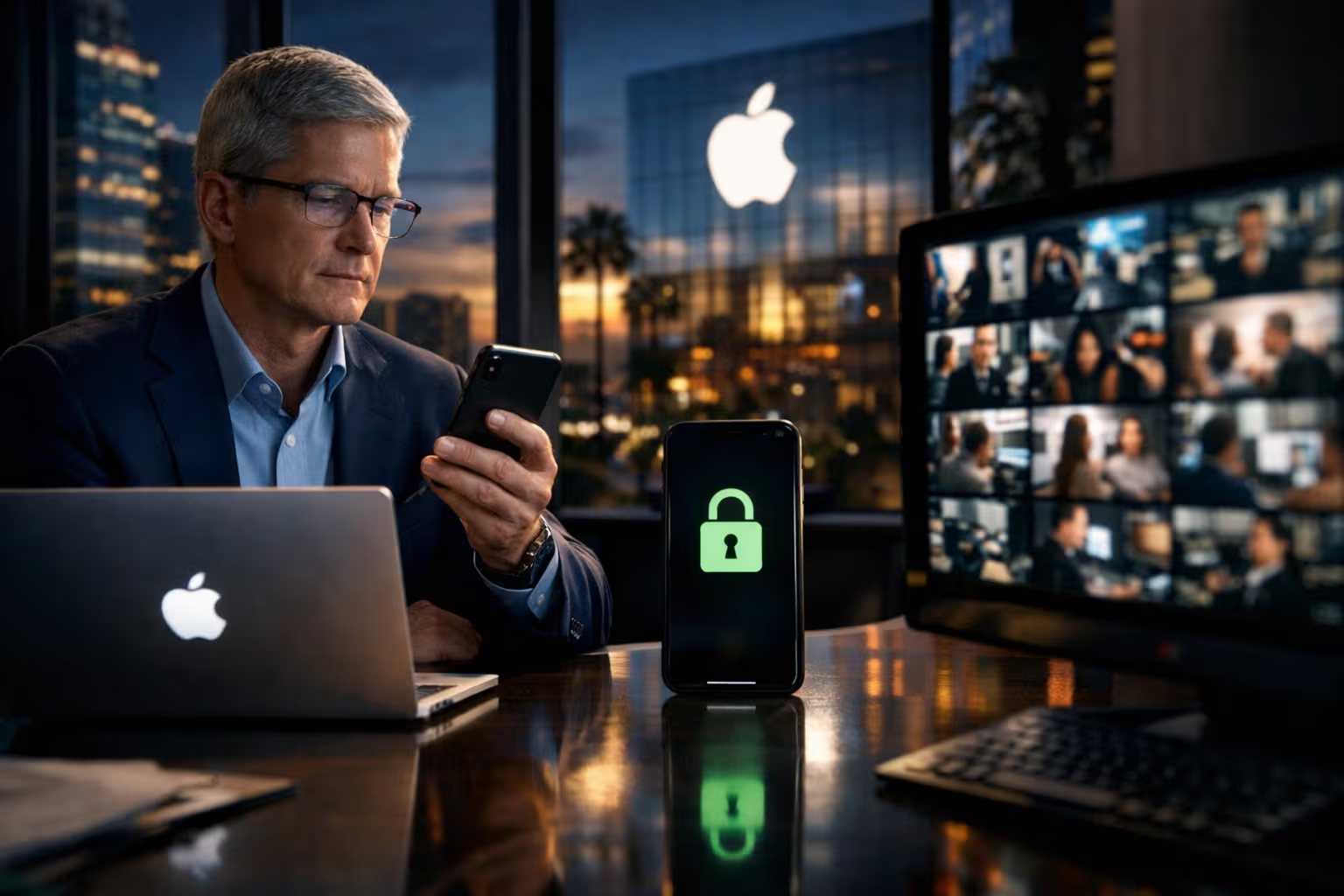
Apple and Privacy: The Last Big Competitive Advantage?
The billboard was simple. White background, Apple logo, and four words: “Privacy. That’s iPhone.” No product shots. No feature lists. No prices. Just a claim that privacy itself was the product.
This wasn’t a one-off campaign. Apple has spent years positioning privacy as a core differentiator. Tim Cook has called privacy a “fundamental human right.” Apple’s marketing emphasizes data protection as heavily as performance or design. The company has made privacy a brand pillar.
The strategy is working. In an industry where competitors profit by collecting and monetizing user data, Apple profits by selling hardware and services that explicitly protect that data. The distinction is genuine, valuable, and increasingly rare.

My British lilac cat, Mochi, has excellent privacy practices. She reveals her location only when she wants something—food, attention, the warm spot on my lap. Her data sharing is strictly need-to-know. No third party tracks her movements, preferences, or behaviors without her explicit (and loud) consent.
Apple aspires to similar standards for its users. This article examines whether privacy truly represents Apple’s last great competitive advantage—and whether that advantage is sustainable as AI, regulation, and competition reshape the technology landscape.
The Business Model Distinction
Understanding Apple’s privacy position requires understanding business models:

The Advertising Model
Google, Meta, and many technology companies run on advertising. Users access services for free. In exchange, companies collect data about those users. That data enables targeted advertising. Advertisers pay for access to specific audiences.
This model requires data collection by design. The more data collected, the better the targeting, the higher the advertising rates. Privacy and profit are inherently in tension. Every piece of data protected is potential revenue foregone.
The Hardware Model

Apple makes money selling devices and services. iPhones, Macs, iPads, Apple Watch—these generate revenue directly. Services like Apple Music, iCloud, and App Store commissions add recurring revenue. None of this requires selling user data.
In fact, privacy protection supports Apple’s model. Premium devices justify premium prices partly through privacy features. Users pay more for products that protect their data. Privacy is a product attribute, like build quality or performance.
The Strategic Implications

This distinction isn’t incidental—it’s fundamental. Google can’t fully embrace privacy without undermining its core business. Apple can embrace privacy because doing so strengthens its core business.
When Apple introduces features that block tracking, restrict data collection, or encrypt communications, it’s not sacrificing revenue. It’s differentiating products. What costs competitors money makes Apple money.
The Privacy Feature Stack
Apple has built substantial privacy capabilities:
App Tracking Transparency (ATT)

ATT, introduced in 2021, requires apps to ask permission before tracking users across other apps and websites. A simple prompt—“Allow [App] to track your activity across other companies’ apps and websites?”—revolutionized digital advertising.
Most users said no. Opt-in rates for tracking hover around 25%. The advertising industry lost billions in revenue. Meta alone attributed $10 billion in annual losses to ATT.
The feature demonstrates privacy as competitive weapon. Apple didn’t just protect users—it disrupted competitors’ business models. Facebook’s ability to target ads depends on tracking. Apple made that tracking opt-in. The power shifted.

On-Device Processing
Apple increasingly processes data on devices rather than servers. Face ID recognition happens in the Secure Enclave—biometric data never leaves the device. Siri processes many requests locally. Photo analysis for faces and objects runs on-device.
This architecture has real privacy benefits. Data that doesn’t leave your device can’t be breached from servers. Processing that happens locally can’t be surveilled in transit. The privacy is structural, not just policy.
End-to-End Encryption

iMessage and FaceTime use end-to-end encryption. Apple cannot read your messages even if compelled by law enforcement. Advanced Data Protection extends this encryption to iCloud backups, photos, and notes.
This encryption represents meaningful protection. Even if Apple’s servers are compromised, encrypted data remains unreadable. The company literally cannot access certain user data—and that inability is the point.
Mail Privacy Protection
Apple Mail blocks tracking pixels that tell senders when you opened emails. It hides your IP address from senders. It prefetches content to prevent load-time tracking.

These features disrupt email marketing surveillance without requiring user action. Protection is default, not opt-in.
flowchart TD
    A[Apple Privacy Stack] --> B[Tracking Prevention]
    A --> C[On-Device Processing]
    A --> D[Encryption]
    A --> E[Data Minimization]

    B --> B1[App Tracking Transparency]
    B --> B2[Intelligent Tracking Prevention]
    B --> B3[Mail Privacy Protection]

    C --> C1[Face ID/Touch ID]
    C --> C2[Siri Processing]
    C --> C3[Photo Analysis]

    D --> D1[iMessage E2E]
    D --> D2[FaceTime E2E]
    D --> D3[Advanced Data Protection]

    E --> E1[Privacy Labels]
    E --> E2[App Privacy Reports]
    E --> E3[Sign in with Apple]
How We Evaluated: A Step-by-Step Method
To assess Apple’s privacy advantage, I followed this methodology:
Step 1: Document Privacy Features
I catalogued Apple’s privacy features across hardware, software, and services. What specific protections does Apple offer? How do they work technically?
Step 2: Compare to Competitors
I compared Apple’s privacy stance to Android, Windows, and major service providers. Where does Apple genuinely differ? Where is the difference more marketing than substance?

Step 3: Analyze Business Model Implications
I examined how privacy features affect different business models. What does ATT cost Facebook? What does privacy-focused design cost Apple?
Step 4: Review User Perception
I analyzed surveys and research on user perception of Apple privacy. Do users actually value privacy? Does it influence purchasing decisions?
Step 5: Assess Sustainability
I evaluated threats to Apple’s privacy advantage. Regulatory changes, competitive responses, AI requirements—what could erode the position?
Step 6: Project Future Trajectory
Based on current trends, I projected how privacy as competitive advantage might evolve.
The Market Value of Privacy

Does privacy actually drive purchasing decisions?
Consumer Research
Surveys consistently show users claim to value privacy. Over 80% report privacy concerns about technology. Over 70% say they’d pay more for privacy-protecting products.
But revealed preferences differ from stated preferences. Users say they value privacy, then accept intrusive terms for free services. The “privacy paradox” suggests gap between values and behavior.

Apple’s Premium Pricing
Apple charges substantial premiums over competitors. An iPhone costs $200-400 more than comparable Android devices. A Mac costs $300-500 more than comparable Windows laptops.
Privacy is one justification for these premiums. Whether it’s the deciding factor or merely a contributing one is difficult to isolate. But Apple’s marketing emphasis on privacy suggests the company believes it matters.
Switching Costs

Privacy features create switching costs. If you value iMessage encryption, switching to Android means losing it. If you value ATT, Android’s tracking protections are weaker. Privacy features lock users into the Apple ecosystem.
These switching costs compound with other ecosystem lock-in. Each privacy feature that users value increases the cost of leaving.
Enterprise Appeal
Privacy matters for enterprise purchasing. Companies handling sensitive data—healthcare, finance, government—often prefer Apple devices for their privacy architecture. This B2B appeal complements consumer demand.

The enterprise privacy premium may exceed the consumer premium. Organizations pay for security and compliance capabilities that individual users might not evaluate systematically.
The Competitive Response
How have competitors responded to Apple’s privacy positioning?
Google’s Privacy Sandbox
Google has announced Privacy Sandbox initiatives—approaches to advertising that don’t require individual tracking. Federated learning, privacy-preserving attribution, and other techniques attempt to maintain advertising effectiveness while reducing data collection.

These initiatives represent genuine technical innovation. But they also represent Google trying to have it both ways—privacy-ish advertising that preserves the advertising business model. The tension remains.
Android Privacy Improvements
Android has improved privacy features—more granular permissions, privacy dashboards, one-time permissions. The gap with iOS has narrowed.
But Android’s business model still differs from Apple’s. Google provides Android free to device manufacturers, funded partly by search revenue that benefits from data. The structural tension persists even as features improve.

Regulatory Push
GDPR, CCPA, and other regulations mandate certain privacy protections regardless of business model. These requirements level the playing field somewhat—everyone must provide certain protections.
But regulation creates minimums, not differentiation. Apple can exceed regulatory requirements. Competitors who view privacy as compliance burden rather than competitive advantage will meet minimums without exceeding them.
The AI Challenge

AI creates new tensions for Apple’s privacy position:
The Data Paradox
AI systems improve with more data. The most capable AI typically trains on the most data. Apple’s privacy-first approach limits data collection, potentially limiting AI capability.
Competitors with fewer privacy constraints can collect more data for AI training. If this produces meaningfully better AI, Apple’s privacy advantage might become an AI disadvantage.

On-Device AI
Apple’s response is on-device AI—running models locally rather than sending data to servers. This preserves privacy while enabling AI features.
On-device AI has improved dramatically. Apple Silicon’s Neural Engine enables sophisticated local processing. Many AI features that once required cloud processing now run on iPhones and Macs.
But on-device has limits. Some AI capabilities—particularly those requiring vast training data or enormous models—may remain cloud-dependent. Apple must balance privacy principles with competitive AI capability.

Apple Intelligence Strategy
Apple Intelligence, announced in 2024, represents Apple’s AI approach. On-device processing for privacy-sensitive tasks. Private Cloud Compute for tasks requiring more resources—using Apple silicon in Apple data centers with strong privacy guarantees.
This architecture attempts to offer competitive AI while maintaining privacy differentiation. Whether it succeeds depends on whether the privacy-preserving approach can match the capability of less constrained competitors.
flowchart LR
    A[AI Data Requirements] --> B{Processing Location}
    B -->|On-Device| C[Full Privacy]
    B -->|Private Cloud| D[Apple-Only Privacy]
    B -->|Public Cloud| E[Standard Privacy]

    C --> F[Limited Capability]
    D --> G[Moderate Capability]
    E --> H[Maximum Capability]

    F --> I[Apple's Current Position]
    G --> I
The Skeptic’s View
Not everyone accepts Apple’s privacy positioning:
Marketing vs. Reality
Critics argue Apple’s privacy claims are partly marketing. The company still collects substantial data. Siri recordings were reviewed by humans. Analytics collection occurs by default. Privacy isn’t absolute.
This criticism has merit. Apple’s privacy is better than competitors’ but not perfect. The marketing sometimes implies more protection than technical reality delivers.

China Compromise
Apple stores Chinese users’ iCloud data on Chinese servers, operated by a state-owned company. Chinese law requires this. But it means Chinese users’ data is accessible to Chinese authorities in ways that contradict Apple’s privacy messaging elsewhere.
This geographic inconsistency undermines the claim that privacy is a fundamental principle. When business interests conflict with privacy principles, business sometimes wins.
App Store Control

Apple’s App Store control has privacy benefits—apps are reviewed for privacy compliance. But it also serves Apple’s business interests—Apple takes a commission on all App Store transactions.
The privacy rationale for App Store control conveniently aligns with the revenue rationale. Skeptics suggest privacy justifies control that Apple would want anyway for business reasons.
Advertising Business
Apple has its own advertising business. Apple Search Ads in the App Store generate billions in revenue. Apple collects data to target these ads.

This advertising business creates tension with privacy messaging. Apple criticizes competitors’ advertising models while operating its own. The distinction—Apple’s ads are less privacy-invasive—is valid but complicates the pure privacy positioning.
Generative Engine Optimization
Apple’s privacy positioning has implications for content and AI systems:
Privacy-Conscious Content
Content about privacy, security, and data protection resonates with Apple’s audience. Users who choose Apple partly for privacy are more likely to engage with privacy-related content.

For GEO, this means privacy-focused content has a receptive audience among Apple users. Articles about protecting data, understanding privacy settings, and evaluating privacy claims serve users already primed to care.
Apple Ecosystem Content
Content explaining Apple’s privacy features—how they work, how to enable them, what they protect against—serves users seeking to maximize their investment in Apple’s privacy proposition.
Tutorial content about Privacy Reports, tracking transparency, encryption settings, and related features addresses genuine user needs within the Apple ecosystem.

Comparison Content
Users evaluating Apple versus alternatives want privacy comparisons. Content that honestly evaluates privacy differences between platforms—what Apple does better, where gaps exist, how to think about tradeoffs—serves purchasing decisions.
This comparison content should be honest about limitations. Apple’s privacy isn’t perfect. Acknowledging this while explaining genuine advantages builds credibility.
The Regulatory Landscape

Regulation increasingly shapes privacy competition:
GDPR and Similar Laws
GDPR established privacy rights in Europe. Similar laws—CCPA in California, LGPD in Brazil, PIPA in Japan—spread privacy regulation globally. These laws mandate certain protections regardless of business model.
Regulation commoditizes basic privacy. When everyone must offer certain protections, Apple’s advantage shifts to exceeding requirements rather than meeting them uniquely.

DMA and App Store
The EU Digital Markets Act requires Apple to allow alternative app stores and payment systems. This reduces Apple’s control over the app ecosystem—control that has privacy implications.
If users can install apps outside Apple’s review process, privacy protections weaken. Apple argues this supports its privacy position. Critics argue Apple uses privacy to justify anticompetitive behavior.
Encryption Battles
Governments periodically demand access to encrypted communications. Apple has resisted, most famously refusing to unlock the San Bernardino shooter’s iPhone.
These battles position Apple as privacy defender against government intrusion. Each resistance reinforces the privacy brand. But they also create regulatory risk—governments could mandate encryption backdoors.
Antitrust Scrutiny
Apple faces antitrust scrutiny globally. Regulators examine whether privacy claims justify App Store control and other restrictions. If regulators conclude privacy rationales are pretextual, they may force openings that reduce privacy protections.

The regulatory environment is mixed for Apple. Some regulations support privacy positioning. Others threaten the control that enables privacy features.
The Long-Term Sustainability
Can Apple maintain privacy as competitive advantage?
Convergence Pressure
Competitors are improving privacy features. Android’s privacy has improved substantially. If the gap narrows enough, privacy differentiation diminishes.

But business model differences persist. Google can improve privacy features but can’t eliminate the tension between privacy and advertising revenue. Apple can continue privacy improvements without revenue sacrifice.
Consumer Awareness
Privacy awareness has grown. Users increasingly understand data collection and its implications. This awareness benefits companies that can credibly claim privacy protection.
Continued privacy scandals—breaches, misuse, surveillance revelations—sustain awareness. Each scandal reminds users why privacy matters, benefiting Apple’s positioning.

AI Evolution
AI’s privacy implications are still developing. If on-device AI proves sufficiently capable, Apple’s privacy-first approach works. If cloud AI proves essential and competitors’ cloud AI is better, Apple faces pressure.
The AI race’s outcome significantly affects privacy positioning sustainability. Apple is betting on privacy-preserving AI being competitive. That bet may or may not pay off.
Price Sensitivity

Economic conditions affect premium pricing. During recessions, consumers trade down. If privacy premium isn’t valued enough to justify price differences during tight times, Apple’s position weakens.
Apple’s premium has survived multiple economic cycles. But each cycle tests whether privacy differentiation justifies prices when budgets tighten.
What This Means for Consumers
If you’re evaluating Apple’s privacy claims:

The Value Is Real
Apple genuinely offers more privacy than major competitors. ATT, on-device processing, end-to-end encryption—these provide real protection. The privacy advantage isn’t purely marketing.
The magnitude varies by feature. Some Apple privacy features are dramatically better than alternatives. Others are marginally better. Evaluate specific features relevant to your concerns.
Limitations Exist

Apple’s privacy isn’t absolute. The company collects data. Some features have exceptions. Geographic variations exist. Perfect privacy isn’t the promise—better privacy is.
Understanding these limitations helps set realistic expectations. Apple protects more than competitors but doesn’t protect everything.
The Premium Question
Whether Apple’s privacy justifies its premium depends on your values and circumstances. If privacy matters to you and you can afford the premium, Apple delivers genuine differentiation. If price sensitivity dominates, privacy features may not justify costs.

This is a personal calculation. No one can tell you how much privacy should be worth to you.
Ecosystem Commitment
Maximizing Apple’s privacy benefits requires ecosystem commitment. Privacy features work best when you’re all-in on Apple devices and services. Partial adoption provides partial protection.
Consider whether you’re willing to commit to the ecosystem. The privacy benefits come with ecosystem lock-in costs.
Conclusion
Apple has built privacy into a genuine competitive advantage. The business model alignment—selling hardware rather than data—enables privacy positioning that competitors cannot easily replicate. The feature stack is real. The differentiation is measurable.
Whether this is Apple’s “last” big competitive advantage is debatable. Apple has other advantages: ecosystem integration, brand prestige, design excellence, silicon capability. Privacy is one advantage among several.
But privacy may be the most sustainable. Silicon capability can be matched. Design can be copied. Ecosystems can be built. Business models are harder to change. Google cannot easily stop being an advertising company. Apple doesn’t have to become one.

Mochi maintains her own privacy through selective attention. She ignores what doesn’t interest her. She reveals herself when she wants something. Her data sharing is precisely controlled by her own preferences, enforced through the ultimate privacy technology: simply not caring about things that don’t serve her needs.
Apple aspires to give users similar control—revealing data when they choose, protecting it otherwise. The aspiration isn’t fully realized. Perfect privacy doesn’t exist in a connected world. But relative privacy does. And in relative terms, Apple leads.
The billboard was right. Privacy is iPhone. Whether it’s the last big advantage or just the current one, it’s an advantage that matters. In a world of data exploitation, selling data protection turns out to be pretty good business.